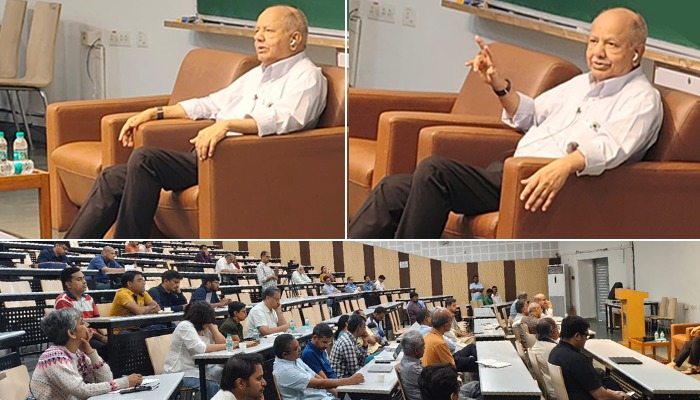
Even as AI becomes ubiquitous in our lives, there are significant concerns and fears about the possible futures. Seeking to allay such fears especially in the context of education, Prof. Raj Reddy, founding chairman of IIIT-Hyderabad and Turing award winner addressed IIIT-H faculty and called out for a manifesto for education in the AI era.
What happens to education when every student carries an “Einstein in your pocket”? That was the provocative starting point of Prof Raj Reddy’s wide-ranging and deeply thought-provoking address to the faculty. With characteristic clarity, he laid out a future in which AI is not just a tool, but a constant intellectual companion, reshaping what we teach, how we teach, and even why we teach.
“The current dogma,” he began, “is that AI will change education as we know it. There won’t be a need for professors. There won’t be a need for teachers. There won’t be a need for classrooms.” He was quick to add that he does not believe classrooms will vanish overnight but admitted that change is inevitable. The real question, he argued, is how institutions prepare for that transition.
Fewer Faculty Lectures
Prof Reddy invited faculty to imagine a near future where every student has access to a powerful, personal AI system, what he called “sovereign AI” or “edge AI”, running directly on their devices. These models, distilled from massive foundation models, are already passing advanced placement exams with remarkable scores.
“They know all the subjects that you can decide to teach,” he noted. “So the question is, should you be teaching it? And if so, how?” In such a world, he suggested, much of what we currently do in classrooms, especially teaching facts and figures, could be reduced dramatically.
“My feeling is even today, given the current state of AI, you can reduce the content of your lectures by 50%.” Stating that his current view was not to throw the baby out with the bath water, he said faculty ought to continue doing whatever they’re doing but revisit the manner in which they’re approaching it. For instance, instead of three lectures a week, perhaps just have one. The rest? Learning by doing – guided by an AI tutor that tracks a student’s progress, identifies where they struggle, and offers personalized support.
One-on-One Learning at Scale
For Prof Reddy, the most transformative shift is not automation, but personalization. “Promoting one-on-one learning as much as possible is where we need to move.” Research has long shown that one-on-one tutoring significantly improves learning outcomes. AI makes that economically feasible at scale. An AI assistant can guide, correct, challenge, and adapt in real time — something even the most dedicated faculty cannot do for hundreds of students simultaneously. But this does not eliminate the teacher. Rather, it redefines the role. Instead of being primary transmitters of information, faculty would become designers of learning experiences, mentors in reasoning, and architects of intellectual growth. He urged the faculty to come up with strategies on handling different groups of learners – slow and fast. He spoke of cultivating polymaths of the likes of Aristotle and Leonardo da Vinci, especially for fast learners – students who go beyond narrow specialization. In an AI-rich future, the advantage may not lie in knowing more facts, but in thinking across domains.
Beyond Outcomes: Teaching Process and Character
One of the most powerful threads in the discussion was a reminder that education is not just about content mastery. “Today the best institutes cater to only two and a half dimensions of education, ”observed Prof. Sangal, referring to analytical reasoning, creativity, and communication. “The remaining six and a half, including persistence, character, relationships and others, students learn on their own.”
Prof Reddy agreed that AI should free up time not for less education, but for broader education. “The time you save should be used to make students work in groups… They will learn how to interact, how to problem-solve together. We don’t use that opportunity enough now.”
Critical Thinking in the Age of Deepfakes
If AI can generate answers, write code, and even create convincing deepfakes, what remains uniquely human? Critical thinking. “AI models make mistakes. They hallucinate. You cannot simply trust them,” said Prof. Reddy. Rather than banning AI from examinations, he proposed the opposite: incorporate it. Drawing a parallel to the time when calculators were first introduced with a simultaneous movement to ban them from classrooms, he said, “Don’t shut out your AI models. Let them be there.”
The real test, he suggested, is not whether a student can produce an answer, but whether they can evaluate it. Can they detect errors? Challenge flawed reasoning? Understand context? “Just like Chandragupta Maurya was not necessarily the most brilliant king, but had an astute statesman in Chanakya to guide him, we are moving to a world where you are a human being with human values, but you will have an assistant who is super brilliant. And together, you navigate life.” For evaluations, Prof Reddy asked faculty to gauge students based on learning objectives drawn out as well as students’ problem-solving speed and their critical thinking.
Research at Machine Speed
The implications of AI in education extend beyond teaching. AI is already accelerating scientific discovery – from protein folding breakthroughs to new materials discovery. “Research will advance much faster now,” predicted Prof. Reddy. “It will be human–machine augmented.”
The future scholar, therefore, must be AI-enabled, capable not only of generating ideas, but of collaborating with intelligent systems to explore vast solution spaces that no human alone could traverse. One discussion point centered around leveraging the evidence-based ways of designing courses or AI-based interactive methods from Cognitive Science which focuses on how people acquire information or reasoning abilities. This would perhaps give more robustness to how courses or learning strategies are designed in the future.
Why Learn at All?
Perhaps the most provocative question came toward the end: If an AI agent can teach, evaluate, remember everything, and even outperform us – why should we learn anything at all? Prof Reddy’s answer was simple and profound. “You need to learn to validate the answer you’re getting.”
An educated person in the AI era is not someone who memorizes facts, but someone who can critically interpret, contextualize, and challenge machine output. Without that capability, dependence becomes dangerous.
A Call for a Manifesto
Prof Reddy closed with a challenge. “You as a faculty must say what are we going to be in the AI era? What are we going to teach? Who are we going to turn out?” He called for a manifesto – a deliberate, faculty-driven reimagining of curriculum, pedagogy, and evaluation for an AI-augmented future.
And he left students with reassurance. “Don’t worry. The education you’re receiving here will have profound impact. You will be the most sought-after people.”
If his vision comes to pass, the graduates of tomorrow will not compete with AI. They will think with it, question it, and build upon it. And perhaps, carry a little Einstein in their pocket.
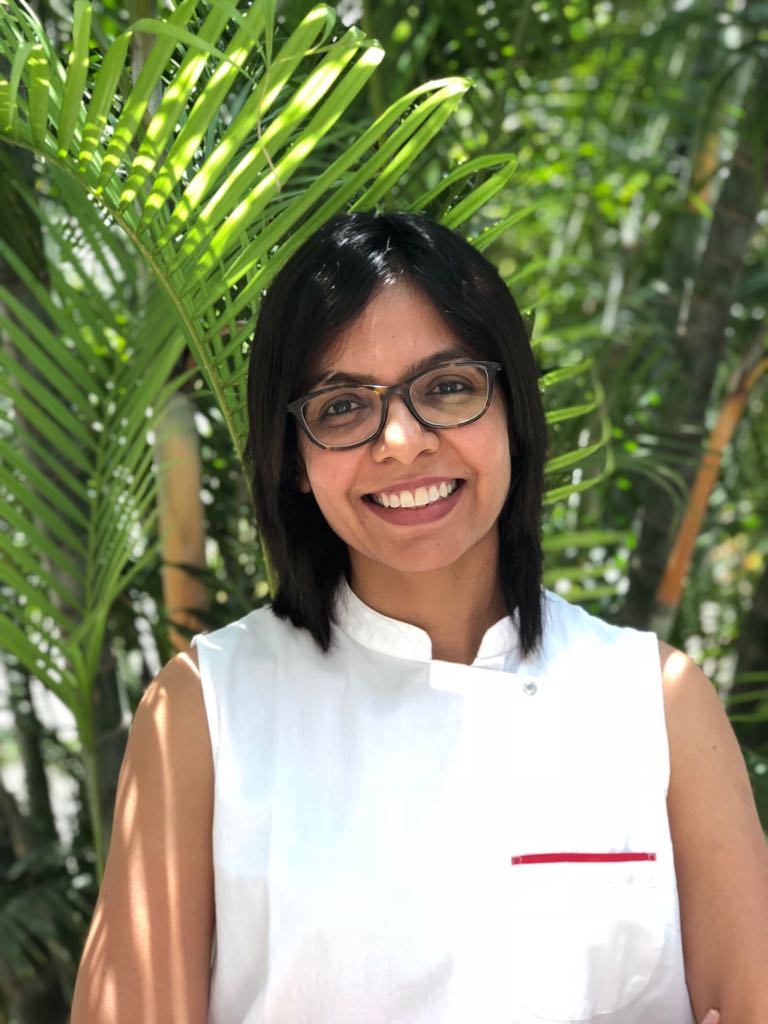
Sarita Chebbi is a compulsive early riser. Devourer of all news. Kettlebell enthusiast. Nit-picker of the written word especially when it’s not her own.
Next post