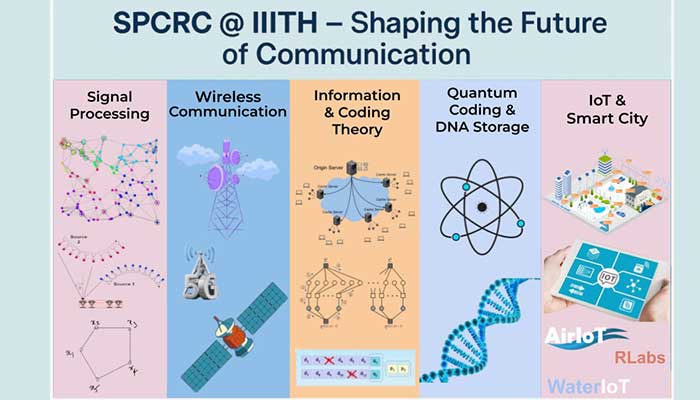
If you have ever wondered what underlies research in futuristic technologies, then the Signal Processing and Communications Research Centre at IIITH is a good place to start at. Some current/futuristic technologies related to which the researchers in SPCRC work on include graph signal processing, satellite-based IoT networks, reflecting intelligent surface based communication, DNA storage, quantum computing, security and privacy. Here’s a sneak peek into the broad areas of research that are carried out at one of the oldest centres of IIITH.
Signal Processing
In nature, signals are everywhere. Speech, audio, images, sensory data, ECG signals, EEG signals, astronomical signals and many many more are all signals and to extract useful information from them is the art/science of signal processing. At IIITH, Prof. Santosh Nannuru and Prof. Praful Mankar work in different aspects of signal processing – graph signal processing and localization and tracking. Research in the former aims to develop tools for processing data defined on irregular graph domains such as functional brain imaging. It also helps model the spread of diseases as a graph. Localization and tracking on the other hand, is used in GPS, Wi-Fi, Bluetooth, and radio frequency identification (RFID).
Wireless Communication
Cellular communications has come a long way in the last 3 decades. Starting with 2G GSM phones and 3G mostly driven by packet switching based protocols, the data rates have increased from a few kilobytes per sec to megabytes per sec. Orthogonal frequency division multiplexing (OFDM) has been the key enabler for 4G and 5G. 5G offers very high peak data rates but there is a lot of scope for innovation to go to 6G. Research in wireless communication includes methods of manipulating reconfigurable intelligent surfaces (RIS) by adjusting their reflection, refraction, or absorption properties. RIS are programmable, planar structures much like panels that can dynamically adjust their characteristics to optimize wireless communication. For instance, they can be installed in areas to improve coverage and capacity of wireless networks by enabling more efficient signal propagation. Profs. Praful Mankar and Arti Yardi are actively involved in this area of research. They are also investigating applications of orthogonal time frequency space (OTFS) modulation that include how to improve spectrum usage. OTFS exhibits unique advantages over the existing OFDM-based communications such as in the case of high-speed train communication in bullet trains where OFDM typically breaks down. Prof. Sachin Chaudhari is actively involved in Satellite Communications for IoT applications. IoT networks benefit from enhanced coverage by using satellites. Still, they suffer from the challenge of large path losses due to long distances between IoT devices and satellites. Prof. Chaudhari’s work focuses on the physical (PHY) and medium access control (MAC) layer aspects of satellite-based IoT networks with a particular focus on topology design, transmission schemes and performance analysis.
Information and Coding Theory
How did the word ‘Information’, vague as it sounds, turn from ‘what someone knows about something’ into a precise mathematical unit that could be measured, manipulated and transmitted? The answer lies in the form of an equation (H= -p(x)logp(x)) in the 1948 paper ‘The Mathematical Theory of Communication’ authored by Claude Shannon. It explained an elegant way to work out how efficient a code could be and laid the foundation for the Science of Information Theory – a set of ideas that has allowed us to build the internet, digital computers and telecommunications systems. When anyone talks about the information revolution of the last few decades, it is Shannon’s idea of the information that they are talking about. At SPCRC, research by Profs. Lalitha Vadlamani, Prasad Krishnan, Arti Yardi, and Gowtham Kurri is under way on latest developments in coding theory which could have broad applications in the future of signal processing, and communication domain. According to these researchers, coding theory is a key component of fault-tolerant systems. As a part of that, they are working on decoding algorithms and designing low-latency codes. While low-latency is not super critical for codes used in say, mobile phones, it is vital in scenarios such as remote surgeries where communication delays can prove fatal. Similarly, research in novel coding schemes and development for DNA storage is gaining momentum especially with ever-surging data in the world today. Traditional methods of storage are proving to be grossly inadequate and hence DNA storage has emerged as a medium with enormous potential because of its high storage density. Prof. Lalitha Vadlamani and Prof. Prasad Krishnan also work on problems related to reliable data storage in data centers and also efficient transmission of information over broadcast networks.
Quantum Coding
In order to protect quantum information from errors caused by environmental noise, it is important to employ quantum error-correcting codes. This is an area that Prof. Lalitha Vadlamani is currently involved with. With all qubits prone to errors, designing codes and decoding algorithms for fault tolerance is essential and forms a major part of this research.
IoT and Smart City
Prof. Sachin Chaudhari works in the field of IoT for Smart City Applications, such as air pollution monitoring and water monitoring. Moreover, he is working on IoT for Education, specifically on Remote Labs. The theme for these applications is Indian solutions for Indian problems. For air pollution, a dense deployment of 50 low-cost air pollution sensors was deployed in Gachibowli, and data was collected in 2021-2022. For a solution scalable to the city level, an image-based solution has been proposed, where mobile-phone-based images can be used to estimate the pollution. For water monitoring, several interesting solutions have been proposed for flow estimation in pipes/taps, and water levels in tanks/borewell. One such example is a low-cost retrofit for the digitisation of analog water meters which has been making waves as a viable alternative to expensive smart digital water meters. Prof. Chaudhari’s team has filed several patents in these areas. In addition to this, a startup, HydrowVerse Pvt Ltd, co-founded by Prof. Chaudhari and Thomas Tency, has been incubated at IIIT-H, which has been involved in developing innovative solutions for water management. Prof. Sachin Chaudhari’s work is also part of the Smart City Living Lab that was set up with the support from MEITY, Smart City Mission, Government of Telangana, EBTC, and Amsterdam Innovation Arena. For IoT for Education, remote labs have been offered to students in remote areas to access science experiments equitably and easily. Given the interdisciplinary nature of IoT applications, Prof. Chaudhari has collaborated with several faculty from different research centers in IIITH on these topics.
SPCRC – Then and Now
SPCRC traces its origins all the way back to 2003, when it was initially known as the Communications Research Centre (CRC). It was founded on the strong foundations laid by three senior professors: Prof. V. U. Reddy, Prof. P. R. K. Rao, and Prof. K. R. Sarma. Over time, Prof. V. U. Reddy and Prof. P. R. K. Rao left the institute, while Prof. K. R. Sarma continues to be associated with the centre to this day.
Recognizing the need to broaden the centre’s scope and attract faculty with diverse research interests, Prof. Jayanthi Sivaswamy spearheaded the initiative to rename CRC as SPCRC. In hindsight, this rebranding proved to be a pivotal move, positively impacting the centre’s growth and direction. While there was some flux in faculty membership in the early years, the centre achieved stability around 2012. Since then, it has grown steadily, both in terms of faculty and student strength. Today, SPCRC is a vibrant, interdisciplinary hub, attracting students from both ECE and CS backgrounds, and stands out as one of the most sought-after centres at the institute.
Sarita Chebbi is a compulsive early riser. Devourer of all news. Kettlebell enthusiast. Nit-picker of the written word especially when it’s not her own.
Next post