The AI-powered platform developed with guidance from the Anusandhan National Research Foundation (ANRF) helps convert complex research papers into summarised video presentations, customisable in different Indian languages making them accessible to all.
What makes the language of Science so arcane? The lament is real if the number of queries on Reddit and other online forums for simplifying research papers is any indication. And it’s not only the general public that wants to know “How to skim through a research paper” and get to the crux of it but also the scientific community at large. In a bid to make Science research accessible to wider audiences, researchers at IIITH with guidance from the Anusandhan National Research Foundation (ANRF) have unveiled an AI tool that can seamlessly translate complex research papers into engaging and concise video presentations.
Prof. Ponnurangan Kumaraguru who is leading the efforts from IIITH remarks that the idea of democratising research took shape while brainstorming about how to get across scientific research to the non-scientific community and get them excited enough about the breakthroughs. “One thought was to have research available to others in different formats. Back then, we didn’t really think of what format to begin with. It could be a poster, podcast, blog post, a LinkedIn post or a tweet on X,” says the professor who is quite active on social media himself. But while these formats serve as avenues to showcase one’s own research, the idea veered towards the ways in which globally available research could be similarly consumed.
Research Outreach With ANRF
IIITH then teamed up with ANRF which aims to seed, grow and promote research and development (R&D) and foster a culture of research and innovation throughout India’s universities, colleges, research institutions, and R&D laboratories. Dr. Shivakumar Kalyanaram, CEO, ANRF, says that their goal is to change the landscape of research in the country. “As part of ANRF’s mandate to foster excellence in research and innovation, we are committed to broadening research capabilities across a wider range of institutions, and researchers. We see the democratisation of research via technology and AI as a key contributor in this effort along with other programs — accelerating the discovery of knowledge. Through initiatives like SARAL, we aim to promote the diffusion of ideas, build strong partnerships, and use platforms like AI for social media, and demystification of research to amplify the impact of science and research.”
Input Paper, Output Video Summary
Inspired by Google’s NotebookLM which summarises uploaded documents such as research papers and converts them into easy-to-understand podcasts, Prof. PK says that their team comprising Project Leaders Dr. Lakshmanan Natraj and Rahul Sundar along with developers Imandi Sai Ganesh, Arihant Rastogi and Vishnu Sathwik (see pic), considered the video format instead. “Typically, students and faculty present slides at conferences. So, we wanted to create an application that would automatically take a research paper as its input and generate a 3-4 minute concise video based on slides in different Indian languages.”

As SARAL as Pie
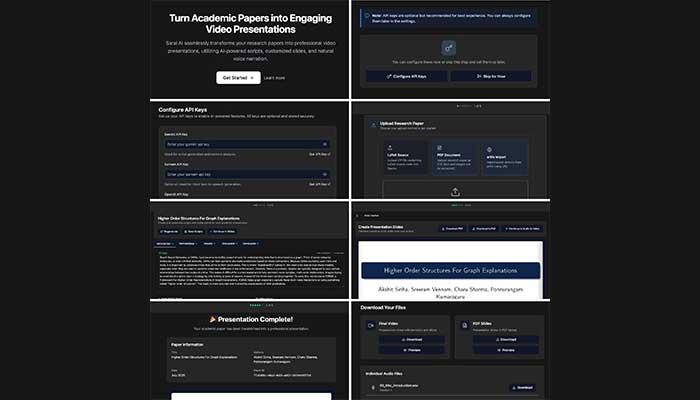
Like the name suggests, SARAL’s entire workflow is streamlined into a few easy steps beginning with the upload of the research paper itself. This can be done in one of three ways – directly via LaTex files which contain the source codes and figures, by importing the paper from arXiV using the URL or by uploading the PDF version of the paper. The next step breaks down the paper into individual slides that mirror the sections that an academic paper typically contains; Introduction, Methodology, Results, Discussion and a Conclusion – all while allowing you to customise the bulleted points on each slide. It also lets you edit the content through the addition of appropriate figures and diagrams from the paper to the slides. From the created slide deck, the last step enables you to create a corresponding video and audio in any one of 11 languages, including English. “The research summary is created with the help of AI tools such as Gemini, Claude, GPT and so on. When the script is ready in the form of slides, we then use Sarvam’s Text-to-Speech conversion engine to create an audio in the voice (either male or female) and language of our choice,” elaborates Prof. PK. There are also options to download either individual audio sections and slides or the final output in its entirety as a video presentation and to eventually share on social media.
Scope For Improvement
Currently, the slides are static. “Who wouldn’t like to watch an animated, engaging video?,” quips the professor. Students came back with feedback for generating different kinds of outputs such as posters. “Conferences also require posters which contain all the required information on a single page. We are currently working on it. It is a difficult one but a problem we are trying to solve nevertheless right now,” he affirms.
Democratise Research
SARAL is one of the first tools that the team has built under the domain name, Democratiseresearch.in. Another kind of Democratise tool under consideration is for patents and industry folks. “We keep writing papers but the industry doesn’t know what is out there. A platform would bring the two – industry and researchers- on the same page and catalyse technology transfer better,” he says. Interestingly enough, Prof. PK’s efforts towards democratising research can be traced to his early association with the ACM India Council. In 2020, he was instrumental in the setting up of PhD Clinics that facilitated Computer Science researchers from all over the country to obtain inputs and advice from expert mentors located in premier academic institutions and industry. While this was an online initiative, the professor was also instrumental in setting up an in-person mentorship programme in 2021 titled, Anveshan Setu Fellowship that allows any registered CS / IT PhD students to physically intern with a professor for a minimum period of 4 weeks in a year. “I even conduct a workshop titled, ‘Using AI and Social Media for Research’, different from ‘Research on AI’. There is an entire research lifecycle from zeroing in on a domain, finding a problem in the domain, determining if it is interesting enough to study, then data collection, analysis, writing the paper, and publishing it. Even after it is published, we need to determine if content can be generated for dissemination and publicised on social media. AI can influence this whole cycle,” he remarks.
Conclusion
With the SARAL tool open to public (code on GitHub), Prof. PK remarks that a lot of interest has been generated in the non-tech community too. “I received queries from ‘Science Communicators’ who experimented with and were excited about the platform. At the end of the day, we are trying to demystify not just the concerned research paper but the research process in general. And this seems like a step in the right direction.”
The SARAL team is in the process of organising hackathons and competitions around the theme of democratising research for which they are keen on adding contributors to the efforts. Interested folks may reach out to Prof. PK.
Sarita Chebbi is a compulsive early riser. Devourer of all news. Kettlebell enthusiast. Nit-picker of the written word especially when it’s not her own.
Next post