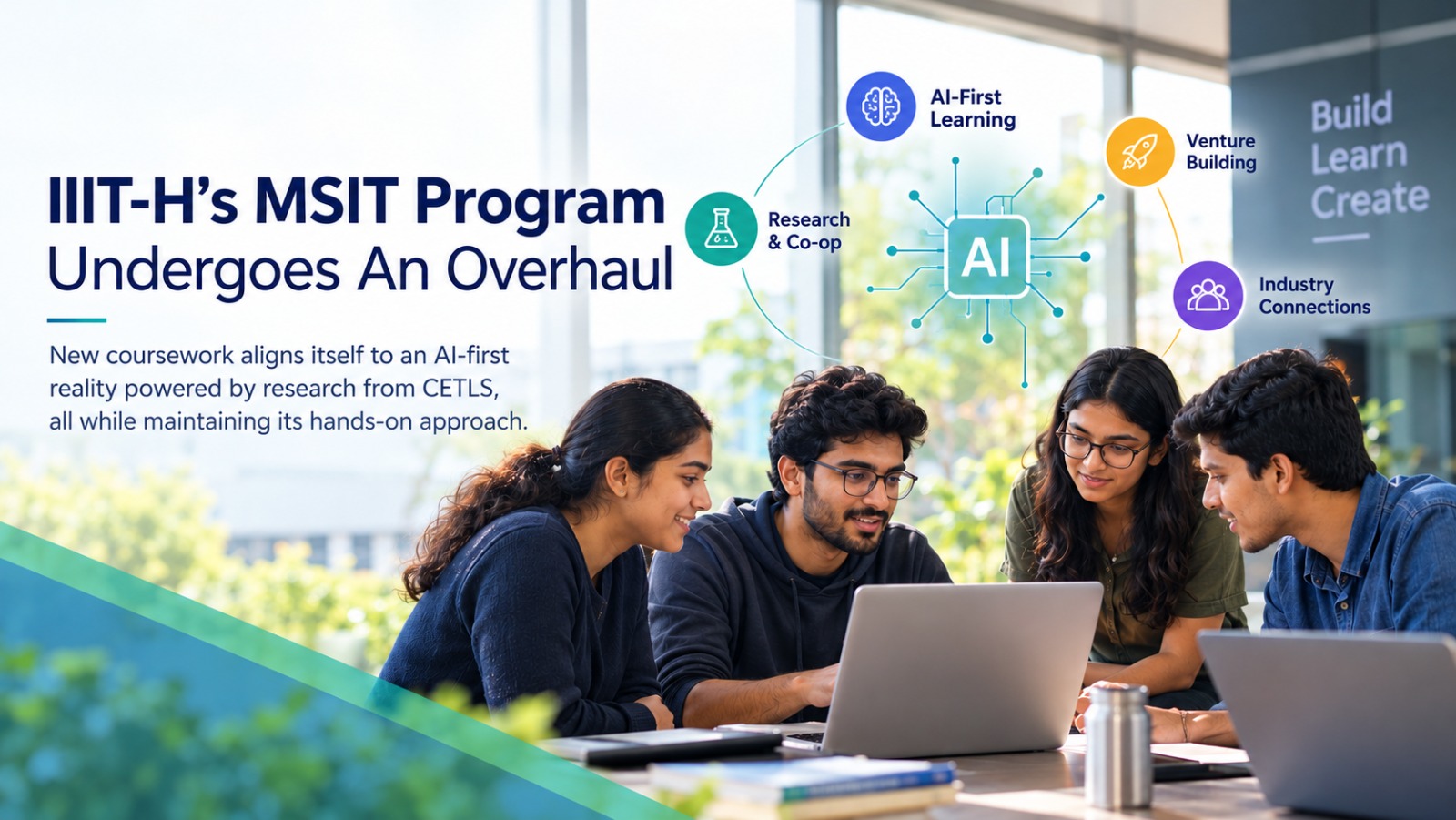
New coursework aligns itself to an AI-first reality powered by research from CETLS, all while maintaining its hands-on approach.
If you were to ask IIIT-H’s founding father and Turing Award winner Prof. Raj Reddy to name his pet peeve in Indian education, you’re likely to get “rote learning” as your response. It was his vision to break away from the spoon-fed way of memorising facts towards a journey of self-discovery that led to the creation of the MSIT program back in 2001. Originally established as part of the Consortium of Institutions of Higher Learning (CIHL), with initial academic and content guidance from researchers at Carnegie Mellon University (CMU), the emphasis in this program continues to rest on ‘learning-by-doing’.
The distinctive feature of the program lies in the fact that it provides a way into the IT world for those who might otherwise not have access to a specialised Computer Science education. “It was originally targeted towards those who perhaps couldn’t obtain a seat in CS and had to opt for Mechanical Engineering or some other branch of Engineering, or those from tier-3 colleges where they might have a CS degree but the facilities were not great and they couldn’t really learn much. This time around though, the entry criteria has been relaxed to welcome anyone with 16 years of formal education regardless of background so as to have a diverse cohort across domains,” explains Anandaswarup, Head, MSIT.
Partnering With CETLS
More than 25 years later and with over 3000 alumni working across the technology sector, the program is reshaping itself to fit into an AI-native world. “Every 5 years, there’s a churn in the industry and to align with that we revamp our curriculum. With GenAI changing how software itself is developed, and how problems are solved, what people need to learn in order to stay relevant is important,” says Anandaswarup of the course rejig. The course restructuring is happening in conjunction with the newly established Center for Educational Technology and Learning Sciences (CETLS). The interdisciplinary center brings together Psychology, learning sciences, cognitive science, and technology to design new methods and tools to help people learn better amidst AI. “The danger with AI is that it hands students answers; the opportunity is that, designed well, it can be the most patient tutor they will ever have. What CETLS lets us do is study which is which – where students get stuck, what kind of support actually moves them forward, and how the mentor and the machine should divide the work between them,” explains Praveen Garimella, Professor of Practice at CETLS and one of its two founding full-time faculty.
By working alongside CETLS, the aim is to implement learning sciences and theories into the MSIT curriculum. “The hope is that MSIT will serve as a living lab for CETLS,” remarks Anandaswarup, explaining that the center’s ideas about how to effectively teach CS concepts and such can be implemented in the MSIT program. “We get the data and thus establish a loop between CETLS and MSIT. The partnership with CETLS will help us learn where students struggle, at what point do they need support and when do we let them go. Additionally, with the presence of AI tools, we can teach students how to effectively use them to become more productive and so on. Another aspect we are hoping to explore with CETLS is how we can personalize learning for the students with the help of AI. Some students will need more support, others not so much, and some others will need to be challenged a bit more in order not to lose interest.” The alliance is also forcing a rethink on the traditional ways of assessment in the light of readily available AI-generated answers. “We want students to analyse and evaluate whether the solution is logical or not instead of blindly accepting it.”
Learning At MSIT
Since the emphasis in the MSIT program is on the practical approach, there are no passive lecture-based sessions. Instead, the courseware is known for its immersive discussion-based sessions. There are three skills that serve as the structural framework for MSIT’s project-centric, mentor-guided model – ‘learning to learn’, ‘learning to think’, and ‘learning to do’. The shape of MSIT’s curriculum is deliberate. It draws on research led by Matthew Kam at Google, whose team studied developers at the frontier of working with AI – mapping 12 work goals and 75 tasks across 21 engineers – and found that the skills of an AI-enhanced developer fall into four domains, which the study arranges as a T: using generative AI effectively, core software engineering, adjacent engineering disciplines, and adjacent non-engineering skills. MSIT’s curriculum follows that T. The horizontal bar covers the full range of GenAI tools and how to use them. The vertical stem goes deep into the fundamentals of software; designing, building and testing it. The space to the left of the stem holds engineering skills beyond software development; the space to the right holds professional skills such as communication, teamwork, presentation and the ability to take feedback. According to Prof. Praveen, of the four, it is the depth that matters more now, not less. “AI has removed almost all the friction from turning an idea into working code. Anyone can have a prototype running in an afternoon. What separates a prototype from a product is systems thinking, which is understanding how components interact, where a design will fail under load, what happens to data, security and cost when ten users become ten million. That judgement cannot be generated on demand; it has to be learned, and it is why the vertical of the ‘T’ is where MSIT asks students to spend most of their time,” he says.
Research, Industry and Venture-Building
After a solid foundation in the fundamentals of Computing which takes place in the first semester, the remaining three semesters are all practical. “We’re following a research co-op system in the second semester. The co-op model – short for co-operative education – is something we’ve borrowed from the American and Canadian universities,” explains Anandaswarup. It is essentially a system where the students alternate between full-time study and full-time professional work experience and unlike an internship that typically takes place only during college breaks, this works throughout the semester. In this case, MSIT students will be spending half their time doing a co-op in IIIT-H’s research labs along with faculty and mentors. “We conducted a very successful pilot last year where our students worked with Prof. CV Jawahar in the Center for Visual Information Technology (CVIT),” he says. The third semester is about helping students build their own ventures. They will form teams, build a working product and business plan around a real problem which they can then pitch to early-stage VCs for seed funding. Those lucky enough to obtain funding will continue to work on launching their startup in the final semester with MSIT support. “Otherwise they can work full-time on production systems with an industry partner,” says Anandaswarup, adding, “We have already lined up external partners from different domains such as pharma, or the legal field where our students will get the opportunity to implement their AI knowledge and build products in those domains. ”
Creating And Not Just Chasing Jobs
With the new curriculum in place, the emphasis is on creating postgraduates who will go beyond looking for mere jobs to identifying problems that exist and creating appropriate solutions. “We want them not to think about the jobs which exist today, but the jobs that will exist five or ten years from now, and maybe not just chase such jobs, but also create those jobs,” says Anandaswarup.
The revamped program begins on Jan 2, 2027. For more details about the admissions process and deadlines, click here.
Sarita Chebbi is a compulsive early riser. Devourer of all news. Kettlebell enthusiast. Nit-picker of the written word especially when it’s not her own.
Next post