
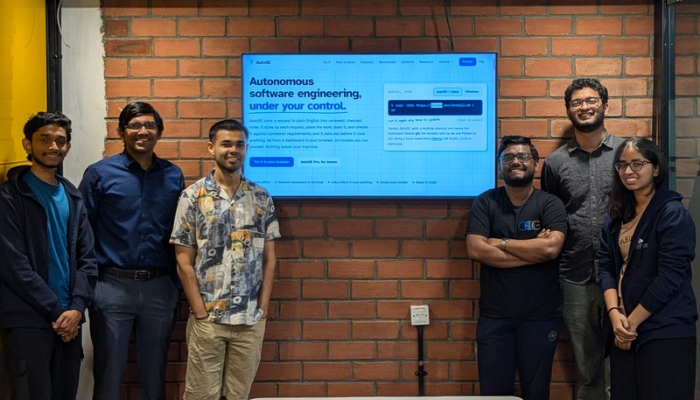
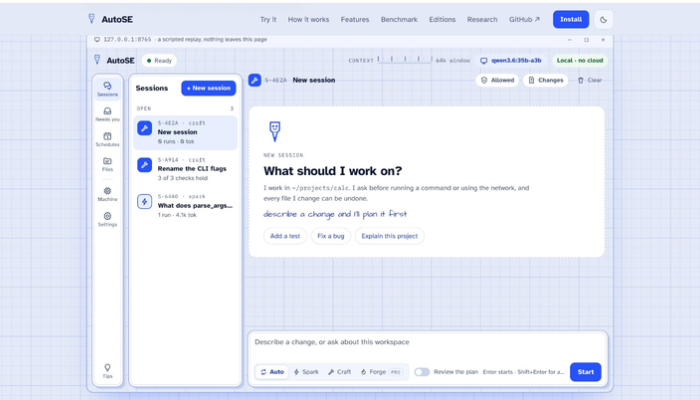
What if you could build software using AI agents without paying for expensive subscriptions or sending your code to the cloud? Prof. Karthik Vaidyanathan and his team is working towards making this possible with AutoSE, a Made-in-India, patent-pending, open-source, locally deployable agentic harness/tool that aims to make AI-powered software development more accessible, private and sustainable.
We don’t write code anymore. Familiar admission or lament – whichever way you look at it, the truth is that software development is way faster today thanks to AI-powered coding assistants. These assistants can write code, identify bugs, make changes and even build entire software applications – all with one instruction. Alas, the convenience comes with a price. Most of these tools not only rely on powerful cloud infrastructure but also paid subscriptions that cost anywhere between $20 and $100 a month. For students, individual developers and smaller institutions, this can be a significant expense. Add to this the question of privacy. When developers use cloud-based coding assistants, their source code is sent to external servers for processing. For organisations such as banks, which handle sensitive information and critical systems, this may not be an acceptable proposition. Not to mention the environmental cost of running increasingly large AI models, which require substantial computing power and energy.
Is it possible then for software development to become AI-powered without depending on expensive subscriptions, external cloud infrastructure or increasingly large models? Prof. Karthik Vaidyanathan and his students at the Software Engineering Research Centre (SERC), IIIT Hyderabad definitely believe so and are demonstrating this with AutoSE (Autonomous Software Engineering), an open-source tool that allows AI agents to build software locally, using smaller language models.
It All Began With A Course
Interestingly, AutoSE owes its genesis to a course offered by Stanford University – the Modern Software Developer which examines the emerging practices and technologies behind AI-native software development. As someone in SERC who was already doing a lot of research in the space of autonomous software engineering under a group labelled, Software Architecture For Sustainability (sa4s), the course prompted Prof. Vaidyanathan to consider offering something similar to the students of IIIT-H. “Humans writing code is passe, right? I mean, you have agents who can automate all these processes. So it’s important to go to the next level of understanding of how to build software around these capabilities,” he reasons. Traditionally, software development has involved several stages: understanding requirements, designing the system, writing code, testing it, deploying it and maintaining it. Different specialists often handle these stages, with humans involved at every step. AI agents are changing this equation. Developers can increasingly focus on defining what needs to be built, while agents take on much of the actual implementation and testing.
When Prof. Vaidyanathan was brainstorming about the course contents, he wanted students to go beyond learning about the technology itself. “For me, it was important that we also build something so that we are very familiar with where this field is going,” he says. What began as a research idea under the ANRF PM Early Career Grant research project titled SustAInd – a software-centric framework for engineering sustainable AI-enabled systems evolved into a tool that could put some of these ideas into practice.
The Trappings Of An Agent
To understand AutoSE, the professor remarks that it’s essential to understand the difference between an AI model and an AI agent. “Models like LLMs have become extremely popular. They take an input like a prompt and generate code for you. But that’s where they stop; they can only generate code,” he says, adding that building software requires more capabilities than mere code generation. This is where an agentic harness comes in providing the whole shebang of tools, memory, prompts and mechanisms for planning and evaluating tasks, enabling a model to perform more complex activities. The central idea behind this was to create an ecosystem around these models that would enable them to undertake software development while keeping everything local. “There are a lot of open-source models available that can be hosted on an organization’s own infrastructure, but they lack a ‘harness’ that can work around these models,” explains Prof. Vaidyanathan.
Sovereignty, Accessibility & Empowerment
“We are at an age where anyone with access to software tools can build systems. When was it ever possible that a 10th-grader in a remote village with a fair understanding of computers could use these tools and build a software system that could help his or her parents running a kirana shop?,” offers Prof. Vaidyanathan as explanation for having an open-source version. It is available under the Apache 2.0 licence, which means individuals, developers, students and institutions can download and use it without paying for the harness itself. “All they need is a reasonably capable machine and a suitable locally hosted model.”
For students and educational institutions, this could make a considerable difference. “Imagine a professor wanting to teach AI-powered software development to a class of 70 or 100 students. Requiring everyone to purchase individual subscriptions to a proprietary coding tool would make the exercise expensive, particularly for smaller colleges. We don’t want people focusing too much on building this itself. But instead, you can build a lot of cool software that was never possible before by just having access to a harness like this,” says Prof. Vaidyanathan.
For organisations, the benefits extend to data security and control. AutoSE’s local-first approach allows them to host the system within their own premises, ensuring that their code stays within organisational boundaries. The team is also working towards an enterprise-oriented offering called AutoSE Pro. This builds on research into understanding how organisations develop software: their preferred technology stacks, coding conventions and architectural decisions. By studying an organisation’s existing codebase, the system aims to understand these patterns and generate code that follows its established practices. The team has filed an Indian patent application for this approach and is developing an initial version. “This will give organisations greater control over their software development infrastructure,” says the professor adding that it has implications beyond individual organisations. “Going forward we should not be dependent on certain countries to decide the future of our country,” he says, emphasising the importance of technological sovereignty.
Sustainability Not Mere Jargon
The tool’s main target audiences may be individual users and organizations, but as the professor likes to emphasize, “Both are rooted in the local”. The goal is to reduce dependence on huge computing resources and cloud infrastructure by keeping the processing local or on individual laptops. The advantage is two-fold; apart from minimizing reliance on cloud data centres, it also guarantees that sensitive code doesn’t travel externally. While the tool scores big on the ‘green’ front, the team is cautious of making tall claims of energy efficiency. “Running a model locally still consumes electricity and affects battery life,” acknowledges Prof. Vaidyanathan. That said, the researchers are working on optimising AutoSE’s resource utilization to consume less power.
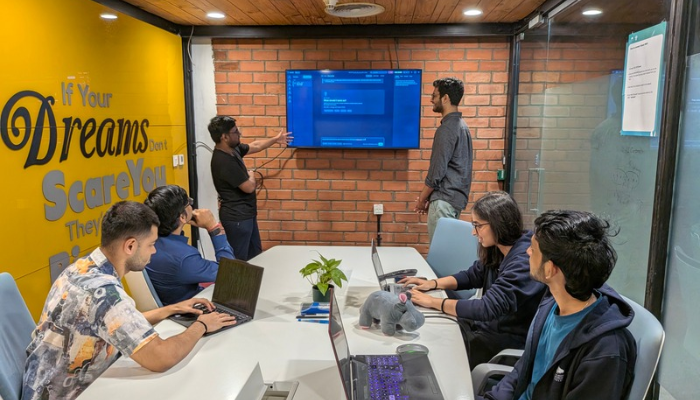
For the team, the bigger sustainability picture lies in making the models perform more efficiently through better engineering. Researcher Pranav Swarup puts this into perspective when he draws a comparison with the Indian space programme. Just like India’s Mangalyaan mission demonstrated how careful engineering and resourcefulness could achieve something remarkable without matching the enormous budgets of other western space programmes, he says there’s a similar opportunity in AI. “There’s one side that’s making bigger and bigger models and their mantra is just to throw more and more compute. But for a country like India, where we want to empower everybody to be able to design and create their own stuff on their laptop, the approach ought to be different.”
Focus On SLMs
Smaller language models, unlike LLMs can potentially run on ordinary computers and laptops. However, they have limitations. They may struggle with complex instructions, have shorter context windows and lack some of the implicit knowledge that larger models possess. The researchers explain that simply replacing a large model in an existing AI coding tool with a smaller one does not necessarily work. Aviral Gupta, 4th year Dual Degree student of Computer Science, mentions that the team experimented with existing software engineering harnesses by replacing their large models with smaller ones. They found that while these combinations performed very well with powerful models, their performance dropped dramatically when smaller models were introduced.
It highlighted an important insight that the model alone does not determine how well an AI agent performs. The way the system around it is designed matters just as much. Prof. Vaidyanathan also sees this as an opportunity to rethink how AI systems are built. Instead of relying on one enormous model that knows something about everything, could developers use a collection of smaller, domain-specific models that are better suited to particular tasks? ”For instance, a software development system building an e-commerce application may not need a model with extensive knowledge of healthcare or electronics. Smaller models specialising in relevant areas could potentially work together to deliver the required results.”
Efficient Engineering
Working around the constraints of smaller models needs more carefully engineered support. For instance, SLMs may not anticipate that a software package needs to be installed within a virtual environment. A larger model might automatically recognise this requirement, while a smaller one may simply attempt the installation and encounter an error. AutoSE addresses such limitations through mechanisms such as memory, structured planning and architectural records. The system can retain information about previous actions, remember what worked and use that information to guide subsequent tasks. The team is working on improving this memory mechanism. The objective is to ensure that an agent working on a large codebase does not repeatedly ask for the same information or make the same mistakes. They are also exploring ways to select and switch between smaller models depending on the task to make them more efficient.
Visibility In Software Development
Another distinctive feature of AutoSE is its emphasis on transparency. Arihant Tripathy, from the sa4S group, explains that the tool presents a plan before modifying code, allowing users to see proposed changes, identified issues and how they will be addressed. It also verifies whether the promised changes have been completed. This is particularly useful when AI agents work on large codebases, where small modifications can have wider implications. “We also have a list of architectural records, so we know who has made what change, and we can track down every part of what’s happening,” says Pavan, an MS by Research student in the group. The aim is to give developers control rather than asking them to blindly trust AI-generated output. They can monitor every stage or reduce visibility for simpler tasks, while retaining the option to intervene.
Glocal Process
For the SERC team, AutoSE represents more than an alternative to proprietary AI coding tools. It is an attempt to make advanced software engineering capabilities more accessible without following the industry’s increasingly resource-intensive approach. The team hopes to build a community around AutoSE, encouraging developers, students, educators and organisations to download the tool, experiment with it and contribute feedback. “Ultimately, our larger goal is to enable people to build software applications that may previously have been beyond their reach,” says Prof. Vaidyanathan. Speaking about the novelty of their academic research, Pavan sums up succinctly by saying, “I think we are very well positioned because a large part of the developer community is now pushing away from the cloud and from an organizational standpoint, they want to go more local. We are a good market fit where we can target both”.
To learn more about the tool and test it out, click here.
Sarita Chebbi is a compulsive early riser. Devourer of all news. Kettlebell enthusiast. Nit-picker of the written word especially when it’s not her own.
Next post