
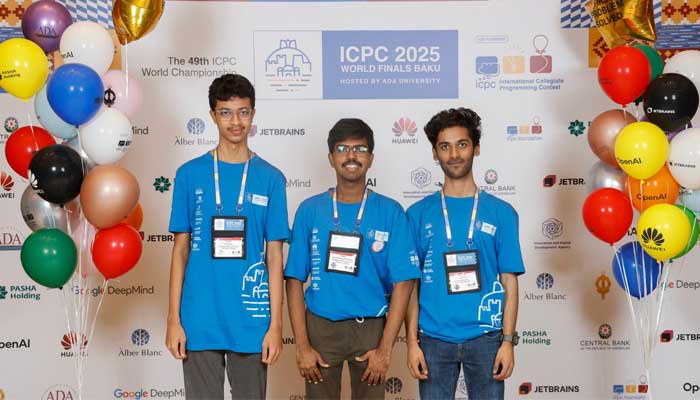
SubtasksWhere, IIIT Hyderabad’s winning team of competitive programmers climbed to 73rd world ranking in the ACM –ICPC World Finals, gaining a place on the Honors list , for solving six or more programming problems. The three-member team did the Institute proud when they ranked 11th world-wide, at a separate Huawei-sponsored Challenge, positioning ahead of the top-seeded St. Petersburg State University!
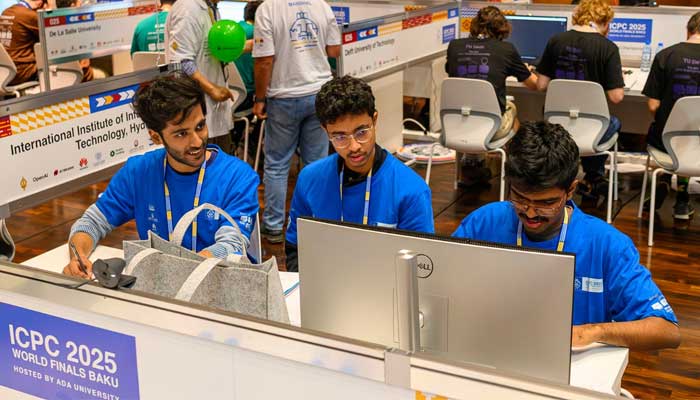
It was a sweet sense of accomplishment for the IIIT Hyderabad coding team comprising of Shiven Sinha, Hari Aakash K and Sushil Raaja Umasudhan, at the recently concluded 2025 ICPC World Finals. Hosted by ADA University at Baku in Azerbaijan, the algorithmic programming competition challenges university students to grapple complex real-world problems within a tight timeframe.
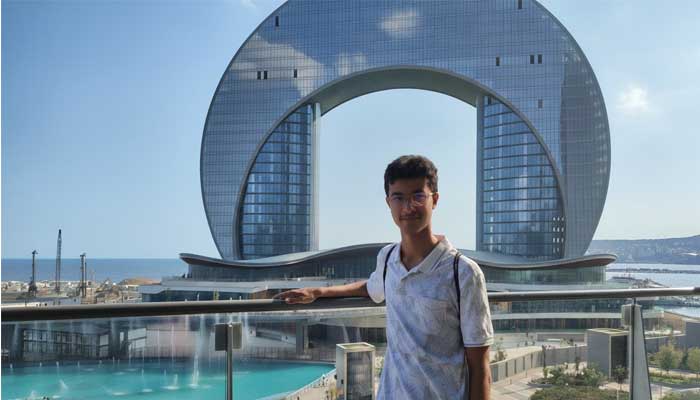
The global contest featuring 73,083 students from 103 countries, tested the creativity, teamwork and problem solving skills of 140 shortlisted teams from 3,424 universities. Held between August 31 and September 5, the ICPC venues included three iconic architectural wonders including the futuristically designed Heydar Aliyev Center by Ar. Zaha Hadid, the Baku Convention Center and the Baku Expo Center.
Who, What and SubtasksWhere
Securing first place in the Kanpur contest in December 2024 and 3rd in the Asia-West championship in March 2025, meant a direct ticket to the World Finals for the IIIT Hyderabad contingent. The Association for Computing Machinery – International Collegiate Programming Contest (ACM-ICPC) World Finals is famously referred to as the “Olympics of Programming Competitions” for college students.
The cherry on the cake actually occurred a day before the main competition, at a separate ICPC 2025 World Finals Challenge, that was deemed mandatory for all teams. “This challenge was designed differently from standard ICPC problems and aimed at problems of contemporary interest to industry”, notes Prof. Vikram Pudi who first heard about the IIITH team’s accomplishment on a Reddit post. “Ranking 11th in the Huawei sponsored challenge is creditable especially since they were up against heavily coached participants from some nations who are tutored in this system from a very early age”. In India, students learn programming only at undergraduate levels. This has skewed the playing field but when they face a very different style of problems, it changes the game quite significantly.
Whipping up the perfect ecosystem
While ICPC is mostly a student-run activity, IIIT Hyderabad has set the right environment for the world-class challenge. For instance, in the Practice- theory-practice curriculum format, explains Prof. Vikram, theory is sandwiched between the culture of practise initially and intensive programming later; honing the student’s computing capabilities to contribute to Google’s Summer of Code and other open source initiatives. “These skills are built very quickly, initially. This is one of the good things that we do at IIIT and one of the chief reasons why we have consistently good participation in world competitions every year”, notes the professor. “In the last three years, students who are interested in competitive programming have been signing up with me for independent study. What’s great is that, with successive batches training their juniors, an ecosystem and connect has been formed. They actually do a lot of seminars. Problems that are given as part of practicals and lab exams, are usually selected by TAs who tend to be involved in ICPC kind of events”.
Building a winning team
Participating in Informatics Olympiads, and discussions on Discord were some things that team-members Shiven, Sushil and Hari Aakash had in common. Shiven Sinha, a veteran of many IOI competitions, is now a final year student who is about to commence a six-month research internship at Germany. “Initially, I attended a camp on our IIITH campus that had invited IITs, NITs and top colleges from around the country, for an ICPC style competition. When I learned that Hari and Sushil were joining the Institute, I texted them and they immediately agreed and that is how the team came together. After every contest, we would discuss strategies, what worked and what didn’t. We would individually solve problems to maximize the learning from the contests that we participated in. I am thankful to the programming club for organizing those competitions that were really cool. Prof. Vikram Pudi facilitated a lot of the things that have helped us in competitive programming”, says the scholar who hopes to pursue a Ph.D someday. “Having spent so much time fine-tuning our own brains to work well on quantitative problems, can we mechanize it for machines with an algorithm?”
Team work made the dream work
“All three of us have Olympiad backgrounds”, comments Sushil Raaja Umasudhan, a second year CSE student of IIITH who has been to IOI twice. “As a team, we tried out a few past ICPC-style contests together, and rigorously reviewed our performance and these sessions really helped our performance. ICPC problems are quite different and require some special training. At the World Finals, the entire problem set had twelve problems based on data structures in algorithms and we solved six of them. As far as the contest went, while it didn’t go as well as we expected, the whole experience was quite good; with plenty of interesting events and chill zones where we got to meet contestants from other countries”.
Shiven adds, “The ICPC World challenge was in two legs. The main part is the actual conference. The ICPC Challenge which was held a day before, presented a set of problems that are closer to industry, usually designed by the lead sponsor, which was Huawei this year. It is hard to prepare for it and you have to figure it out on the spot. That was really fun, and we ended up doing pretty decently, and were actually in the top a few times. Right after the main event, we had the opportunity to meet the second place winners from the University of Japan and discuss their practise schedules and strategy. That was a solid discussion”.
“For the Baku contest, we sat together for a few weeks and worked on virtual contests to prepare for the World Finals” comments second year student Hari Aakash, who joined IIIT Hyderabad as a gold medal winner in the Indian National Olympiad of Informatics. “Additionally, we split topics among ourselves and practiced problems specific to the content for two weeks, practicing different types of problems within competitive programming”.
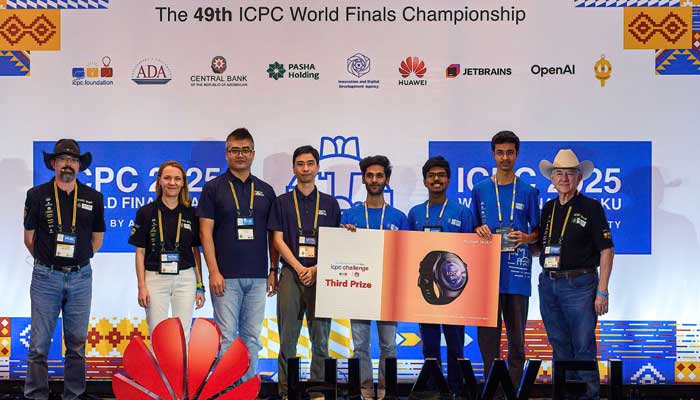
“The Huawei ICPC Challenge was a heuristic programming contest with one problem”, notes Hari. “We secured the eleventh place, and since the top twelve spots got prizes, we received the third prize, which in this competition was a Huawei smartwatch. That was something quite nice because we defeated a lot of strong teams to get there. I want to give a shout out to our families, friends who helped us prepare for Olympiads, the Discord servers and our college professors and our friends”.

Deepa Shailendra is a freelance writer for interior design publications; an irreverent blogger, consultant editor and author of two coffee table books. A social entrepreneur who believes that we are the harbingers of the transformation and can bring the change to better our world.
Next post