
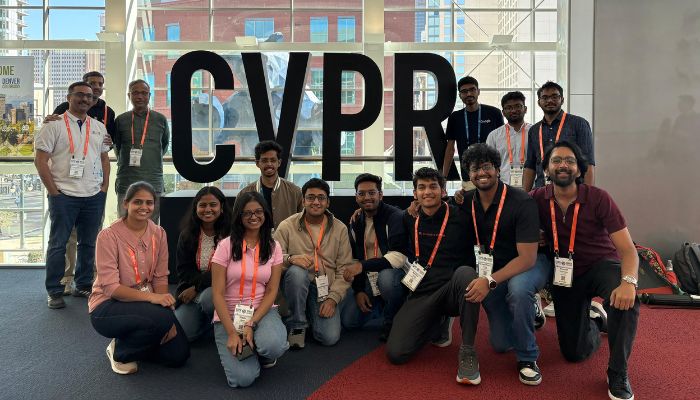
Continuing its tradition of having the largest Indian research delegation, this year too, IIIT-H presented its cutting edge work at the main Computer Vision and Pattern Recognition (CVPR) conference and its associated workshops showcasing advancements in object detection, 3D image generation, and vision language models.
For AI researchers, especially those in the Computer Vision domain, having a paper acceptance at the highly acclaimed Computer Vision and Pattern Recognition (CVPR) conference is the holy grail. These bragging rights are due to the fact that aside from being one of the top conferences in computer vision, alongside venues such as International Conference on Computer Vision (ICCV) and European Conference on Computer Vision (ECCV), acceptance rates are highly competitive, making accepted papers a strong indicator of research quality. The 2026 edition drew a record number of paper submissions – 16,092, a 24% increase over 2025, of which only about one-quarter were accepted to the program, resulting in 4,089 paper presentations.
Best Paper Runner-Up Award
Dual degree graduate from the Computer Science and Engineering and Master of Science in Computer Science and Engineering program, Kunal Bhosikar’s first ever CVPR event is an experience he will never forget. He presented two papers at workshops there tackling very different challenges in the rapidly evolving world of 3D AI. One of them titled, “Fast and Robust Mesh Simplification for Generated and Real World 3-D Assets” was presented at the Workshop on 3D Geometry Generation for Scientific Computing where it won the Best Paper Runner-Up Award. The acclaim was in recognition of its potential to solve a key bottleneck in 3D graphics and visualization. Explaining his work that came about as a result of his internship at TCS Research under Dr. Lokender Tiwari, Kunal says, “Today’s AI systems can generate incredibly detailed 3D models from images, videos, and even text prompts. These models are represented as “meshes” or networks of tiny triangles stitched together to create a 3D object. But the models often contain thousands of tiny triangles, making them computationally expensive to store, render, and process.”
Kunal’s award-winning research involved a fast mesh simplification technique that intelligently removes unnecessary triangles while preserving important details such as shape, curvature, and texture. The result is lighter 3D models that remain visually accurate but can be processed much faster. This has applications in healthcare, where doctors use 3D reconstructions from medical scans for diagnosis, and in virtual reality, where reducing rendering delays can create smoother and more immersive experiences. The work was developed during a research internship at TCS Research under Dr. Lokender Tiwari.
Preventing Unauthorised 3D Reconstruction
Kunal’s other paper titled “PatchPoison: Poisoning Multi-View Datasets to Degrade 3D Reconstruction” was presented at the SPAR-3D Workshop (poster presentation and lightning talk). The work which was carried out under the guidance of Profs. Ankit Gangwal and Charu Sharma is focused on a growing concern in the AI era: protecting images from being used to create unauthorized 3D models. The research explored adversarial attacks on 3D Gaussian Splatting, a popular technique that reconstructs 3D scenes from multiple photographs. The team developed an almost invisible digital patch that can be embedded into images. While humans cannot notice the patch, it disrupts AI reconstruction pipelines, causing the resulting 3D model to appear blurred or distorted.
The research highlights a potential privacy-preserving solution for photographers, content creators, individuals, and businesses who may not want their images to be used for 3D reconstruction without consent.
Seeing Through Other Objects
Dual degree graduate Vaibhav Agrawal has achieved a rare feat – that of having two consecutive acceptances at CVPR. “The previous year’s visit enabled him to meet his to-be PhD adviser!,” exclaims Prof. Ravi Kiran S, under whom Vaibhav worked on occlusion in 3D image generation. Vaibhav’s paper titled, “SeeThrough3D: Occlusion Aware 3D Control in Text-to-Image Generation” introduces a system known as SeeThrough3D which essentially helps AI generate images from 3D scene layouts by explicitly teaching it which objects are in front, behind, or partially hidden, resulting in more realistic and geometrically consistent scenes. “Current AI image generators are not very good at understanding occlusion – when one object partially blocks another from view (for example, a chair hiding part of a table),” offers Vaibhav as explanation. “Our work also enables 3D layout control in generated images, allowing the artist to control the pose and location for each object which is generated in an image,” he adds.
Better Video Understanding With Less Data
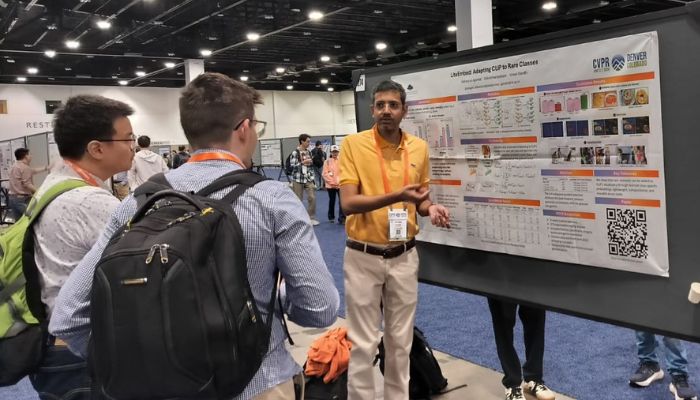
At a workshop on Computer Vision with Small Data: Beyond Scale Toward Data-Efficient Dynamically-Aware Video Intelligence, Darshan Singh, a Masters graduate and a predoctoral researcher at Google DeepMind presented and won the Best Paper Award for, “SRL-CLIP: Efficient CLIP Video Adaptation via Structured Semantic Role Labels”. Advised by Prof. Makarand Tapaswi, the paper essentially explores how to make an AI model called CLIP better at understanding videos. “CLIP is already good at connecting images and text (for example, matching a photo with a description),” says Darshan, adding that to adapt it for videos, researchers usually train it further using millions of videos paired with captions or narrations. The problem however is that these captions are often incomplete. They might say something like: “A person is cooking.” but leave out important details such as who the person is, what exactly they’re cooking, where they are, and so on. Instead of using ordinary captions, the team used Semantic Role Labels (SRLs), which gives AI rich, structured descriptions of what happens in videos. With this, the researchers were able to train a strong video-understanding model using only a small amount of data, instead of millions of loosely described videos. “The model’s level of efficiency directly tackles the workshop’s core focus on operating “Beyond Scale” without relying on massive compute or huge datasets,” reasons Darshan as the biggest factor in winning the award.
Findings Paper: Who, What. Where
This year’s edition of the CVPR conference saw the introduction of a new Findings Track. According to the organizers, “The goal is to reduce resubmissions by offering a venue for technically sound papers with solid experimental validation, even if their novelty is more incremental.” Balaji Darur who is an undergraduate researcher, pursuing a BTech in Computer Science and an MS by Research in Computational Linguistics presented “One Identity, Many Roles: Multimodal Entity Coreference for Enhanced Video Situation Recognition” at the Findings venue. His work which was supervised by Prof. Makarand Tapaswi tackles a problem faced by most video AI systems. Currently, these AI systems analyze scenes as separate events, which makes it hard for them to consistently track the same person or object when their appearance, role, or camera angle changes. “We have introduced a new approach known as Multimodal Entity Coreference that helps AI connect people and objects mentioned in text with what appears on screen throughout an entire video,” says Balaji.
This allows the AI to continuously understand who is doing what, creating more accurate and coherent story summaries while also knowing where and when each person or object appears. By combining story understanding with visual tracking, this approach moves AI closer to a more complete understanding of videos.
Findings Paper: Road Tones
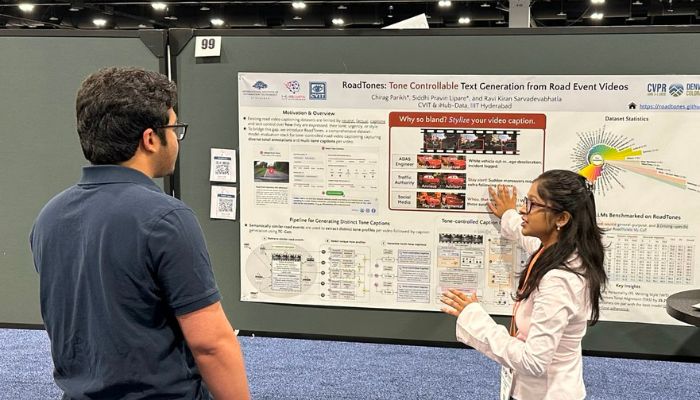
“Communication isn’t just about facts. It’s about framing them in context,” says Prof. Ravi Kiran, referring to AI-generated descriptions of road videos which are typically dry and mostly factual. In a Findings paper titled, “RoadTones :Tone Controllable Text Generation from Road Event Videos”, co-authored by the professor along with his PhD student Chirag Parikh and MS student Siddhi Lipare, the team proposes a system that teaches AI not just what happened in a road video but also how to describe it. For instance, a video of a car suddenly braking might be described plainly as ‘A vehicle brakes abruptly at an intersection’. But different audiences might need different wording. A social media post might describe it as: ‘Whoa! That car slammed on the brakes at the last second!’, an insurance report might say, ‘The vehicle performed an abrupt braking maneuver before entering the intersection’, a driver safety alert might go, ‘Warning: Sudden braking ahead. Reduce speed immediately’ and so on.’ “We created a dataset of 51,000 road video descriptions, and each video contains a multitude of captions written in different ways – formal, casual, etc across personality traits like professional, humorous, and so on. The AI can be told how exactly to write – short summary vs. detailed explanation, either from a first person point of view or as an external observer and more,” explains Siddhi.
Findings Paper: Unifying Scientific Communication
The Findings track saw another paper acceptance authored by MS by Research student Megha Mariam, Prof. Vineeth Balasubramanian and Prof. CV Jawahar. Titled, “Unifying Scientific Communication: Fine-Grained Correspondence Across Scientific Media”, the work brings together research papers, slides, conference presentations, and explanatory videos for the same scientific studies. “Scientists often explain their work in many different ways, such as research papers, presentation slides, conference talks, and explainer videos. While all of these describe the same research, they are usually not connected in a way that makes it easy to move between them or see how the same idea is presented in each format,” explains Megha. To solve this problem, the researchers created the Multimodal Conference Dataset (MCD), the first resource to combine research in various formats from the same studies. By testing leading AI models on this dataset, the team found that while current systems can often connect text and images, they still struggle to match detailed scientific concepts, particularly mathematical equations. The new benchmark is expected to support the development of AI tools that make scientific research easier to search, understand, and navigate across different formats.
Document Visual Question Answering
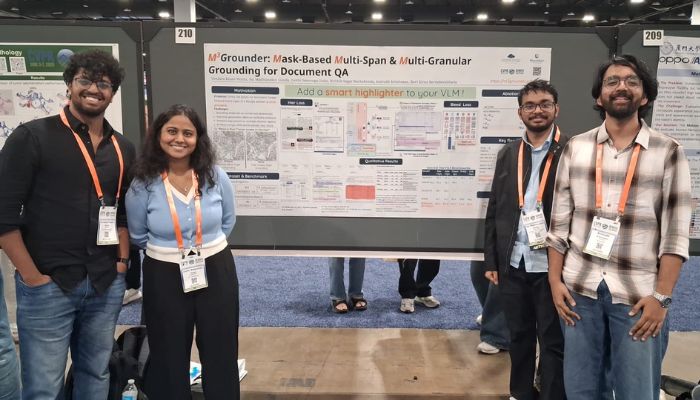
A team effort by Prof. Ravi Kiran and Venkata Kesav Venna, Sai Madhusudan Gunda, Jyothi Swaroopa Jinka, Hrithik Sagar and Anirudh Srinivasan from IIIT-H and the BharatGen group led to the paper titled, “M3Grounder: Mask-Based Multi-Span and Multi-Granular Grounding for Document QA”. It was accepted at three workshops – the DataMFM (Emerging Directions in Data for Multimodal Foundation Models), GRAIL-V (Grounding and Reasoning in AI with Language and Visuals), and MMFM5 (5th Workshop on What is Next in Multimodal Foundation Models?). “Most document AI systems today can answer questions from documents. But there’s a problem. They rarely show where the answer came from. And documents are messy. Additionally, text can be curved, scattered across regions, or embedded in charts, tables, and forms. Plus, sometimes the answer comes from multiple places on the page,” explains the professor. To solve this problem, they created a new document AI called M3Grounder that not only answers questions but also shows exactly where each part of the answer comes from using highly precise, pixel-level highlights instead of rough bounding boxes. Why does this matter? “The future of document AI isn’t just answering questions. Because in real-world domains – finance, healthcare, legal, enterprise workflows – answers alone aren’t enough. Trust comes from verifiable evidence,” says Prof. Ravi Kiran.
EgoVis Distinguished Paper Award
Alongside the main CVPR conference, the 3rd Joint Egocentric Vision (EgoVis) Workshop was held with the aim of addressing key research challenges in the field of egocentric vision. Egocentric devices such as wearable cameras, smart glasses, and AR/VR headsets are becoming increasingly capable of understanding their users through built-in cameras and sensors. Powered by advances in artificial intelligence, these devices can recognize actions, track eye and hand movements, and interpret a user’s surroundings, enabling new applications in healthcare, education, gaming, robotics, and assistive technology. Until recently, progress in this field was slowed by a lack of large, high-quality datasets. The release of public datasets such as HoloAssist, Ego4D, Ego-Exo4D, and EPIC-KITCHENS is helping researchers develop and evaluate AI systems that can better understand the world from a first-person perspective.
According to Prof. CV Jawahar who delivered a key note address at the EgoVis workshop, one of the key highlights of attending the CVPR conference was seeing the CVPR 2024 paper titled, “Ego-Exo4D: Understanding Skilled Human Activity from First- and Third-Person Perspectives” receive the EgoVis 2024-25 Distinguished Paper Award. The paper presented a large public dataset, Ego-Exo4D to help computers better understand how people perform real-world skills. It contains more than 1,200 hours of video of people doing activities like sports, music, dance, and bike repair. Each activity is recorded from two angles at the same time: a first-person view (like wearing a camera) and an outside view. The dataset also includes much more than video such as sound, eye movement tracking, 3D spatial data, body motion sensors, and detailed written descriptions, including expert feedback from coaches and teachers. Researchers are using this resource to test AI systems on tasks like recognizing actions, judging skill level, and understanding human movement in 3D. The entire dataset is freely available to support further research.
The Right Optics
Taken together, the set of papers presented by the IIIT-H at CVPR 2006 reflects a research program that has already been confidently engaging with some of the field’s most challenging problems, ranging from representation learning and recognition to explorations in vision under real-world constraints. Aside from the unique experiences of sitting through talks and seminars by some Vision GOATs, the conference also afforded an opportunity for the CVIT researchers – most of them undergrad or Masters students – to network at the prestigious event. Speaking about his student, Vaibhav Agrawal who has now enrolled into a PhD program at Max-Planck Saarbrucken, Germany, Prof. Ravi Kiran mentions, “Someone at the conference said that at any other place, he would be mid-way through PhD. This is a testament to the environment at IIIT-H’s Center for Visual Information Technology!”
Sarita Chebbi is a compulsive early riser. Devourer of all news. Kettlebell enthusiast. Nit-picker of the written word especially when it’s not her own.
Next post