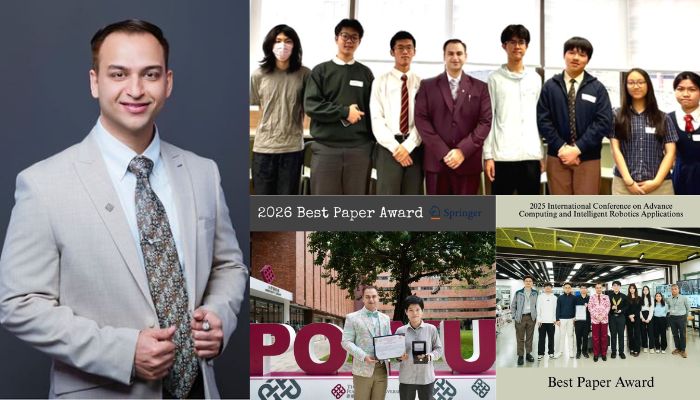
Dr. Mohammed Aquil Mirza’s 2026 Teaching Excellence Award in Hong Kong is the latest in a string of global honours for the young Dean & Professor at Liaoning Technical University and Senior Lecturer at The Hong Kong Polytechnic University. His career reflects a rare blend of teaching excellence, robotics entrepreneurship and cross-border academic leadership, with classrooms where AI, robotics and real-world innovation converge.
A true-blue Hyderabadi with Nizami-Mughal ancestry, Prof. Aquil Mirza credits his foundational roots and IIIT-Hyderabad’s network strength for shaping his global journey.
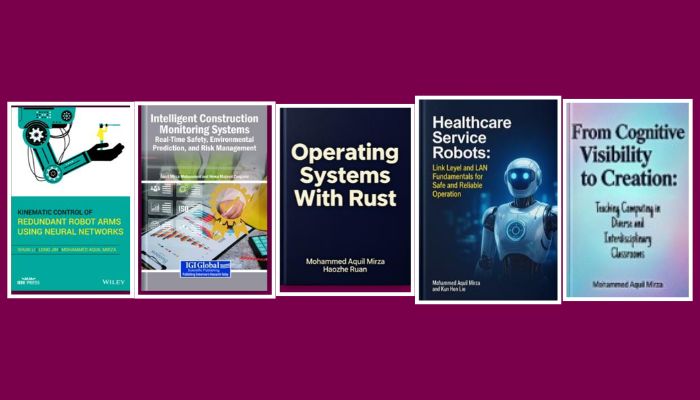
At a relatively young stage in his career, Prof. Mirza has built a portfolio spanning six books and monographs with IEEE Press/Wiley, Springer and IGI Global, research in leading IEEE Transactions, Neurocomputing and IEEE/Springer venues, a PCT filing and multiple patent-stage technologies in adaptive testing, lung nodule CT screening, medical triage, edge robotics and safety-verified service robots. Between 2025 and 2026, his research and student-led work won IEEE and Springer Best Paper recognitions across India, China and Finland, along with the Young Investigator Award at the World Congress of Sports in Hong Kong.

A Fellow of IES and IETE and Senior Member of IEEE, Prof. Mirza straddles academic, professional and industry ecosystems with unusual ease. He has been invited to deliver keynotes and lead international forums on AIoT, smart healthcare, smart construction and inclusive education, while mentoring projects that move beyond publication into prototypes, patents, startup funding and clinical or industrial validation.
His larger contribution is not confined to a single invention or classroom. It lies in building a repeatable model where students learn to identify real problems, assemble cross-disciplinary teams, and translate AI and robotics into deployable systems.
At PolyU, Prof. Mirza teaches large undergraduate cohorts in Operating Systems, Computer Networking, Programming Fundamentals and AIoT, earning consistently high student feedback scores of 4.6–4.8.
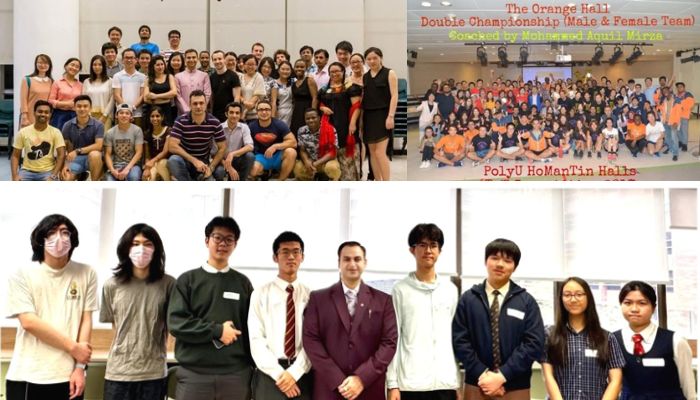
But what makes his story exceptional is not teaching alone; it is the way he turns teaching into an innovation pipeline. Alongside his academic journey, he co-founded a Hong Kong robotics company during his PhD tenure, working on robotic surgical machinery now undergoing experimental validation at Queen Elizabeth Hospital. Today, he also serves as Academic Secretary General at Turon University, Chief Technology Officer at Field of Dream Studio in the United States, and Director of Strategic Innovation at Sinovated Technology Limited in Hong Kong.
One student-led innovation making waves is PulmoSight, an AI-assisted medical screening project that uses vision-language models to support rapid lung nodule analysis and triage. Under his mentorship, PulmoSight won the Outstanding Grand Award at CTM Macau AI+Big Data 2026, while his student teams also secured the Gold Award and Overall Champion title at the Global Youth Innovation & Invention Competition, multiple PolyU Micro-Fund and FCMS Ideation awards, and Top-10 recognition among 200+ departmental projects. Across student ventures and innovation schemes, his teams have attracted over HK$1 million in startup and project support.
For Prof. Mirza, these wins are not merely trophies. They validate a teaching model where students move from coursework to prototypes, patents, funding and social impact. Whether the problem is medical triage, construction safety, autonomous service robots or adaptive testing, he pushes students to think like researchers, engineers and founders at the same time.
Unboxing a technical brain at IIIT Hyderabad
Prof. Mirza believes that when one finds the right teacher, the momentum of life changes. For him, that teacher was Prof. Garimella Ramamurthy of IIIT Hyderabad, who first sparked his joy of mathematics and scientific temper.
“After my tenth boards from St. George’s Boys Grammar School, I needed guidance on how to navigate mathematics,” he smiles. A family friend, IIIT-H Prof. Zafar Ali Khan, introduced him to Prof. Ramamurthy, who would become a mentor at critical junctures. Under his guidance, the youngster excelled in physics and mathematics in classes 11 and 12 and was encouraged to pursue engineering at Osmania University.
Later, as Prof. Mirza’s mentor during his MS by Research at IIIT-H in VLSI and Embedded Systems, Prof. Ramamurthy guided his work on sensor networks. Their research led to early publications and IEEE conference exposure in India, Jordan, Thailand and other venues, laying the foundation for his later work in underwater sensor networks, robotic control, embedded systems and AIoT-enabled systems.
“IIIT-H taught me that research is not a silo; it is a way of thinking across problems,” he says.
Atomic habits and a golden era
“When I look back, the conversations on self-improvement and the connections forged at IIIT-H were possibly the golden period of my life,” says Prof. Mirza. One of the deepest influences was Prof. P. J. Narayanan, whose advice on beginning each day with a small achievable goal, reviewing it at night and updating it for future action became a lifelong operating system.
“That habit pushed me to participate in every contest, not necessarily to win, but to gather ideas, applications and reviewers’ feedback,” he recalls. As an organising committee member for Felicity and international conferences, he interacted with leading Indian and international researchers, slowly transforming from a shy student into a confident academic connector. Encouraged by sports coach Kamalakar, he also tried rifle shooting, winning local competitions and qualifying for the nationals.
The IIIT-H years taught him to measure academic strength not by a single domain, but by the ability to move across domains with depth. That philosophy later shaped his work in translational computing pedagogy, real-time robotics with IoT and edge AI, operating systems with Rust, intelligent construction monitoring, healthcare technologies and patent-linked robotics.
Force multiplier assumes his superpower
The signs that Prof. Mirza would become a force multiplier were visible early. During his undergraduate years, a teacher challenged him to explain neural networks to his batchmates. Two days of preparation with Prof. Ramamurthy led to a lecture that became a defining moment.
“My style was to use simple examples and analogies,” he says. Soon, classmates began visiting his home every evening to clarify concepts. Many of them now hold senior positions in academia and industry.
His own academic journey became deliberately multidisciplinary. After IIIT-H, he completed a second master’s in electrical engineering and underwater communications at King Abdullah University of Science and Technology, followed by a PhD in Computing and autonomous robotics at The Hong Kong Polytechnic University. “My PhD supervisor and I co-founded a robotics company manufacturing robotic surgical machinery now undergoing experimental validation at Queen Elizabeth Hospital in Hong Kong,” says Prof. Mirza, who has remained deeply invested in creating a pipeline of robotic engineers with cross-disciplinary strengths.
More than fifty student projects under his guidance have translated into conference papers, book chapters, prototypes, competition entries, patent-linked technologies and student startup initiatives. He also runs robotics workshops for underprivileged students, with several participants moving into Hong Kong-based companies.
Paying it forward with intellectual capital
Prof. Mirza’s game plan was always to bring international exposure into Indian education systems that needed it. He hopes to continue building bridges between IIIT-H, Indian institutions and global innovation ecosystems in AI, robotics and healthcare technologies. After stints at IIT Delhi and BITS Pilani, he returned to India as an assistant professor at a JNTU-H affiliated institution, working on teaching, training, placements, online learning and innovation initiatives. Later, while negotiating internship protocols for overseas students at his robotics firm, he realised that deeper engagement with Hong Kong’s innovation ecosystem required him to return. He moved back in December 2021.
The secret to learning Mandarin in thirty days
The Liaoning role came with an unusual challenge: learn enough Mandarin in a month to function in a new academic environment. Prof. Mirza turned his apartment into a language lab, covering walls with sticky notes and insisting that colleagues and students speak to him only in Chinese. It became another experiment in accelerated learning.
Pioneer in crafting cross-disciplinary curricula
Today, his collaborations connect IIT Kharagpur, University of Oulu, Duhok Polytechnic University, New Taipei Municipal TuCheng Hospital, Sai Siddhartha Super Speciality Hospital and industry partners around the globe. Projects range from VLM-based cancer screening and robotic-assisted neurophysiological testing to berry-picking robots, construction safety intelligence and vision-language-action service robots. At Liaoning Technical University, he is also working with students on a US$3 million robotic hair-grooming systems project, part of his larger interest in the next generation of service robots.
His passion project remains cross-disciplinary curriculum design. Courses and learning models he helped shape have been assimilated into academic environments at BITS Pilani, PolyU and Liaoning Technical University. His forthcoming book, Operating Systems with Rust, is slated for introduction into PolyU’s curriculum in the next academic year.
Making time to watch the rain
The middle child of a Hyderabadi family, Prof. Mirza credits his father, a retired Unani scientist, and his mother, a PhD in psychology, for grounding him in hard work, community service and adaptability. Casual conversations with co-faculty and students, swimming, soccer, rowing and gym sessions help him reset.
“What I loved most about IIIT Hyderabad is how humble the Institute is, in spite of its top ranking,” muses Prof. Mirza. “That is what I tell my students. Be like water. Flow, adapt and keep building.”
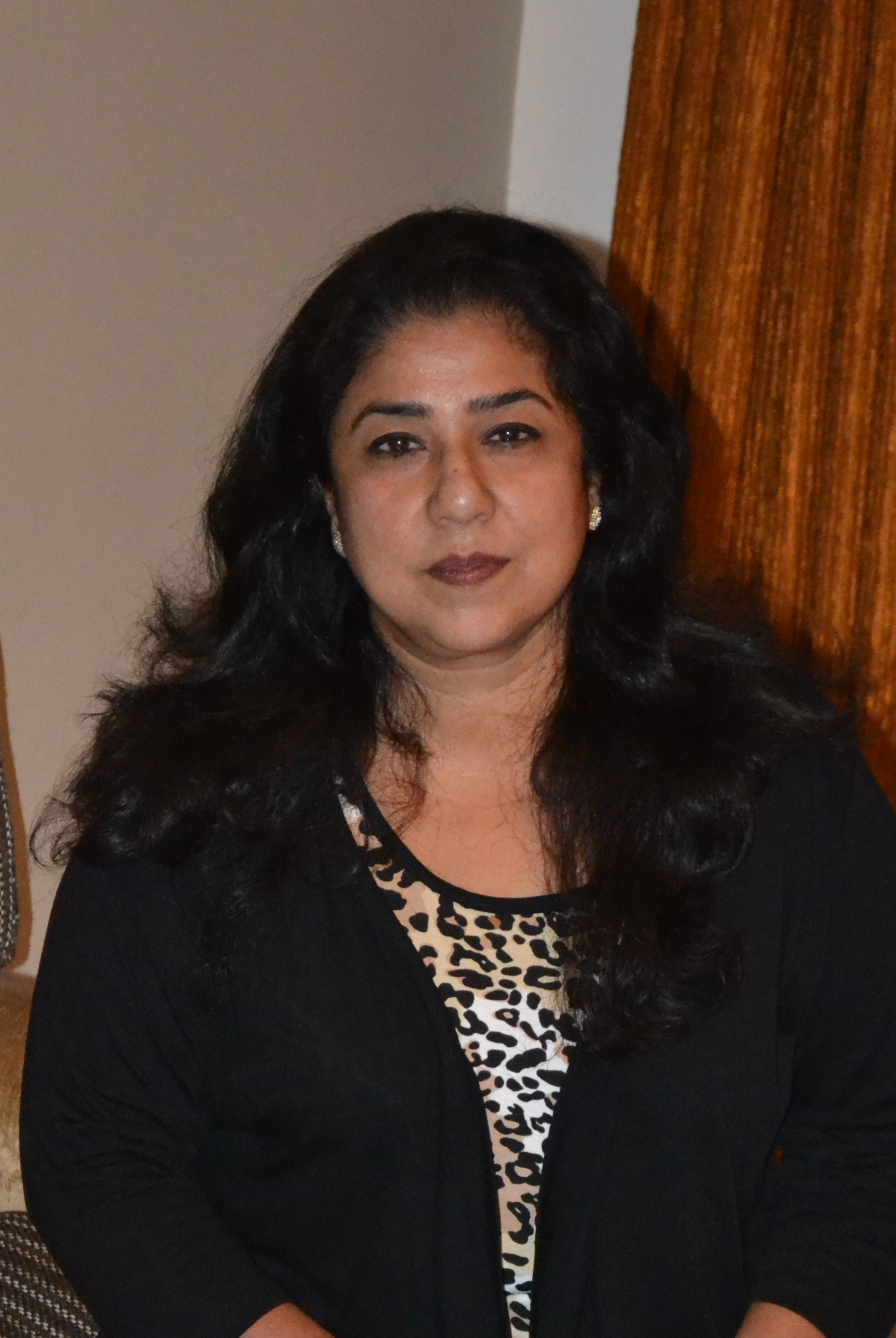
Deepa Shailendra is a freelance writer for interior design publications; an irreverent blogger, consultant editor and author of two coffee table books. A social entrepreneur who believes that we are the harbingers of the transformation and can bring the change to better our world.
Next post