
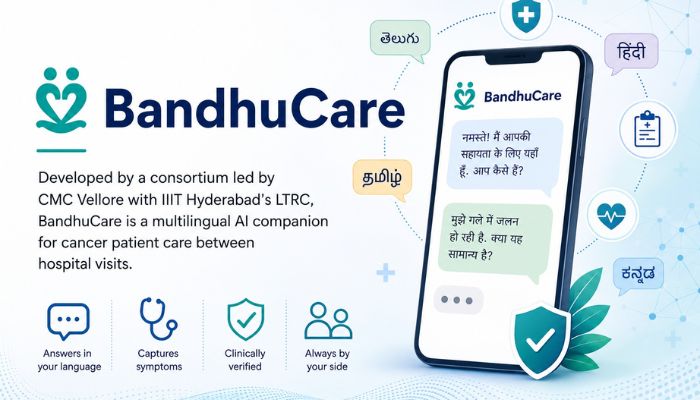
A multi-partner consortium led by Christian Medical College (CMC) Vellore, in collaboration with IIIT Hyderabad’s Language Technologies Research Centre (LTRC), is developing BandhuCare – a multilingual AI companion that answers patients’ queries in their own language, captures their symptoms through natural conversations, and helps clinicians understand what happens between hospital visits.
Is this side effect expected, or should I be worried? Can I eat normally again? Why is my throat still burning? Will my voice return? “These are questions that we hear every single day,” says Dr. Balu Krishna, Prof. and Head of Radiation and Oncology, Unit II at CMC, Vellore. But these are also questions that patients sometimes forget to ask, are too overwhelmed to ask or questions that can’t fit into a 10-minute consultation. While it is the reality of an overburdened healthcare system that leaves little room for prolonged conversations, the result is an invisible information gap – one that affects not just treatment, but the quality of life that follows. “There is an additional layer of a language barrier that exists with information modules existing only in English, which are again accessible only to a few, and this leads to unsafe care practices,” he says.
BandhuCare seeks to bridge this gap through a multi-lingual AI-powered patient engagement platform designed specifically for cancer care. Bandhu means companion. And that’s precisely what the team hopes the technology will become.
BandhuCare is the latest outcome of a long-standing partnership between Christian Medical College (CMC), Vellore and IIIT Hyderabad’s Language Technologies Research Centre (LTRC) – a collaboration that began not with AI chatbots, but with a much simpler problem of translating patient information and consent forms into Indian languages.
An Association That Has Evolved With Tech
The partnership began when CMC approached IIIT-H for help in translating patient information sheets and consent documents into Indian languages. For hospitals serving patients from across the country, communicating complex medical information in a patient’s own language had long been a challenge. At the same time, for researchers at LTRC, it was an opportunity to develop language technologies in a real-world setting. “We realised there was tremendous scope for language technology to make a difference in healthcare in India, a domain previously unexplored,” says Prof. Dipti Misra Sharma, who has been heading machine translation efforts at IIIT-H for decades.
The collaboration eventually grew into a formal MoU. While CMC provided domain expertise and anonymised medical data, IIIT-H developed machine translation technologies that could be refined using continuous feedback from clinicians. Over the years, that relationship has evolved alongside advances in language AI. “What started as machine translation with VaidyaDesk, an internal multilingual translation interface that allows hospitals to translate patient-facing documents, gradually expanded into multilingual patient communication, clinical decision support and conversational AI, laying the foundation for BandhuCare,” explains Prof. Sharma.
A Chatbot Rooted In Clinical Care
Unlike consumer AI assistants that answer virtually anything, BandhuCare emerged after years of working closely with oncology patients and understanding where healthcare delivery quietly breaks down, not during diagnosis or treatment, but between hospital visits.
Dr. Hannah Mary Thomas, scientist, researcher and lead for the QIRAIL (Quantitative Imaging Research and AI Lab) at CMC, specialising in Medical Imaging, Radiomics, and Clinical Data Science, who has spent two decades bringing emerging technologies into clinical practice, has witnessed this challenge firsthand. “My work has always been about adapting existing technology so that it becomes part of routine clinical care”. From introducing PET imaging into everyday diagnostics to building AI models for medical imaging, Dr. Thomas’ focus has remained the same: to translate innovation into something clinicians can actually use.
While Large Language Models are powerful, in the healthcare domain, confidence without correctness can be dangerous. BandhuCare tackles this problem using Retrieval-Augmented Generation (RAG). Rather than trawling through the internet, the AI answers questions only from information carefully curated and verified by clinicians. “Suppose a patient asks: “When will my voice come back?”, the answer comes not from generic online advice, but from hospital-approved clinical guidance specific to head and neck cancer patients undergoing radiation therapy. Plus, a second AI layer performs an additional safety check. Before any response reaches the patient, it verifies whether the answer genuinely comes from the approved medical knowledge base. If not, the system flags it instead of presenting potentially misleading information,” explains Dr. Thomas underscoring the safeguards in place in an era where AI hallucinations remain a significant concern. Prof. Dipti adds, ”The philosophy is simple: BandhuCare isn’t designed to diagnose diseases or recommend treatments. It exists to answer routine questions, explain symptoms patients commonly experience, and guide them back to their healthcare team whenever clinical intervention is needed.”
The Problem With Paper And Memory
Modern cancer care increasingly relies on Patient Reported Outcome Measures (PROMs) – structured questionnaires for general cancer, supplemented by disease-specific modules to capture the exact symptom burden, physical function, and emotional well-being. Questions range from general questions, such as, Do you need to stay in a bed or a chair during the day? Or have you had a lack of appetite?, to more disease-specific such as those for head and neck cancers that ask patients about symptoms such as pain, swallowing difficulty, fatigue or dryness of the mouth. Patients rate these experiences on a 4-point scale (Not at all, A little, Quite a bit, Very much) for the past week. The goal is simple: to understand how patients are actually doing between hospital visits. “The reality is much more complex,” says Dr. Thomas. Patients are often asked to recall symptoms over several weeks. “How was your pain during the last three weeks? But human memory isn’t built that way. A particularly painful episode from the previous day often overshadows everything else,” she says.
This phenomenon, known as recall bias, means clinicians may receive an incomplete picture of how treatment is progressing. BandhuCare replaces these rigid forms with something far more natural. Instead of ticking boxes, patients simply have a conversation. Rather than asking someone to rate pain on a numerical scale, the app asks questions the way another person would. Did you have pain today? Was it manageable, or was it very severe? Behind the scenes, the AI converts these conversational responses into the standard clinical scores doctors need. “Patients type or speak naturally. And doctors receive structured medical data. Both sides get exactly what they need,” explains Dr. Thomas.
Journaling Between Appointments
“Of course, not every concern fits into a questionnaire,” admits Dr. Balu, adding that some experiences may be deeply personal while others seem too minor to mention until they become serious. BandhuCare introduces journaling to capture these everyday experiences. Patients can note simple diary entries such as: Today I vomited three times. My mouth felt extremely dry. I couldn’t swallow properly. And these entries could even be in the form of voice notes. Over time, the app creates a summary of everything that happened between hospital visits. Instead of trying to remember weeks of symptoms during a brief consultation, patients arrive with a clear record. Clinicians, in turn, gain valuable context before the appointment even begins.
Consent – But Make It Meaningful
One of BandhuCare’s most innovative ideas circles back to one of the initial problems that the IIIT-H and CMC partnership began with. It concerns informed consent. In healthcare, patients often sign consent forms without fully understanding what they’re agreeing to. BandhuCare proposes an interactive Consent Agent. Instead of presenting dense legal documents, the system explains consent in simple language and checks comprehension before asking patients to proceed. It’s a small change with potentially profound implications for patient autonomy. “Consenting is often just a formality. We want to make it an active conversation,” notes Dr. Thomas.
Speaking the Same Tongue – Literally
Another problem that BandhuCare tackles is that of supporting India’s linguistic diversity. Most medical information sheets are written in English, filled with technical terminology that many patients neither read nor understand. The platform currently supports eight Indian languages, allowing patients to ask questions through text or voice in the language they are most comfortable with. Responses are delivered both as speech and as written text. This flexibility is especially important for head and neck cancer patients. “Radiation therapy often affects speech with some patients temporarily losing their voice,” explains Dr. Balu. Additionally, there are others who may not be comfortable typing. For them, caregivers can step in and interact with the app on the patient’s behalf. “We don’t want patients adapting to technology. We want technology adapting to patients,” affirms Dr. Thomas.
From Doctoral Research To a Startup
This multilingual capability is powered by HimangY (HIndustani Machini ANuvaad TechnologY), a consortium project for Indian language machine translation developed under the Government of India’s Bhashini programme. Among the technologies contributing to HimangY is Bhashaverse, the multilingual machine translation platform developed by IIIT-H researcher Vandan Mujadia during his PhD. His doctoral research focused on speech-to-speech machine translation for Indian languages, with the vision of enabling people speaking different languages to communicate seamlessly using AI. That work not only became part of the HimangY initiative but also laid the technological foundation for BandhuCare and later evolved into the startup Raven AI. Named after Reva, a monicker for the Narmada river, the startup was founded to take these language technologies into the real world, with BandhuCare becoming one of its first healthcare applications. “Just as a river flows and gives life to many, we want AI to reach and benefit millions of Indians, irrespective of their language,” says Mujadia, adding, “We always felt that research should go beyond papers and reach actual users. Productizing the technology gave us an opportunity to test it on real problems and create tangible impact.”
“BandhuCare is a real-world use case of that research,” continues Mujadia. “We use multilingual AI to translate between Indian languages and English, breaking language barriers in healthcare through both voice and text.” Today, Bhashaverse supports 36 Indian languages through both speech-to-text and text-to-text translation. “The chatbot and Bhashaverse perform complementary roles,” explains Mujadia. “The large language model understands the patient’s question and generates answers based only on verified healthcare information, while Bhashaverse allows patients to interact with the system in whichever Indian language they are most comfortable using.” When a patient asks a question in Telugu, Tamil, Hindi or another supported language, Bhashaverse translates it into English for the large language model, which retrieves a clinically validated response before the answer is translated back into the patient’s preferred language.
But the collaboration revealed something conventional evaluation metrics couldn’t. While the translations were accurate, they however just didn’t sound like how people actually speak. “Our models produced excellent Hindi, but it was textbook Hindi. Patients wanted their Hindi,” remarks Prof. Sharma. That insight has led the LTRC team to fine-tune HimangY further so responses sound conversational rather than overly formal – a critical last-mile challenge for multilingual healthcare AI.
Helping Docs Too
The platform isn’t designed only for patients. It also supports clinicians working under severe time constraints. Instead of reading lengthy notes, doctors receive concise summaries of patient journals along with automatically generated PROM scores. If most entries revolve around swallowing difficulties, they immediately know where to focus the consultation. If repeated questions concern nutrition, patients can be referred to dietitians. If conversations indicate emotional distress or concerns about body image, psychologists can be involved earlier. “We want to ensure that technology doesn’t replace the clinician but instead help make every minute count,” explains Dr. Thomas.
Multi-partner Consortium
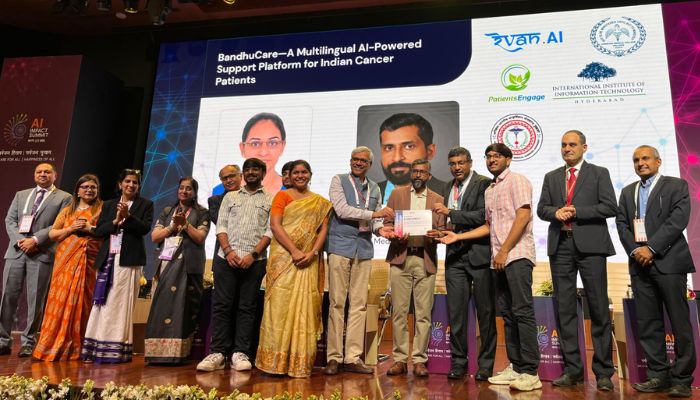
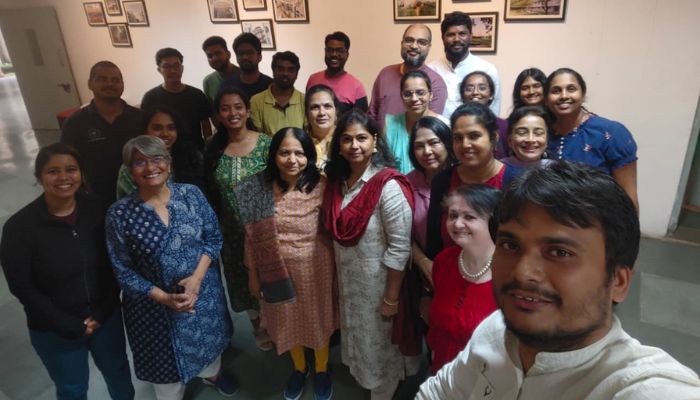
The consortium brings together clinical expertise from CMC Vellore, AI and language technologies from IIIT-H’s Language Technologies Research Centre, startup partner Revan AI, AIIMS Guwahati as an external clinical collaborator, and patient advocacy organisation, PatientsEngage that ensures patient voices remain central to development. It is an apt model of translational research where clinicians, language technologists, entrepreneurs and patients have shaped the platform together from the outset.
Real-World Impact
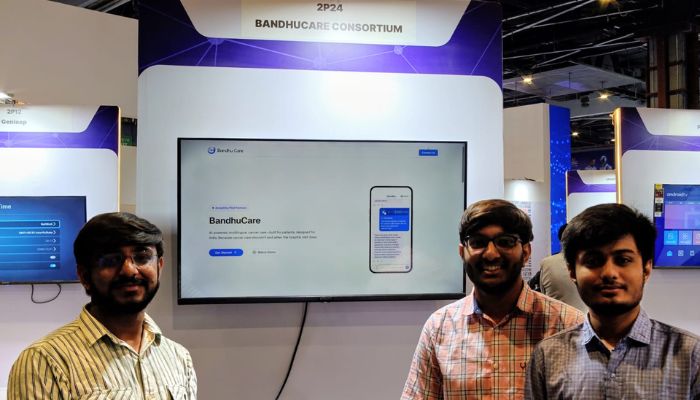
The project has already crossed an important milestone. Supported by the National Cancer Grid and MeitY’s India AI initiative, BandhuCare has reached Technology Readiness Level 5, with ethics approvals in place for clinical pilot studies involving patients.
The next phase, which is the pilot study on real cancer patients and specifically head and neck cancer patients, is perhaps the most important. At CMC Vellore, head and neck cancers constitute one of the largest cancer burdens, giving clinicians deep expertise and years of experience in understanding not just the disease, but the long-term challenges patients face after treatment. It was within this clinical setting that the need for a solution like BandhuCare first became impossible to ignore. Radiation therapy for head and neck cancers often leaves patients dealing with swallowing difficulties, persistent dry mouth, changes in speech, dental complications and even altered facial appearance. These side effects can linger long after treatment ends, affecting confidence, relationships and the simple pleasures of daily life. “We’ve realised that survivorship itself is an unaddressed problem,” says Dr. Thomas.
The clinical team wants to understand not just whether the technology works, but whether patients trust it, understand it, and genuinely find it helpful. Only then can it expand to other cancers – and eventually to chronic diseases such as diabetes, cardiovascular conditions and dialysis care.
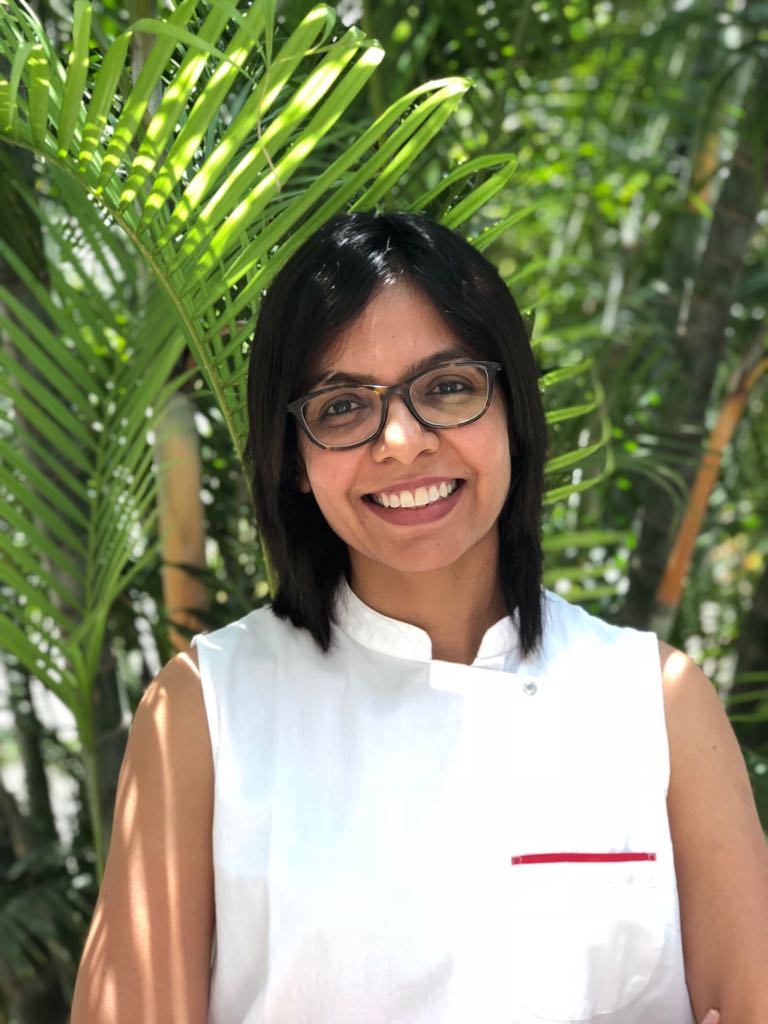
Sarita Chebbi is a compulsive early riser. Devourer of all news. Kettlebell enthusiast. Nit-picker of the written word especially when it’s not her own.
Next post