
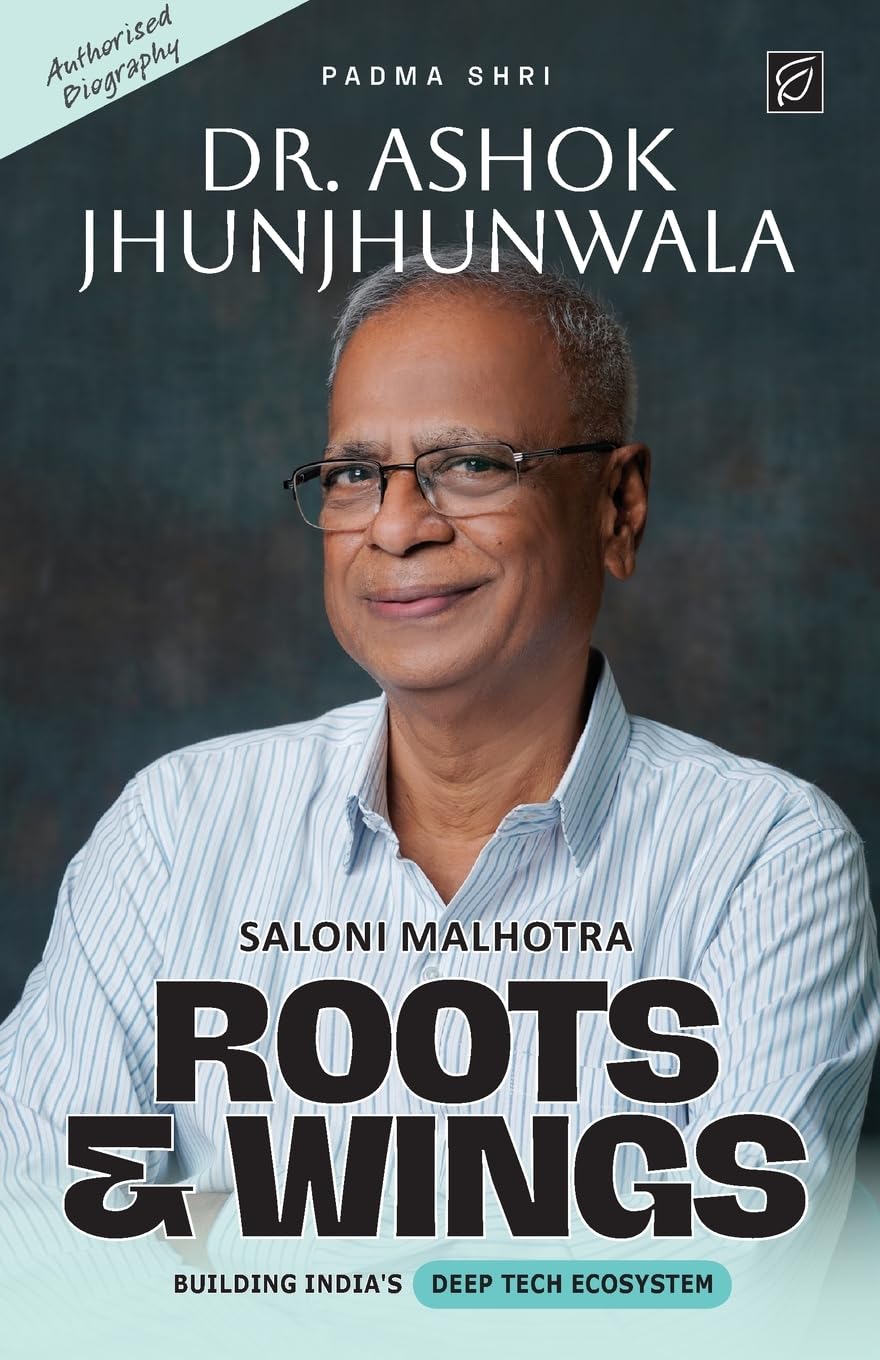
In this thoughtful review, Prof. Rajeev Sangal reflects on Prof Ashok Jhunjhunwala’s Roots and Wings — a compelling account of how research at IIT Madras evolved into technologies, startups, and institutions that shaped India’s innovation landscape. More than a biography, the book offers lessons in perseverance, nation-building, and the transformative power of purpose-driven academia.
Roots and Wings is a passionate story of building products and technologies by Ashok Jhunjhunwala and his team located in academia at IIT Madras. It takes you through a saga of challenges faced, and the extraordinary effort made by them so that these could move out to real-life through startups or established companies.
This was done in the face of odds stacked against them – indeed against any effort making India self-reliant at that time – because of prevailing mindsets, lack of support systems, decadent rules, all knowing ignorant bureaucrats, and even due to corrupt vested interests. The first three reasons have improved enormously, but the last two still exist and indeed have become more powerful than before. To guard against slipping back into similar problems within seemingly new societal systems, it is important to document and write histories of not so ancient times, namely, of the last few decades of Indian technologies.
The Promise of Indigenous Innovation
The technology story here begins in 1984 with Jhunjhunwala developing a real-life system for communication over power lines using a carrier device for a private company. A lab prototype, barely working, demonstrated the possibillity of indigenous technology. And it was enough to shift the dynamics of power and price for the company, while negotiating contracts with their foreign technology provider (ibid., p.90).
CorDECT: Innovation, Intrigue, and Resistance
The above lesson got repeated with the development of WiLL (Wireless in Local Loop) telecom technology by the group around 1995 (ibid., p.140), but this time the impact was national. The story of three brilliant professors – Ashok Jhunjhunwala, Bhaskar Ramamurthi, and Timothy A. Gonsalves – obsessed with work or should they be called possessed (ibid., p.143), along with their students. Equally important was the strategic alliance formed with Analog Devices India for sourcing of custom chips needed by them, without which the system would not be viable, and the forming of the startup Midas Technology. It led to the final development of the technology ready for the country. But along with it was the presence of all knowing ignorant bureaucrats, some of them perhaps corrupt; the stealing of their technology by a Chinese company, a well-known consumer name today (how one wishes that the name was revealed!). This part of the book reads like a spy thriller. It culminated in the meeting called by the telecom minister, with the bureaucrats of telecom ministry. The proposal to tax the CorDECT WiLL technology (ibid., p.157) came out. An Indian technology was to be taxed whereas the foreign technology was tax free! The proposal was so outrageous that it exposed the people with limited understanding and vested interests, and turned the tide. But it also goes to show the extent to which the bureaucracy can go.
Champions of a Technological Revolution
Also comes out the stellar role played by individuals: N. Vittal, a visionary bureaucrat; Prof. Indiresan, Director of IIT Madras; Sam Pitroda, the technology pioneer; Yashpal, Govind Swarup, MGK Menon, and APJ Abdul Kalam, scientists in high positions; and Jagmohan, the telecom minister. However, in spite of them, the technology was stalled in India for full 5 years. It was being installed in foreign countries, and making waves there, but denied entry in its own country.
This delay was enough for the foreign companies to develop the same or similar technology, and offered to India for deployment – with perhaps large kick-backs? Even though the battle of installation of indigenous technology was lost, the war was still won. India benefitted by tens of thousands of crores while negotiating with the foreign companies because the Indian technology was ready and available!
Purpose Before Profit
The mere indigenous possibility of an alternative technology, changes the dynamics of negotiation. Situation has changed since then. The foreign MNC companies are located here in the country, right next to Indian academia and startups, to take advantage of the Indian possibility and use it in their favour. This is so because most Indian companies are too slow or risk-averse to come forward, even today.
What kept the spirits up in the face of such trechery in their own country? The team of three professors at IIT Madras – like Amar, Akbar and Anthony – were driven by purpose. To build for the country, money was secondary. In fact, they decided not to take a paise out of the technologies they were building.
Their collaboration together was also unique, with loud discussions and debates regarding solutions when there were differences in the approach to be taken. They were united in values, however, driven as they were by a common purpose, mutual trust, and egoless action. IIT Madras provided the stability and research space (ibid., p.109).
Technology for the Rural Masses
What came next was the spawning of new technologies for the rural masses. It came in the form of N-Logue (ibid., p.178), a company incubated at IIT Madras, which developed among other things technology for rural kiosk in 2006. This offered technology which was a pre-cursor to the Common Service Centres by Govt. of India. Similarly, came Vortex the builder of low cost rural ATMs, which could operate in tough environmental conditions. They experimented with UPI like phone banking, tele-medicine, rural talent serving as back office, etc. However, not all enterprises succeeded, what with the low paying capacity and the lack of paying-mindset of Indian users. One wonders whether the above can be carried out today by roping in the social forces?
From Startups to an Innovation Ecosystem
How could the lessons of the above saga be taken to the next stage, for supporting their commercial success? Understanding and building technology is not enough; there should be a way to handle human failings, government limitations, low paying capacity, and market competition. This happens when “a visionary academic, a savvy industry practicioner, and a fearless entrepreneur” come together (ibid., p.188). This understanding led to the building of an entire eco-system in the form of IIT Madras Research Park (IITMRP) around 2008. Thus, all these lessons have been brought together in an eco-system, almost seamlessly, for today’s generation! A young person entering that eco-system would not even know what problems were faced just a decade or two ago. The book describes a large number of technology companies, and not just in electronics and computers, that too are being incubated at IITMRP. A new entrepreneur is asked tough questions, forced to think and rethink, challenged to innovate, build a prototype, test it in real conditions, but supported once mettle and persistence are proven.
Tackling the Grand Challenges of Tomorrow
Having setup IITMRP, a unique success, which has been copied across a large number of institutions, he does not seem to slow down even now. As Chairman of Immersive Technology and Entrepreneurship Labs (ITEL), a Section 8 company, he is grappling with the hardest problems of today. For example, how to go from one point to another in a city in just 20 minutes at an affordable cost – the city might even be Bengaluru or Mumbai. Or take some others problems: waterlogging, waste, air quality, soil degradation, climate change. The goal is to work out affordable solutions requiring one to think out of the box.
The Making of Ashok Jhunjhunwala
The question that comes up is what environment shapes the character of people like Jhunjhunwala. He mentions the social group at IIT Madras and PPST group in larger Chennai in early 1980s, that developed his thinking regarding India’s roots and its relation to the world. This is where he found his wife Bhavani, who continues to stand by him supporting him unflinchingly for all these years. Earlier, his exposure in US academia had given him a panoramic view of research and technology development.
His studies at IIT Kanpur as a B.Tech. student in early 1970s molded his character, where he learnt how to think about social problems, about fairness, about dialogue. And one applied what one had learnt to the rich but complex social surroundings there.
One’s basic character, of course, gets shaped in early years at home. From his paternal family in Kolkata, and in particular his grand uncle, he learnt industriousness and hard work. Living in the joint family, with close bonds with a large number of siblings and cousins, gave him firm roots and trust in others. His maternal grand father, who was a Gandhian and a freedom fighter, gave him a sense of purpose – the upliftment of the country and of the poor people living in this rich land as a result of colonization.
Roots, Wings, and Character
The formation of the basic qualities of character takes place at a young age, but then adolescence and later gives one the goals of one’s life. Jhunjhunwala learnt the importance of frugality and industriousness, while keeping high goals and purpose in life at the forefront. Frugality is sometimes confused with miserliness, but it is far from it. It is giving up on one’s consumption for the larger good. It is like giving up a smaller value (laghu mulya), for the larger value (guru mulya). It appears just normal to the person, and not like giving up at all!
Growing up in the right environment allows one to understand the society and relate it to one’s goals. Immersion in it shapes the young mind and forms one’s character to work with persistence, even in the face of difficult odds. It is like moving out of the nest to flying with wings.
A Message for Educators
This biography conveys an important message to the builders of educational institutions, as well. It tells the academic leaders and the faculty that students are to be molded as human beings with character, and the role of a teacher goes beyond the teaching of his/her narrow subject. Shaping their character means that they become strong and upright individuals, connected with family and society, and upholding values, irrespective of the role they take on in their later life.

Prof. Rajeev Sangal is the former Director of IIT(BHU) Varanasi (2013–18) and the first regular Director of IIIT Hyderabad (2002–13). His research spans Natural Language Processing, Machine Translation, and Artificial Intelligence over 40+ years, starting from faculty position at IIT Kanpur (1982-99).
Next post