
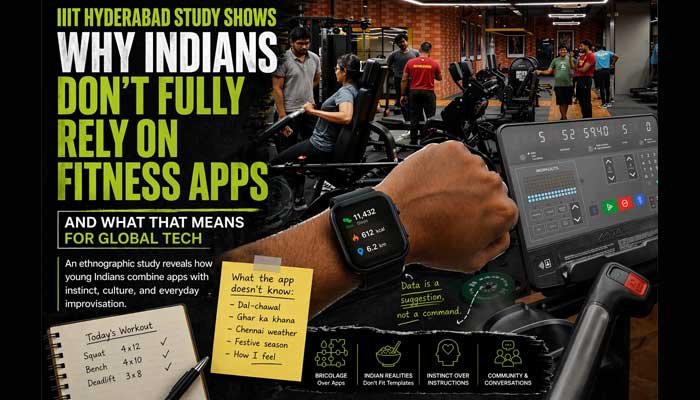
The study presented at the prestigious CHI Conference on Human Factors in Computing Systems reveals how young Indians are navigating fitness technology by mixing apps with instinct, culture, and everyday improvisation.
The fitness landscape in India has evolved over the last few decades and how. At first, there were the traditional akhadas and the vyayam shalas frequented by wrestlers. With a rise in lifestyle diseases, and a focus on preventive health, the traditional setting has since given way to the likes of crossfit boxes, specialised studios and smart gyms. And the fitness story does look familiar – smartwatches track steps, apps calculate calories, and gym-goers check their phones between sets. But beneath this digital sheen lies a quieter reality.
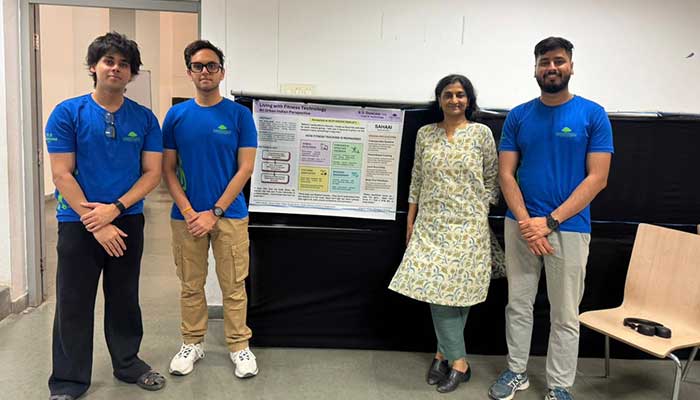
According to the ethnographic study titled, “Everyday HCI of Adaptive Fitness: The Bricolage of Self-Tracking in Urban India”, authored by Shivam Singh, Raagav Ramakrishnan and Chetan Mahipal under the guidance of Prof. Nimmi Rangaswamy, Indians are not simply following what their fitness apps tell them. Instead, they are constantly negotiating, adjusting, and even ignoring the data. “Fitness is not always tech-driven or quantitative. There is a lot of subjectivity in what makes you feel fit,” reasons Prof. Rangaswamy.

The ‘Jugaad’ of Fitness Tracking
One of the clearest insights from the research is how people build their own systems of tracking, often combining digital tools with everyday improvisation. In one instance, a gym-goer used a smartwatch only to track steps but relied on a handwritten notebook to log workouts. Another participant took progress photos instead of trusting calorie counts. Some used phone timers for sets, while discussing routines with fellow gym members to gauge improvement.
Rather than relying on a single app, people stitched together multiple methods, digital and manual. This approach echoes what the researchers describe through the idea of bricolage – a concept where individuals assemble available tools to create something meaningful. “They switch between apps, logbooks, photos, and conversations, whatever works in their context,” explains the professor.
When the App Doesn’t Know ‘Dal-Chawal’
Perhaps the most revealing moments in the study come from how users interpret and sometimes reject data. Participants repeatedly pointed out that fitness apps fail to understand Indian realities. One user questioned calorie counts by pointing out that the app didn’t account for their home-cooked meals. Another said the app couldn’t possibly understand the impact of humid weather in cities like Chennai. “It doesn’t know our diet… it doesn’t know the monsoon.”
This user interpretation offered vivid glimpses of how people make everyday decisions about fitness. On particularly humid days, participants said they would reduce workout intensity because “sweating itself felt like exercise.” During festival or wedding seasons, routines shifted dramatically, often without guilt. In some cases, participants admitted they didn’t track anything at all but still believed they were maintaining fitness through awareness and habit. “The data is in their heads, they are constantly interpreting it,” explains Prof. Rangaswamy.
The findings challenge the dominant belief that more data leads to better discipline. Instead, it reveals a deeply intuitive model of self-tracking. It means that users constantly override the app’s authority. If they feel they’ve worked harder, because of heat, food, or fatigue, they adjust their perception accordingly. Data, in this context, becomes a suggestion and not a command.
Cost Isn’t the Only Factor
While expensive tracking apps or paid features can be a limiting factor towards user adoption, the study finds that cost alone doesn’t explain such non-compliant behaviour. Even when users had access to affordable tools, they didn’t necessarily follow them strictly. Instead, usage was shaped by culture, convenience, and personal belief systems. For instance, participants often preferred flexible, low-cost solutions like basic timers or free tracking features, even when more sophisticated tools were available. “More access doesn’t mean more compliance,” muses Prof. Rangaswamy, stating that it instead leads to more diverse and cultural usage.
Global Apps But Local Lives
Most fitness apps are built in Western contexts, where users are expected to follow data precisely such as step counts, calorie targets, and workout plans. But the Indian context operates differently. Here, fitness is influenced by climate, food habits, social life, and even informal conversations at the gym. The study highlights how these factors often clash with rigid app designs. The implication is clear: technologies designed for one cultural context cannot simply be transplanted into another.
Beyond the Tyranny of Numbers
At its heart, this study is about more than just fitness apps. It is about how people live with technology. “In Indian gyms, data is not blindly obeyed, it is debated, adapted, and sometimes ignored. Users bring their own knowledge, instincts, and cultural frameworks into the equation. As global tech companies look to India as a key market, they may need to accept a simple truth that technology does not shape people as much as people reshape technology,” concludes Prof. Rangaswamy, underscoring that when it comes to fitness, the most important metric may not be what the app says but what the user believes.

Sarita Chebbi is a compulsive early riser. Devourer of all news. Kettlebell enthusiast. Nit-picker of the written word especially when it’s not her own.
Next post