Accidents in high-risk industrial environments are an occupational hazard but what is disconcerting is that they often go unnoticed. A new wearable safety system developed by IIITH’s Centre for VLSI and Embedded Systems Technology aims to change that.
In sprawling industrial landscapes like thermal power plants, oil refineries, construction sites, danger is often part of the job. Thousands of workers move through complex, high-risk environments every day, equipped with helmets, gloves, boots, and harnesses. But when something goes wrong, those protections can only go so far.
What happens when no one sees the accident? That’s the problem Prof. Abhishek Srivastava and his team have set out to solve.
The Invisible Gap in Worker Safety
Industrial accidents are more common than most people realize and more critically, they’re not always immediately reported. In many cases, help arrives late not because it isn’t available, but because no one knows something has gone wrong. In environments where workers are dispersed across vast facilities, relying on manual reporting can cost precious time – time that could mean the difference between life and death.
A Wearable That Speaks for the Worker
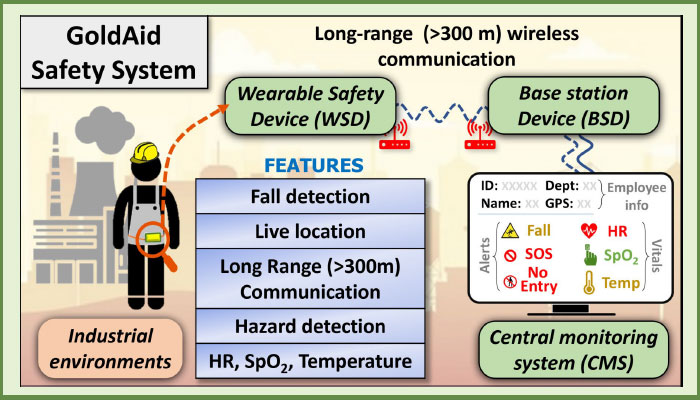
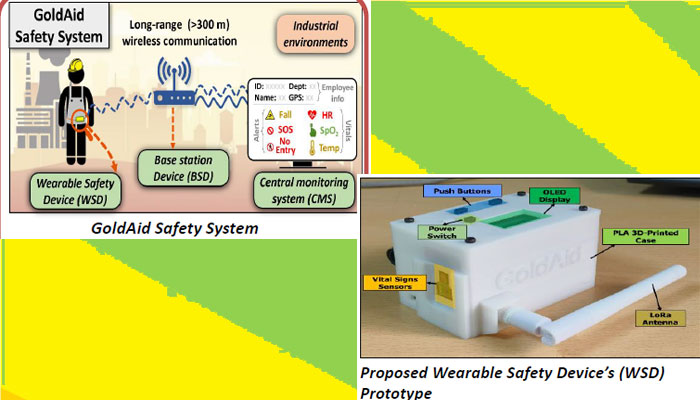
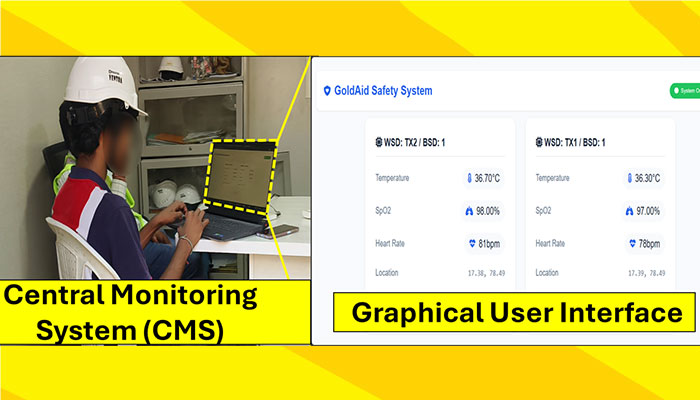
The IIIT-H innovation centers around a simple idea: automatic flagging of an adverse incident. The team has developed a wearable safety device, currently designed as a compact belt-mounted unit. Paired with a base station and a central monitoring system, it creates a continuous communication loop between workers and supervisors. Location monitoring of the workers, hazardous gas detection, detection of falls, monitoring of vitals are among some of its current features. If an accident occurs, say, a fall from a height, the device automatically sends an alert to the base station within seconds. “The base station in turn is connected to a central monitoring station where there is continuous monitoring of each worker on a displayed screen. Anything that goes wrong will lead to a beep/alert sound. In this way, timely medical help can be provided,” says Prof. Srivastava.
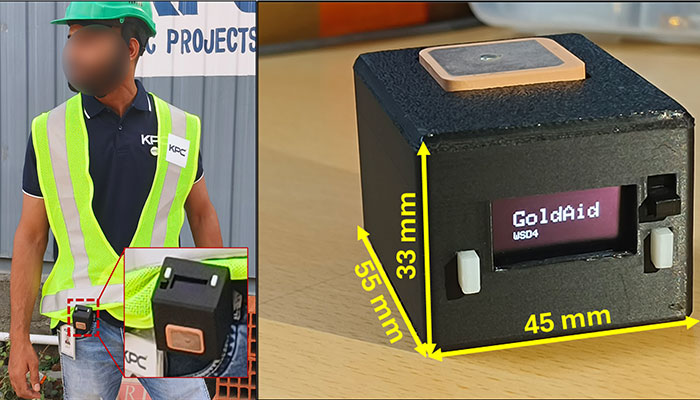
This immediate response taps into what’s often called the “golden hour”, the first 60 minutes after a serious injury, when prompt medical care can dramatically improve chances of survival. Hence the innovation has been termed as the GoldAid system.
Beyond Alerts: Tracking Health in Real Time
In addition to reacting to accidents, the system also actively monitors worker health. Built into the wearable are sensors that track key vital signs such as heart rate, body temperature, oxygen saturation, and even blood pressure. Before starting a task, workers can log their baseline health data, creating a reference point that can be monitored throughout their shift. If something seems off, for instance if a worker is unwell or is showing early signs of distress, intervention can happen before a risky job even begins. “This is a shift from reactive safety to something far more proactive: preventive care that is embedded directly into the workflow,” notes Prof. Srivastava.
Teaching Machines to Understand Falls
Using a combination of motion sensors such as accelerometers and gyroscopes, along with lightweight machine learning models, the device can interpret the nature of a fall. It distinguishes between everyday slips, like a stumble while walking or climbing stairs, and more dangerous incidents, such as a fall from a significant height.
“Our model can tell what type of fall has happened and even estimate the height,” says Prof. Srivastava, explaining how by setting intelligent thresholds, the system interprets falls differently depending on severity. A fall from above a certain height is flagged as critical, while lower-impact incidents are still recorded but treated with proportionate urgency. The models themselves are trained on a wide range of real-world movements from routine tasks like hammering to more abrupt motions, allowing them to achieve over 98 percent accuracy.
What makes this even more effective is where the processing happens. Instead of relying on cloud systems, all computations take place directly on the device, ensuring that alerts are generated instantly, without latency.
Built for Scale, Tested in the Real World
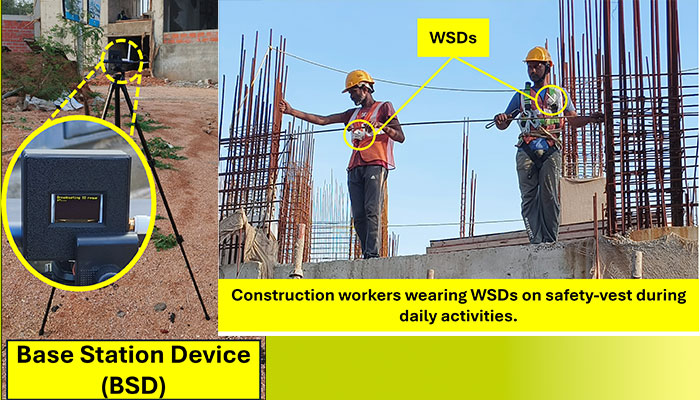
Designing a safety system for one worker is relatively straightforward. But scaling it to accommodate hundreds or even thousands introduces an entirely new set of challenges. The team had to rethink how devices communicate across large, complex environments, factoring in range, signal reliability, potential blind spots, and the optimal placement of base stations. The solution uses LoRa (Long Range) wireless communication, enabling stable data transmission across expansive industrial sites without excessive power consumption.
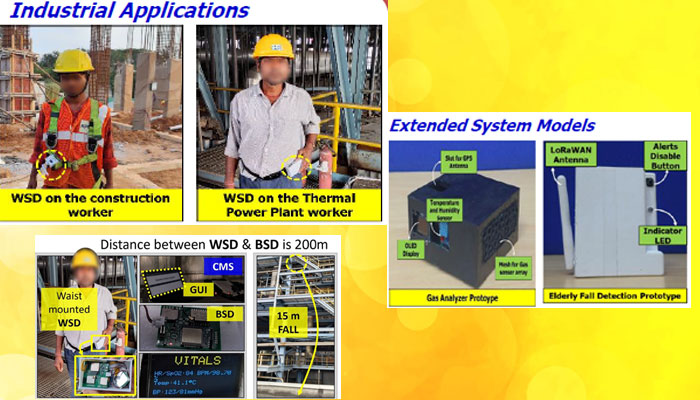
But this isn’t just a lab prototype. The system has already been tested in real-world conditions, including a major thermal power plant in Ramagundam as well as multiple construction sites in Hyderabad. In these environments, workers used the devices as part of their daily routines, allowing the team to observe how the system performs under real operational pressures.
From Lab to Life-Saving Product
Backed by India’s Department of Science and Technology (DST), the project has reached an advanced stage of development, bringing it close to real-world deployment. Along the way, it has resulted in multiple research publications, patents, and strong recognition during project evaluations. The next step is productization. “We want to refine the system into a deployable solution that industries can adopt at scale,” states Prof. Srivastava.
A Future Where Help Is Instant
Perhaps the most powerful feature of the system is also the simplest: an SOS button. In situations where a worker is conscious but in distress, a single press can send an immediate alert to the central monitoring station, ensuring that help is dispatched without delay. At the same time, the monitoring system continuously displays data from all workers, triggering alerts and audible signals whenever something goes wrong.
First Response That Doesn’t Wait
In industries where danger is unavoidable, this wearable system represents a quiet but powerful shift from safety that depends on human reporting to safety that is built into the environment itself. By combining hardware, software, and intelligent design, it ensures that when something goes wrong, the response is not delayed by distance, silence, or chance. The most important question isn’t whether accidents can be prevented entirely, but whether, when they happen, someone knows right away. And now, they will.

Sarita Chebbi is a compulsive early riser. Devourer of all news. Kettlebell enthusiast. Nit-picker of the written word especially when it’s not her own.
Next post