
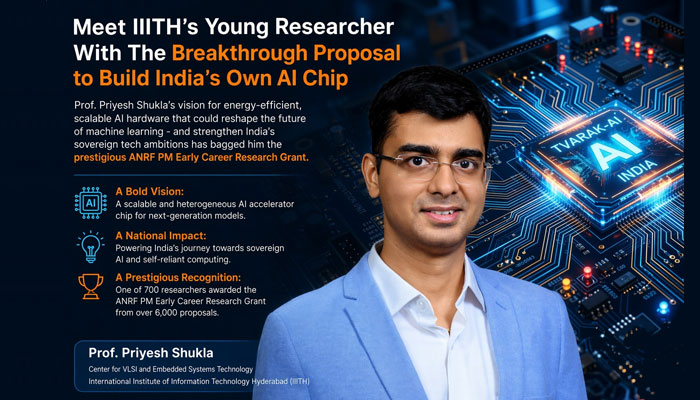
Prof. Priyesh Shukla’s vision for energy-efficient, scalable AI hardware that could reshape the future of machine learning – and strengthen India’s sovereign tech ambitions has bagged him the prestigious ANRF PM Early Career Research Grant.
With the establishment of Anusandhan Research Foundation (ANRF) via an Act of Parliament in 2023, the research landscape in India has seen a significant impetus. Recognising that early career researchers are committed to produce research of the highest quality, bringing in new skills, breakthrough ideas and the zest to explore new frontiers, ANRF considers its responsibility to empower and support the early career researchers in their pursuit of research excellence, providing them an enabling environment to effectively conduct research with ease and flexibility with a generous grant of around 60 lakhs over 3 years.
From over 6,000 research proposals that were received, the ANRF recently announced its decision to award the PM Early Career Research Grant to 700 young researchers across 14 disciplines. Prof. Priyesh Shukla from IIITH’s Center for VLSI and Embedded Systems Technology won the grant for his proposal titled, “TVARAK-AI©: A Scalable and Heterogeneous Accelerator Chip for Sustainable Inference of Next-Generation AI Models”. “Tvarak is a Sanskrit word that means ‘to accelerate’, so in effect it’s a scalable and heterogeneous accelerated chip that we want to build for next generation AI models,” explains Prof. Shukla.
Project Decoded
Artificial Intelligence is everywhere, from recommendation systems to medical diagnostics, but behind this explosive growth lies a quiet crisis. Modern AI models are becoming too powerful for the systems that run them. “Current machine learning models demand extremely high memory, bandwidth and compute intensity. GPUs are very costly, power hungry, and not well optimized for all three needs,” notes the professor. He goes on to add that as models grow more complex, simply scaling existing infrastructure is no longer a viable solution. “The question is not just how to build smarter AI, but more so how to run it efficiently.”

The idea behind the award winning project proposal is deceptively simple: build hardware that can handle both massive computation and high memory bandwidth simultaneously. Unlike traditional GPUs, that are more generic and power consuming, Prof. Shukla’s proposed chip is purpose-built for AI workloads, making it faster, more efficient, and far more sustainable.
Building An Entire AI Ecosystem
Designing an AI chip isn’t just about hardware. It’s about everything that connects to it. From software to compilers, from machine learning models to the physics of electron movement, every layer across the stack must work in sync. The project envisions building not just a chip, but an integrated ecosystem, including a machine learning compiler, a software toolchain and optimized model deployment frameworks, all working together to ensure seamless and efficient AI execution.
The Spark Behind The Research
Every ambitious idea has a moment where it first takes shape. For this project, that moment came not in a lab but in a lecture hall. Back in 2017–18, while working at Qualcomm in Bengaluru and contemplating the next step in his academic journey, Prof. Shukla attended a talk by an MIT professor on domain-specific accelerators for AI/ML. It was a glimpse into a future where hardware wasn’t just supporting AI, but evolving alongside it. Instead of seeing AI as purely a software challenge, it revealed a deeper, more complex layer: the tight coupling between algorithms and the hardware they run on. “This gave me a very solid boost to pursue a PhD because of the very nature of the problem which is quite challenging.”
What followed was a deep dive into one of the hardest questions in modern computing: how to design systems that can keep up with the exploding demands of machine learning. Because AI isn’t just about accuracy anymore. Today’s models must juggle multiple, often competing demands of high performance, energy efficiency, low cost, robustness as well as scalability. Plus the catch is that improving one often worsens another. “These parameters are all stretching in different directions. There are massive trade-offs. How do you find the sweet spot?”
This trade-off between what is possible and what is practical became the driving force behind Prof. Shukla’s research. It eventually led to his doctoral work on in-memory computing based accelerator chips for edge AI, a field that reimagines how data is processed by bringing computation within the memory. The idea is to reduce energy consumption and latency by eliminating unnecessary data movement. But the journey didn’t end there. The current proposal builds on that foundation, scaling the idea from edge devices to next-generation AI systems, where the stakes and the challenges are far greater.
Significant Milestone
While winning the prestigious PMECRG is laudable in itself, it has greater implications not just for the researcher but for the larger eco-system too. The grant is part of a broader national push toward sovereign AI, building India’s own capabilities in critical technologies rather than relying on external ecosystems. “It aligns with India’s mission to develop sovereign computing infrastructure for machine learning,” observes Prof. Shukla. By backing projects like this, the ANRF is enabling indigenous hardware innovation, collaboration across academia, startups, and industry and long-term technological self-reliance. “India is already investing heavily in initiatives like the semiconductor mission, AI mission, and energy efficiency programmes. This proposal sits at the intersection of all three,” he says.
Building What Comes Next
As AI models continue to evolve, the systems that power them must evolve even faster. This project takes a bold step in that direction, rethinking AI from the ground up, starting with the chip itself. It is ambitious and extremely complex too. And it is exactly the kind of thinking needed to move from consuming AI to building it. With the support of the ANRF PM Early Career Research Grant, this idea now has momentum. And if successful, the TVARAK-AI© project won’t just accelerate machine learning models, it could help accelerate India’s journey towards a more self-reliant, sustainable, and sovereign AI future.

Sarita Chebbi is a compulsive early riser. Devourer of all news. Kettlebell enthusiast. Nit-picker of the written word especially when it’s not her own.
Next post