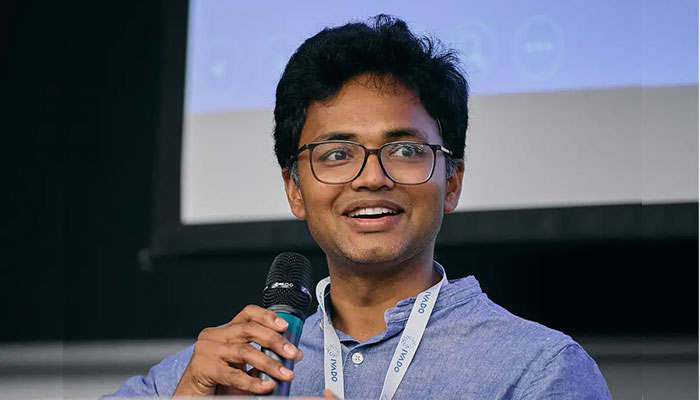
IIIT-Hyderabad alumnus Siva Reddy has built a career at the forefront of NLP research, from student at IIIT-H to professor at Mila, one of the world’s leading AI institutes. A recipient of the 2026 Sloan Research Fellowship, a distinction shared by many future Nobel and Turing laureates, he shares his journey and what drives him.
“I work on building better large language models (LLMs), from their architecture to their safety”, says Siva Reddy. What makes his story particularly compelling is its arc: born in Chintalapudi, a small town in Andhra Pradesh, forged in the rigours of IIIT-Hyderabad’s research labs, honed at Edinburgh and Stanford, and now shaping modern NLP at McGill and Mila. It is a journey shaped by intellectual freedom, curiosity and persistence.
Siva was an early awardee of the Google PhD Fellowship and the CS-Canada Outstanding Early Career Researcher Award 2025. His lab’s datasets and tools have been downloaded millions of times, his work has over 15,000 citations including from teams behind GPT-2, GPT-3, LLaMA and InstructGPT, and his students have gone on to PhDs at Stanford and MIT, research roles at Google DeepMind and Amazon, faculty positions at prestigious universities, and startups. Beyond his own research, Siva plays an active role in shaping Canada’s AI strategy, co-leading programs on LLM safety and autonomous agents, and serving the broader scientific community.
Roots
About his early childhood, Siva says, “My family runs a restaurant. They didn’t always understand what I was doing, but I am grateful they gave me the freedom to steer my own journey. As a high school student in the state syllabus, I remember spending summers with my grandfather in mango orchards, protecting them from monkeys and reading CBSE physics textbooks”.
IIIT Hyderabad sets the rhythm
“Back in the day, I wanted to join IIIT Hyderabad because I had heard about the great applicant pool and the faculty was getting praised. In my Andhra parents’ playbook, it ticked off all the right boxes, as a good engineering college with great placements”.
“My work in NLP started in IIIT-H and I have stayed true to my roots”, says Siva who credits the Institute with being the intellectual bedrock that shaped him. He learned NLP from Prof. Rajeev Sangal, and was shaped by courses across the department: C Programming with Prof. C.V. Jawahar, Information Retrieval with Prof. Vasudeva Varma, Databases with Prof. Kamal Karlapalem, Graphics with Prof. P. J. Narayanan, and Compilers with Prof. Govindarajulu. Starting with engineering projects with Prof. Sangal, he gradually moved into research on word meanings and senses, eventually fast-tracking from B. Tech to an MS in Computer Science.
A freelance gig and the best of times
“Working in LTRC was exciting because Prof. Sangal gave us freedom and flexibility”. Back in 2006-2007, Siva and his friend Abhilash Inumella were working on generating images from natural language as undergrads, well before modern AI made it possible. That was the kind of ambition Prof. Sangal encouraged, pushing students to do research early and publish at top conferences.
“A few of us were freelancing for Sketch Engine, a UK-based company, building corpora and corpus dashboards for clients like dictionary publishers. We got paid a princely sum of five pounds hourly. The first time I went to Western Union, I was handed a big bundle of cash and the feeling was unbelievable. Some of that money went towards my IIIT-H loan, I sent some home and had enough left over for biryanis, KFC and eating out with big batches of friends”, recalls Siva who enjoyed inter-house volleyball competitions and endless games of badminton in the space in front of the Old Boys’ hostel. “The great thing about IIIT-H was that they were hosting major conferences like IJCAI. We were also getting opportunities to travel, presenting at ACL 2010 in Sweden and doing internships in places like Czech Republic”.
Rooted in NLP all the way
Siva completed a second Masters at York University before moving to the University of Edinburgh, one of the world’s largest NLP research hubs, for his PhD. His research evolved from lexical semantics at IIIT-H to phrase-level semantics at York, sentence-level semantics at Edinburgh, and then to discourse-level question answering at Stanford, where he created CoQA, a widely used benchmark. BERT was released around this time, proving that deep learning was the way forward for NLP.
Rubbing shoulders with deep learning’s finest at Mila
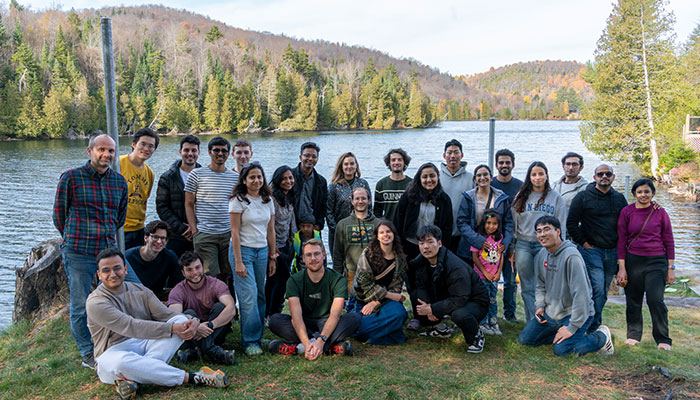
“BERT convinced me that deep learning was the future of NLP. If I wanted to be at the frontier, I needed to be where the best deep learning researchers were”, says Siva. In January 2020, he moved to Mila – Quebec Artificial Intelligence Institute. He is an assistant professor at McGill University in Computer Science and Linguistics, a core academic member at Mila, and a principal scientist at ServiceNow Research. Founded by Yoshua Bengio, considered the father of deep learning and modern neural networks, Mila is the largest academic AI research lab. Mila played a central role in the deep learning revolution. Theano, one of the first deep learning frameworks, was built here. It inspired a generation of tools including TensorFlow and PyTorch.
“Our work is very GPU hungry. Canada has figured out how to share GPUs across universities. At the Vaibhav Summit in 2020, I presented Canada’s shared national computing model, where universities pool GPU resources. India is also adopting a similar approach through the IndiaAI Mission, building shared national GPU infrastructure for universities and researchers”, says Siva. His major contributions have been in making language models more capable, more faithful, and Safer”.
“In 2020, when researchers were not even thinking about safety and language models, my group was among the first to highlight safety issues with these models. Our other contribution was on faithfulness and hallucination that we flagged even before ChatGPT was published”.
During the pandemic, Siva contributed to a Mila-led initiative to build Chloe, a chatbot that helped Quebec’s health agencies handle public queries about COVID-19. He co-organized workshops on LLM safety at McGill’s Bellairs Institute in Barbados (2024) and at the Simons Institute at UC Berkeley with Yoshua Bengio (2025), bringing together leading researchers from academia and industry, including from OpenAI and Anthropic.
In a field that moves at breakneck speed, Siva Reddy’s contributions have been foundational. The Sloan Research Fellowship, awarded annually to outstanding early-career researchers across the sciences, recognized Siva as one of its 2026 awardees. “Working alongside people who are pushing boundaries every day is what keeps me going. That is why it is so important to surround yourself with extremely talented people.”
Life beyond research
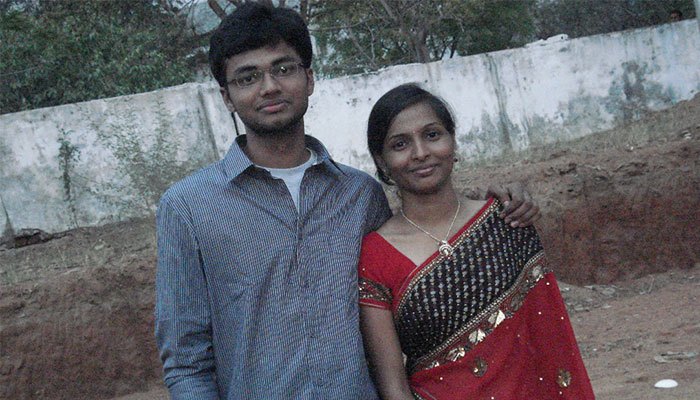
“The very best thing to come out of IIIT Hyderabad was meeting Spandana”, grins Siva. Their chemistry blossomed in their 4th year. In the course of their courtship, they wrapped up their Ph.Ds. from Edinburgh, overcame stiff family resistance and got married in 2014. Spandana is a research scientist at ServiceNow Research. They are parents to two young preschoolers aged 2.5 and 5 who keep them on their toes. Before children’s play and school schedules defined his leisure, Siva enjoyed badminton, gardening and carpentry projects. “Books keep me motivated, especially nonfiction and biographies on how creative people think. My day is time boxed”, says Siva. “Mornings are the most creative part, ploughing through the hardest chores on my To-Do list which was mostly writing stuff”.

A Claude code red
On a cautionary note, Siva says, “AI tools like Claude Code and OpenAI Codex are changing software engineering fundamentally. What used to take a team of engineers days now takes a single person a few hours. A large number of jobs in India are in IT, and students should not assume those jobs will be waiting for them. What will matter is understanding how things work at a deep level: math, machine learning, systems programming, hardware architectures, and how to decompose complex problems into manageable parts. Most importantly, good judgment about what problems are worth solving. A place like IIIT-H is well positioned for this because it emphasizes research in the undergraduate curriculum. My advice: take the hardest courses available, do research early, and surround yourself with people who challenge your thinking.”
Deepa Shailendra is a freelance writer for interior design publications; an irreverent blogger, consultant editor and author of two coffee table books. A social entrepreneur who believes that we are the harbingers of the transformation and can bring the change to better our world.
Next post