
Cracking competitive exams is not the only way to get a foothold in a prestigious Indian engineering college. IIITH’s intern-to-MS/PhD pathway lays emphasis on proven research mettle, trust built over time (between mentor and intern) and academic alignment.
November 21st 2025 is a date very close to Om Kathalkar’s heart. It was the day he successfully defended his thesis as an MS by Research student at the Signal Processing and Communication Research Centre (SPCRC) at IIITH. “Two international conference papers, two patents, two one-of-a-kind datasets, and two technologies have emerged from this thesis,” remarks Prof. Sachin Chaudhari, his advisor with heartfelt pride. Apart from Om’s valuable contributions to one of India’s most pressing challenges, that of scalable urban air quality monitoring, his work on the Pandora project – a multi-partner EU-funded research initiative – has earned him an on-site invite (to Greece) by Prof. Konstantinos Tserpes, Deputy Coordinator of the PANDORA project and key representative of the National Technical University of Athens.
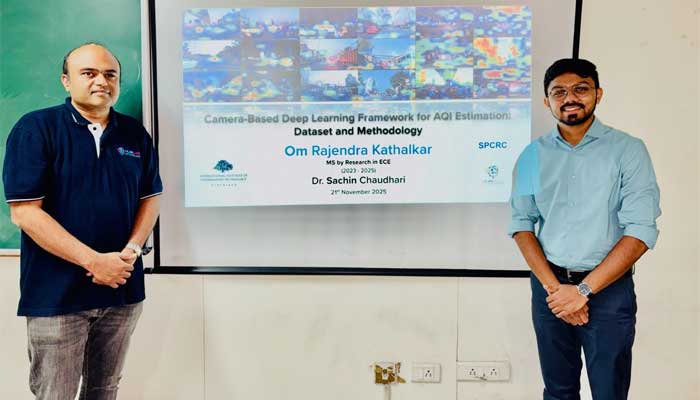
Om’s journey shows how resilience and opportunity shaped his success as a young researcher. After missing out on tier-1 engineering colleges due to severe health issues, he began his BTech in Nagpur. The Covid-19 disruption unexpectedly opened doors when he secured a remote internship at IIIT Hyderabad under Prof. Sachin Chaudhari. Once travel restrictions eased, Om balanced online classes during the day with hands-on research at the SPCRC lab by night. His dedication and initiative led to notable contributions across research papers, patents, and datasets. Recognizing his exceptional performance, Prof. Chaudhari encouraged him to transition into an MS by Research program at IIITH after completing his BTech.
Getting Hands-on Experience
In Tarun’s case, his final year BTech (which was incidentally in Mechatronics from Chennai) project led him to his first run-in with robotics in the form of an autonomous wheelchair leaving him sufficiently intrigued. Realizing he lacked sufficient experience to pursue a master’s abroad, he sought hands-on opportunities in India and discovered IIITH’s Robotics Research Center (RRC). Impressed by its hardware-rich environment and cutting-edge work, he emailed Prof. Madhav Krishna and was accepted into the wheelchair project team due to his prior exposure.
At RRC, Tarun found the ideal ecosystem to grow, saying he learned “80–90% of robotics” after joining. In a year’s time, with guidance from seniors and access to advanced tools, he expanded from hardware into full-system robotics, even implementing methods like ICP SLAM before formally studying them. “My main contribution on the smart wheelchair system has been in modularizing and scaling it using ROS and Docker,” he says. His work has led to one published paper and a patent filing for a compact LiDAR-based design. Though he approached RRC only seeking experience, the journey ultimately motivated him to transition into the PG program, where he has just completed his first semester.
Research-Oriented
As someone inclined towards research from the very start, it was a no-brainer that Aadith Warrier chose the thesis option during his final year at BITS Pilani in lieu of the industry internship. After some deliberate research and explorations of various colleges and labs, he shortlisted and applied to RRC at IIITH. Having tinkered with electronics since he was a child, Robotics was a foregone conclusion and he mentions signing up for “all the Robotics clubs that were there on campus at BITS”. The most innovative one of them all was the Criss Robotics – a Mars rover-making club where he was actively involved in designing and fabricating the mechanical aspects of Ingenuity or Ginny (the helicopter). Alongside this, he was working on research in computer vision. All this certainly came in handy when he got a chance to work on the ‘glass detection’ problem at RRC. “Robots are not really good at detecting transparent and reflective surfaces,” he says, “and this is essentially a problem that needs to be fixed or else they can crash into them.” After about 3 months in at RRC, he mentions that the path to an MS degree was straightforward with Prof. Madhav suggesting that he transition into a full-fledged post-graduate researcher.
From an Intern to RA to MS Student
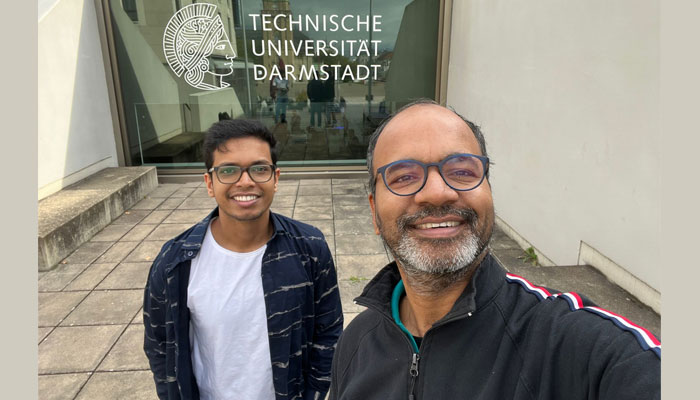
In another part of the world, at the Ubiquitous Knowledge Processing (UKP) Lab in TU, Darmstadt, Germany, as an ELLIS PhD student, Anmol Goel goes about pursuing his interest in the privacy and safety of large language models. “I believe IIITH has played a major part of where I am today,” he says with a smile. It was during his BTech in Delhi that he began collaborating with Prof. Ponnurangan Kumaraguru (PK) first as a research intern at the Precog Lab, and then later as a full time RA at IIITH. “As an intern, I worked on two projects: knowledge graphs and code mixing in NLP. This resulted in two papers: ICANN 2021 and a NAACL workshop 2021. As an RA, I worked on Indian legal documents, code-mixing and stackoverflow analysis. This resulted in three papers: two at ACL 2022, and one at IJCNN 2022,” he mentions. After around 6 months of being an RA, Prof. PK offered him an MS position at IIITH through the Standing Committee (SC) mode of admission. “The process was quite smooth and I was enrolled as a student from January 2022 onwards. I loved my journey from intern to RA to MS student and SC enabled this journey,” remarks Anmol.
From Intern To Formal Student
“IIIT has been nurturing this alternate admissions route for years. Unlike traditional admissions, which rely on rigid tests and formal panels, this pathway recognizes something more human – the relationship built between a mentor and an intern. If a faculty member has watched a student grow, seen their curiosity, their perseverance, their research instincts, and if they have the funding to support them, they can recommend the student directly into the research program,” observes Prof. Vinod PK, Chair of the Standing Committee that oversees admissions based on such recommendations. According to him, this system has proven effective, often bringing in students who thrive in a research-driven environment. “The Standing Committee provides a way of accessing students from good places (BITS, DIT, NSUT, NIT, Thapar Univ etc) who typically do not apply via PGEE – the Postgraduate Entrance Examination conducted by IIITH – but come to IIITH for research exposure or as Project Staff,” states Prof. Madhava Krishna.
“Such students are really no different from the others who come in via the usual route. It’s just that some of them may not be comfortable with the examination or interview process or may have missed out on the opportunity only because they were unable to answer the interview questions satisfactorily. Or there may be others making a return to academia after a stint in industry. Essentially this pathway is positioned such that anybody who is more keen on research and would like to explore MS or PhD in the future can approach us and seek internship opportunities,” says Prof. Vinod.
The Way It Works
Typically, research interns work for a minimum of three months under their choice of faculty before a recommendation is put forth to the Standing Committee for a transition into a post-graduate degree programme. “We look at the recommendations in conjunction with the resumes of the interns, as well as their performance at the labs. If a faculty makes a strong case in favour of a candidate, we approve most of the times because it is the responsibility of the faculty to nurture them and guide them in their research journey,” remarks Prof. Vinod, adding that it is not an easy task since it comes with extra work load. “There is a considerable amount of commitment from the faculty side too, not only with respect to time and effort but also with financially supporting the candidate.” Terming it as a parallel admissions process or a rolling one that takes place all through the year, Prof. Vinod states that such admissions are growing larger in number as compared to the standard admissions process. These interns also make significant contributions to a lot of ongoing projects.
Paving The Way For Fellowship Holders
In order to strengthen its pipeline of motivated research candidates, IIITH has been working on a series of structured outreach initiatives. “Research has always been at the forefront of IIITH’s education and we want to popularise this lesser known route,” explains Prof. Vinod. One other way of seeking research-oriented students has been to encourage candidates who hold or are eligible to receive fellowships from recognized national programs such as CSIR (Council of Scientific and Industrial Research), UGC, DBT (Department of Biotechnology), DST-INSPIRE (Innovation in Science Pursuit for Inspired Research) and so on. “Applicants with a valid GATE, COGJET, or equivalent national qualification, particularly those with high percentile scores, which make them eligible for institute or external research fellowships, are also encouraged to apply,” states Prof. Vinod.
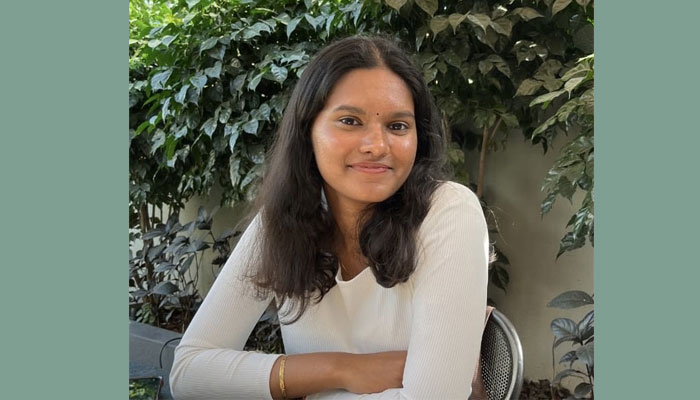
As a voracious learner on NTPEL – a free, e-learning initiative by top academic institutions offering a multitude of courses in engineering, sciences, management and humanities – earning ‘stars’ came easily for Sriharini Margapuri, a BTech student from Osmania University. Outstanding learners on the online platform are encouraged to spend time on research projects following a selection procedure with faculty of one of the participating institutes. It is formally known as a Predoctoral fellowship program and designed to foster a pathway for enthusiastic NPTEL learners towards advanced research opportunities. “I had already taken two of the courses that Prof. PK offered online on responsible and safe AI systems and on privacy and security of online social media. When I saw the list of projects he offered that students can register for as Predoc fellows, I was extremely interested and applied immediately,” she explains. The Predoc fellowship is designed to help researchers transition seamlessly into Masters or PhD programs under their faculty guides. In Sriharini’s case, a letter of recommendation from Prof. PK, a statement of purpose and a duly-filled in application form made the conversion possible.
Other Upcoming Plans
“We are in the process of enabling other modes of postgraduate admissions too,” says Prof. Vinod. These include encouraging applicants with demonstrable research experience such as those who have publications in reputable journals or conferences. “Students with strong academic and research credentials from reputed institutions such as IITs, IIITs, NITs, IISc, or other top 50 research institutes in the NIRF ranking and candidates with admission offers from top-ranked global universities for MS/PhD programs may also be considered,” he says.
This mode of admission also includes individuals from industry who have engaged in R&D projects, authored publications or patents, or demonstrated research-oriented problem-solving in their professional roles.
Interestingly enough, the institute has been actively involved in an outreach initiative known as the ‘College Research Affiliate Program’ where it partners with several local colleges to mentor students and faculty alike in upcoming areas of AI and other emerging technology by providing them opportunities for hands-on workshops, real-world projects, and skill development. The goal is to help build research capabilities and enhance students’ employability, all while providing them practical knowledge. A great many of such workshop participants go on to join IIITH as interns with a high percentage of these converting into formal post-graduate students of IIITH. Some of the immediate outreach activities planned include visiting select colleges, particularly known feeder institutions whose students have historically performed well at IIITH, to introduce them to ongoing research, highlight the benefits of pursuing graduate studies, and create awareness of the intern-to-MS/PhD pathway.
Contemplating Research? Look No Further
According to Prof. Krishna, the alternate PG admission route empowers both faculty and students by means of extending an initial research engagement to a more long term immersive engagement through the MS program enabling more tangible outcomes. “However,” he adds, “the caution is that the faculty should be discretionary in whom they admit. With empowerment comes lot of responsibility else it can shake the foundations of the Standing Committee mode of admission”.
Sriharini terms this route of securing admission into the Masters program “stress-free”. “It gives you the confidence boost that there’s a prof who’s really interested in you joining the program,” she adds. For Anmol, the research atmosphere on IIITH campus and in the lab put to rest any doubts he may have had about academia. “The productive discussions and projects made me confident in my own abilities to pursue research fulltime,” he says. “Some journeys change your destination, some journeys change you,” quotes Om referring to his own life-changing journey at IIITH.
Sarita Chebbi is a compulsive early riser. Devourer of all news. Kettlebell enthusiast. Nit-picker of the written word especially when it’s not her own.
Next post