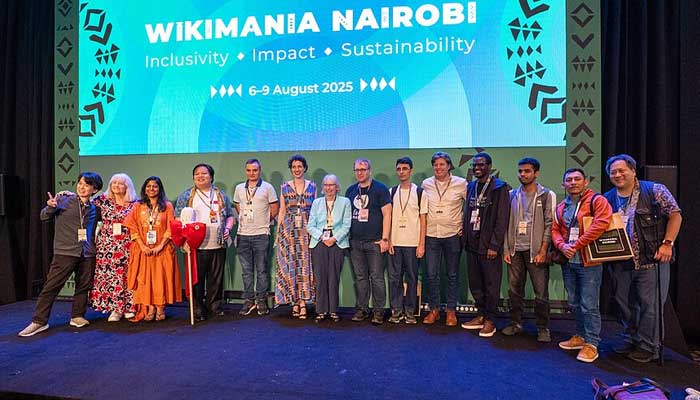
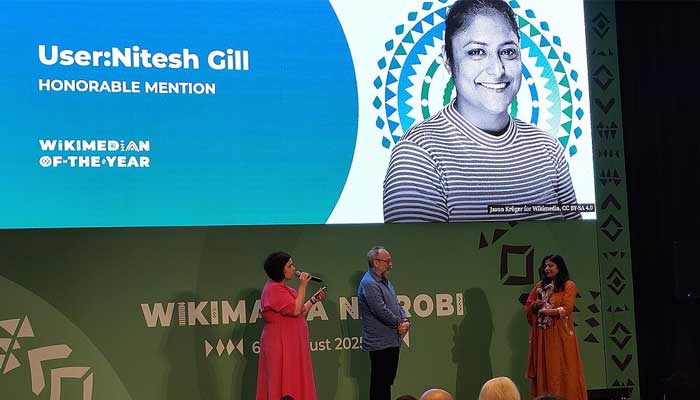
What started off as a mundane Wikipedia project for Nitesh Gill, snowballed into 500 straight days of content building and global recognition at the Wikimedian of the Year 2025 awards at Nairobi in August. The Program Officer’s personal achievement within Wikimedia and the larger free knowledge ecosystem also spotlighted the good work being done by the Open Knowledge Initiatives (OKI) team at RCTS.
Wikipedia has made knowledge accessible and easily comprehensible with its byte-sized information capsules. But what if I were to tell you that there is a global Wikimedia community of volunteer contributors drawn from different walks of life, working behind the scenes, donating their free time and energy to manage and grow the world’s largest knowledge resource.
Nitesh Gill’s Edit-a-thon that never ended
In 2017, what began as a whim with the #100Wikidays challenge, never stopped. Nitesh created a 500-day personal record, that carried on into career-defining work in building content. Her sustained contributions to Punjabi Wikimedia now boasts the most articles about women in that particular genre. She played a key role in organizing Wiki Women’s Camp 2023, champions the She Leads program in women’s leadership, and continues to inspire and guide Indian and South Asian Wikimedia communities by hosting South Asia-wide Wikimedia community calls.
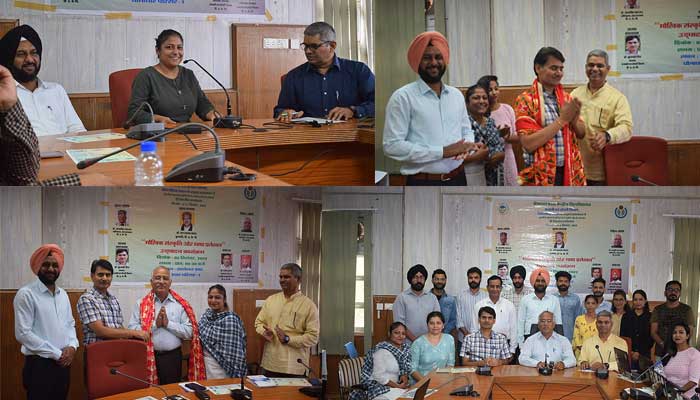
“Nitesh Gill has been doing a tremendous amount of work in the Punjabi domain for many years”, observes Prof. Vasudeva Varma, the OKI project head, whose association with the Wikimedia foundation began six years back.
RCTS – Wikimedia Foundation collab is the first of its kind
The OKI project started as Access to Knowledge (A2K) program at Center for Internet and Society, that later moved to the IIIT Hyderabad in May 2025. Thanks to its strategic integration with RCTS, the OKI movement will now leverage IIIT Hyderabad’s technological strengths to support Indic language communities and strengthen the digital commons ecosystem in India and abroad. From organizing national-level events to supporting technical contributions and strategic partnerships, A2K’s work has laid a strong foundation for a more robust movement across Indic languages. As the sole Institutional Indian partner of the Wikimedia foundation, IIIT Hyderabad has hosted three editions of the Wikimedia technology summit, and the fourth is in the pipeline.
Confluence of multi-disciplinary disciplines
With over 13 major OKI projects in the Indian setting, the Wikimedia Foundation – Raj Reddy Center for Technology and Society (RCTS) collaboration is working closely with the Language Technologies Research Centre (LTRC) and the Digital Humanities Group, to leverage the Centers’ strengths to foster language diversity. Through Wikipedia, Wikimedia Commons, Wikisource and Wikidata, and with strategic partnerships with Open Data communities like Free Software Movements, FOSS United and GLAM institutions (Galleries, Libraries, Archives, and Museums), the goal is to serve as memory institutions that augment the open knowledge and technology ecosystem across Indic languages and increase accessibility to the cultural richness and linguistic diversity of the Indian subcontinent.
OKI’s robust knowledge superstructure
LTRC head, Prof. Vasudeva Varma observes that their work covers three aspects – knowledge structure, creation of tech tools and collation of knowledge and consumption infrastructure for Indian languages and cultures. Public accessibility and knowledge infrastructure; building better technology, productivity tools, storage for communication, etc are the other pillars. While a company’s institutional knowledge is proprietorial, “Wikipedia is called the sum of all human knowledge. The path forward for OKI is the creation of Digital Public Goods that capture knowledge in the local language and make it accessible to everybody, across languages, cultures and regions”.
Elaborating on the project mission, Prof. Varma says, “Apart from mainstream domains in agriculture, legal, medical or healthcare systems, we are looking at grassroot level knowledge to be made accessible in a structured setting and broadened to include culture, festivals, and community mores. As part of our tech infrastructure, imagine machine translation between languages, where our tech tools are capturing knowledge at the local language level and creating documentation out of that; that is available in various Indian languages. .
At least twenty graduating students have built their thesis on Wikimedia technologies, with over three dozen research publications presented at major language conferences and at the WWW conference (Dubdubdub). With Tanveer Hasan , a central figure in this project, the twelve-member OKI team and student cohorts are working with the Maratha community, Kalamkari, Kolhapuri footwear, the Indigo dyeing communities etc; capturing their heritage, skills sets ,best practices and documenting knowledge which would otherwise be lost; by providing critical funding assistance or tech tools.
Nitesh Gill on the refreshing surprise and her work
When Nitesh woke up one morning to a call from a friend at the foundation, asking her to check her mail and then learning about the Honorable Mention as Wikimedian of the Year 2025; “That was a really great feeling”, smiles the enabler from Moga in Punjab. Her articles in Punjabi have covered a wide spectrum of categories like women personalities in politics, literature, business and entrepreneurship, cinema and noteworthy achievers and award winners. “Wikimedia has more than 15 Indian language communities and I have been actively working with Punjabi Wikipedia since 2015”, says the travel buff who has attended over ten national and international conferences in Berlin, Poland, and has visited Prague, Spain, Kenya, Singapore and Uruguay.
Nitesh is currently pursuing her Ph.D at Delhi University, an extension of her M.Phil (Punjab University) on the representation and transformation of prostitution in Punjabi fiction. The program officer works on supporting Indian communities and designing programs; and is currently creating an advanced train-the-trainer module for the Indian Wikimedia community.
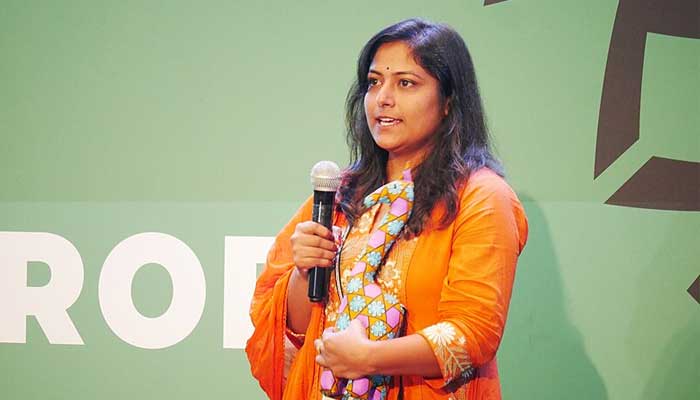
She recently co-founded She Leads, an initiative that promotes women speakers and creates a safe space for them to talk about their issues, challenges, initiatives, ideas and share findings. During the pandemic, Nitesh helped lead the Punjabi Wikimedians User Group, supporting new volunteers to lead while keeping the community networked with regular online meetings.
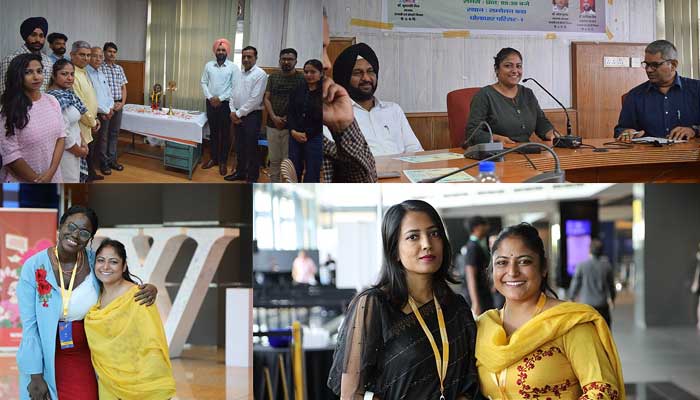
Thanks to her fluent vocabulary and quick typing skills, it takes her half an hour to finish a piece and, “I try to publish at least one article daily” she says, noting that these days they are assisted by content translation tools. Those interested in volunteering at Wikimedia can contact the OKI team at RCTS. New qualified volunteers are encouraged to edit existing articles to learn the writing structure, style and vocabulary, before they dive into contributing content.
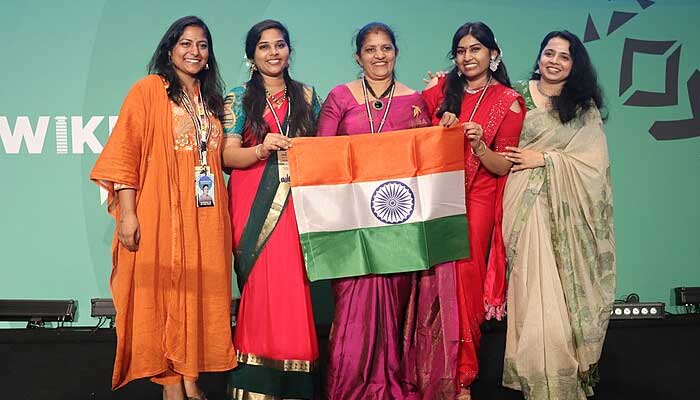
Experiencing a different realm at IIIT Hyderabad
“Prof. Vasudeva Varma, whom we met during onboarding is super cool,” comments Nitesh. “During our visits to the IIITH campus, while I still hesitate to interact with professors who have quite different experiences from us, I personally enjoy it since it forces me out of my comfort zone. There is one initiative, with Prof. Aniket Alam on Himalayan oral documentation. Right now, he is keen on introducing people to Wikimedia Commons and I am working on that. We want to expand our area of work to more collaborations and work with more groups. “
Prof. Vasudeva Varma notes that “Nitesh Gill ‘s journey is a great example of, not only great consistency over a long stretch of time and creating knowledge in rare or low resource languages, but also taking on a leadership position in a manner that has inspired others to do the same”.
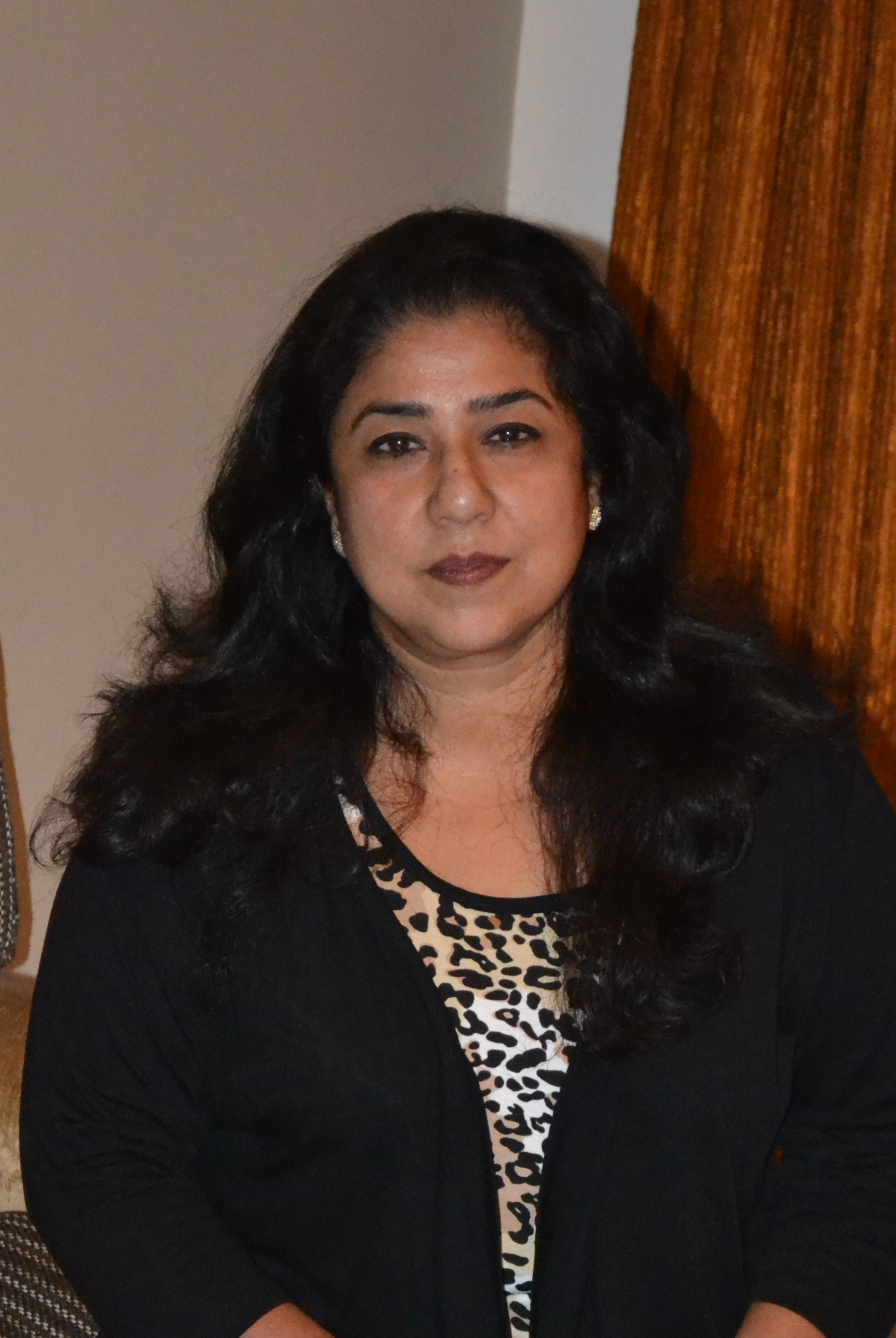
Deepa Shailendra is a freelance writer for interior design publications; an irreverent blogger, consultant editor and author of two coffee table books. A social entrepreneur who believes that we are the harbingers of the transformation and can bring the change to better our world.
Next post