
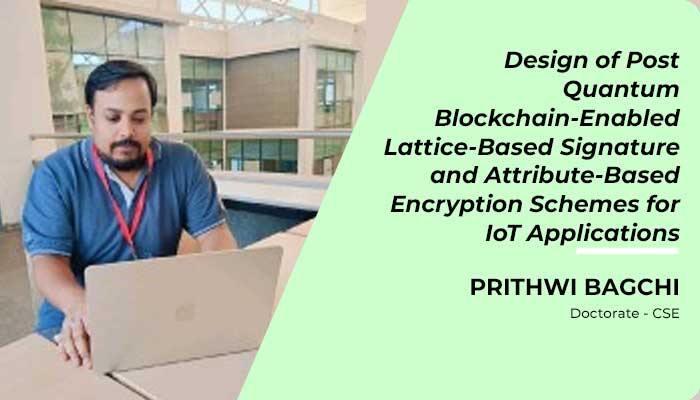
Prithwi Bagchi supervised by Prof. Ashok Kumar Das received his Doctorate in Computer Science and Engineering (CSE). Here’s a summary of his research work on Design of Post Quantum Blockchain-Enabled Lattice-Based Signature and Attribute-Based Encryption Schemes for IoT Applications:
With the rise of quantum computing, the traditional cryptographic techniques may face potential vulnerabilities, particularly in the security-critical applications, such as Internet of Things (IoT)-enabled blockchain systems. These systems rely heavily on the digital signatures for authentication, data integrity, and secure transactions. However, the quantum algorithms like Shor’s algorithm threaten conventional public-key based cryptographic schemes, such as RSA and elliptic curve cryptography (ECC) which make post-quantum cryptography (PQC) essential for future proof security. IoT devices often have constrained computational power and storage, and thus, it makes it challenging to integrate complex security protocols. Post-quantum signature schemes need to be designed which are resilient against quantum attacks, such as lattice reduction attack, hybrid classical-quantum attacks, side-channel and fault injection attacks, and brute-force attacks (e.g., searching for secret keys) using the quantum Grover’s Search algorithm in the context of lattice based signature schemes. Thus, these signature schemes should ensure the long-term security of IoT networks without significantly increasing computational overhead. Additionally, blockchain-based applications rely on immutable records, which become vulnerable if past transactions can be decrypted in the future. Moreover, post-quantum digital signatures mitigate this risk by providing quantum-safe authentication and verification, maintaining trust in blockchain networks. In addition, regulatory and compliance frameworks are evolving to address quantum security threats, necessitating the adoption of PQC in IoT-blockchain systems. Organizations deploying IoT solutions in critical sectors, such as healthcare, finance, and smart cities, must adopt quantum resistant cryptographic methods to ensure data privacy and system integrity. This thesis aims to design and develop blockchain-integrated lattice-based cryptographic schemes, including aggregate signatures, multi-signatures, and Ciphertext-Policy Attribute-Based Encryption (CP-ABE) in IoT environments, to improve security, efficiency, and scalability. These schemes are intended to address the specific challenges of IoT networks, where devices are often limited in resources and require lightweight but strong security measures. In the first contribution, we designed a new lattice-based aggregate signature scheme that relies on the complexity of the Ring Learning-with-Errors (Ring-LWE) lattice-based hard problem for security. This scheme is then applied within the Internet of Drones (IoD) systems using the blockchain technology to ensure secure and transparent data storage. In this scheme, we described the comprehensive security analysis and comparative study, which indicates that the proposed scheme offers enhanced security, including quantum resistance, is efficient. We implemented the testbed experiments and blockchain simulations further to confirm that the proposed scheme is viable for real-world drone applications. Next, by utilizing the widely-adopted lattice hardness assumptions, namely Ring-based short integer solutions (Ring-SIS) and Ring-LWE, we designed an efficient multi-signature scheme for blockchain-based IoT applications. Additionally, we incorporated the single round online phase in the signing algorithm to achieve a low round complexity. The blockchain has been used as an add on service for secure data storage purposes. In this case, each signer engages in pre-processing the offline phase before the single round online phase. In the offline phase, all the signers engage in interactions and exchange a set of commit messages among themselves. Subsequently, each party employs a random linear combination approach to aggregate all the commit messages and utilize them to generate the corresponding signature of the signer. Without the participation of all signers, a multi-signature cannot be generated, thereby making it impossible for an adversary to produce a fraudulent multi-signature without knowledge of all signers’ secret keys. The security analysis confirms that the scheme is capable of withstanding various attacks, including quantum attacks. A blockchain simulation was conducted to measure the computational time required for mining blocks in the blockchain. Moreover, a comparative study was presented, featuring several existing lattice based multi-signature schemes, to showcase the effectiveness of the proposed scheme in IoT applications. Finally, we designed a novel multi-authority CP-ABE scheme based on the lattice structure in a distributed environment for IoT-based smart healthcare applications. The work supports the implementation of the trapdoor generation to substantially reduce the computational overhead associated with the keygen phase and Gaussian Pre-image sampling techniques. The proposed scheme that has been developed regards the numerous authorities as synchronized servers. During the encryption phase, a linear secret sharing scheme was implemented, while the Lagrange interpolation is utilized in the decryption phase to facilitate the recovery of the plaintext. The security of the proposed scheme ensures that the scheme is secure against quantum attacks. We also discussed the implementation in the smart healthcare applications to guarantee the security and the confidentiality of the medical information. We utilized the Hyper ledger Sawtooh framework in the blockchain simulation. In addition, in order to evaluate the computational time needed for the various phases in our scheme, we designed a testbed experiment as well.
December 2025