
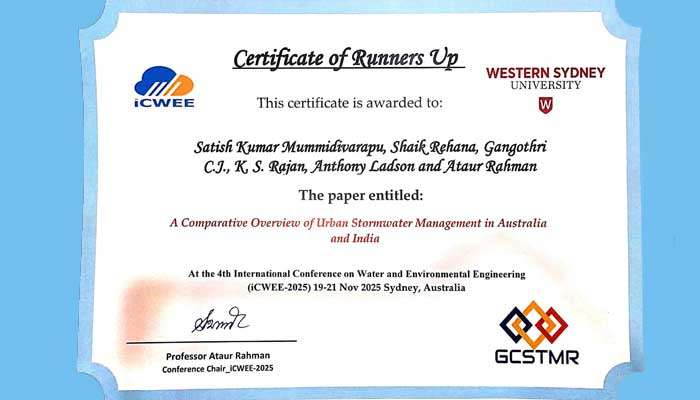
Dr. Shaik Rehana, along with her Ph.D scholars Satish Kumar Mummidivarapu and Gangotri C J, presented their research on Comparative Overview of Urban Stormwater Management in Australia and India at the 4th International Conference on Water and Environmental Engineering (iCWEE), held from 19 – 21 November 2025 at Western Sydney University, Australia. Their high-quality work earned the Best Paper Award (Runners-Up) at the conference.

Here is the summary of the paper as explained by the authors – Satish Kumar Mummidivarapu, Shaik Rehana, Gangotri C J, K S Rajan, Anthony Ladson and Ataur Rahman:
Water-sensitive urban design (WSUD) has emerged as a critical approach to sustainable urban development, integrating stormwater management into urban planning. Australia has a well-developed WSUD framework for stormwater management, while India relies more on conventional drainage. This study overviews key policies and challenges in implementing WSUD in India in relation to Australian experiences in WSUD. The current study reviews key Australian policies, including the National Water Initiative (NWI), Australian Rainfall & Runoff (ARR) Guidelines. It also reviews the Indian policies like the National Water Policy (NWP), Atal Mission for Rejuvenation and Urban Transformation (AMRUT 2.0), and WSUD and planning guidelines by the ‘Central for Science and Environment’ (CSE) to evaluate sustainable urban drainage and water-sensitive planning approaches. The comparison reveals differences in regulatory approaches and urban water management. Australia’s WSUD focuses on decentralised solutions and nature-based designs, while India relies on centralised systems and engineered infrastructure, such as underground drainage and reservoirs. The study highlights key challenges in India, including rapid urbanisation, insufficient enforcement of stormwater regulations, increased urban flooding, groundwater depletion, and inefficient rainwater harvesting integration, compared to Australia’s more well-developed stormwater and flood resilience measures. The findings of this study suggest that India can adopt elements of WSUD, adapting to its unique climatic, economic, and infrastructural constraints. The paper provides recommendations for policymakers to enhance India’s urban resilience, improve water security, and develop climate-responsive urban planning strategies based on WSUD best practices.
December 2025