
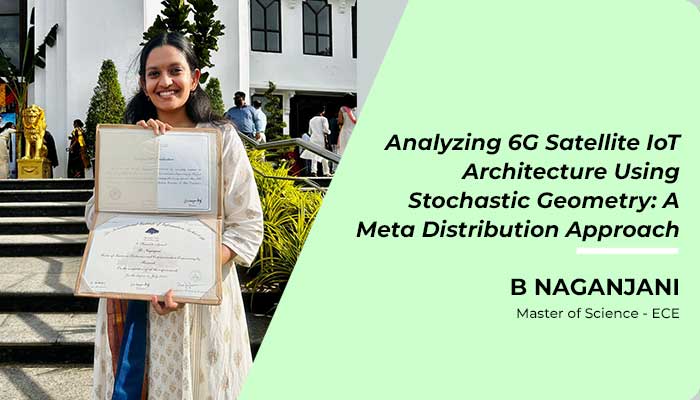
B Naganjani supervised by Dr. Sachin Chaudhari received her Master of Science in Electronics and Communication Engineering (ECE). Here’s a summary of her research work on Analyzing 6G Satellite IoT Architecture Using Stochastic Geometry: A Meta Distribution Approach:
The Internet of Things (IoT) has transformed how devices interact, enabling seamless data exchange. However, traditional terrestrial networks that rely on cellular towers, Wi-Fi, and LPWAN technologies can only reach areas with existing infrastructure. This limitation leaves vast rural, remote, and oceanic regions without reliable connectivity, restricting the full potential of IoT applications. To overcome this challenge, satellite-based IoT (Sat-IoT) has emerged as a promising solution, extending connectivity beyond the reach of ground-based networks. By leveraging Low Earth Orbit (LEO) satellite constellations, Sat-IoT enables direct communication between IoT devices and satellites, ensuring global coverage.
This thesis explores the performance of Sat-IoT networks using stochastic geometry, a mathematical framework that models the random placement of satellites and IoT devices in large-scale environments. The study focuses on coverage probability and meta-distribution, providing deeper insights into network reliability under different channel conditions. This thesis considers a direct-access LEO satellite-IoT architecture where IoT devices communicate directly with multiple satellites. The satellites selectively decode and forward the information with dedicated orthogonal resources, avoiding interference. Signals from each satellite are coherently combined at the GS using maximal ratio combining (MRC).The satellites are considered to be distributed at a fixed altitude around Earth following a Binomial point process. Derived generalized closed-form expressions for coverage and Meta-distribution (MD). The coverage and MD as a function of SNR threshold T, reliability threshold τ and the altitude rmin are analyzed. The results demonstrate the impact of mega-LEO constellations on coverage and reliability, guiding 6G architecture design to improve connectivity and data offloading in smart cities and dense urban environments and also highlights that the proposed architecture can achieve high coverage and reliability with 8-10 satellites at altitudes between 800 km and 1400 km, as seen in upcoming mega-LEO constellations like Star link and OneWeb.
July 2025