
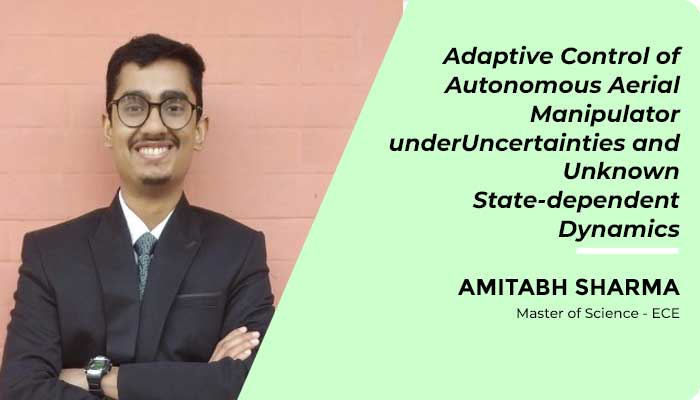
Amitabh Sharma supervised by Dr. Spandan Roy received his Master of Science in Electronics and Communication Engineering (ECE). Here’s a summary of his research work on Adaptive Control of Autonomous Aerial Manipulator under Uncertainties and Unknown State-dependent Dynamics:
Enabling effective grasping capabilities in unmanned aerial manipulators (UAMs) presents formidable challenges stemming from the intricate coupling forces that emerge between the fly- ing platform and manipulator arm, compounded by parametric uncertainties and environmental disturbances. Current methodologies predominantly fall into two categories: those demanding precise dynamic models of the entire system, and those addressing the aerial and manipulator subsystems as separate entities, both approaches facing substantial limitations when deployed in practical settings.
Despite substantial advancement in research on the topic of aerial manipulation, there is a lack of methods that properly address the effect of uncertain interaction forces between the manipulator interacting with the environment and the floating aerial base. These forces tend to be notoriously hard, if not impossible, to model due to uncertainties in payload characteristics and environmental interaction.
This thesis proposes a novel adaptive control architecture for an integrated solution for the UAM system combined with a bistable passive gripper to facilitate dependable aerial grasping operations without necessitating prior knowledge of system dynamics or disturbance characteristics. The bistable gripper employs a pre-stressed spring steel band that transitions between two stable states, autonomously initiating object capture upon contact and thereby minimizing alignment precision requirements. Its innovative cable-driven actuation mechanism, powered by a single compact DC motor, enables efficient gripper release without requiring bulky pneumatic components.
The developed adaptive control strategy effectively addresses the challenge of unmodeled coupling dynamics and state-dependent uncertainties inherent in aerial manipulation systems. The controller incorporates adaptation mechanisms that dynamically estimate composite uncertainties, encompassing variations in inertial parameters, Coriolis and centrifugal effects, gravitational influences, and external forces, maintaining reliable tracking performance despite the absence of precise system identification. A rigorous Lyapunov stability analysis demonstrates that the closed-loop system achieves uniform ultimate boundedness under practical operating conditions.
Extensive experimental evaluation using a quadrotor equipped with a two-link manipulator and the proposed gripper confirms the efficacy of the integrated approach during dynamic object acquisition tasks. Comparative assessment against contemporary adaptive sliding mode controllers shows substantial performance enhancements in positional, attitude, and arm angle tracking. The system demonstrates consistent grasping capability across multiple approach velocities, confirming its operational robustness and adaptability.
Through the synergistic combination of mechanical design innovation and advanced control techniques, this research establishes a framework for enhancing the reliability and versatility of aerial manipulation platforms operating in unstructured environments and executing complex interaction tasks. The integrated methodology resolves the conventional compromise between mechanical design sophistication and control system complexity, providing a holistic approach to the aerial manipulation challenge.
July 2025