
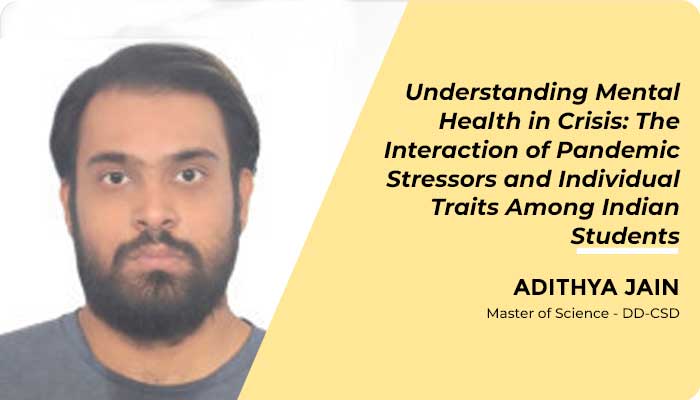
Adithya Jain supervised by Dr. Priyanka Srivastava received his Master of Science – Dual Degree in Computer Science and Engineering (CSD). Here’s a summary of his research work on Understanding Mental Health in Crisis: The Interaction of Pandemic Stressors and Individual Traits Among Indian Students:
Psychological well-being is a complex construct that is influenced by an interplay of individual traits and external stressors and circumstances. People manage stressors on an everyday basis based on their traits and behaviours. However, significant disruptive events can significantly amplify psychological strain. The COVID-19 pandemic was one such unprecedented disruption. The pandemic’s challenges turned daily life upside-down, with imposed lockdowns, job disruptions, and rampant infection rates. For students in India, students were unexpectedly faced with sudden changes in academics, social isolation and uncertainty about exams and their futures. This thesis explored how individual differences in various psychological traits and coping mechanisms buffer or worsen the impact of the pandemic’s challenges on well-being. Understanding these influences would be crucial for developing targeted interventions like ACT and CBT to foster resilience in future crisis events. The first study collected data from 161 intermediate and college students in India during the second wave of the pandemic. We measured variables such as psychological flexibility, coping styles and our own COVID-19 impact index as predictors of mental and cognitive health outcomes, such as psychological distress, depression, student-related stress, and attention measures of Sustained Attention to Response and Stroop tasks. Regression analyses showed that these individual traits and coping styles significantly predicted mental health outcomes. Mediation analyses further showed that the impact of the pandemic’s challenges was buffered by psychological flexibility and exacerbated by avoidant style coping strategies. These findings stress the importance of interventions that promote psychological flexibility and reduce the reliance of maladaptive coping strategies. We built upon these findings in our second study, expanding the sample size to 254 while narrowing our scope to only college students in India. We incorporated trait anxiety as an additional individual trait for our predictors while expanding our list of pandemic variables to more comprehensively capture the specific environmental stressors of the pandemic with our Pandemic Life Impact Scale. Regression showed that the addition of trait anxiety boosted the prediction of mental health outcomes significantly.
Further analyses revealed that psychological inflexibility, avoidant coping styles and higher trait anxiety significantly exacerbated the impacts of pandemic challenges and stressors on mental health, suggesting that these internal traits may be key pathways through which external stressors exert influence. To summarise, the thesis highlights how the interplay of individual psychological characteristics and external stressors can lead to differences in psychological outcomes, using the context of students dealing with the pandemic in India. Psychological flexibility, coping patterns, and trait anxiety not only help explain variations in mental health during periods of widespread disruption but also highlight promising targets for intervention. Efforts aimed at enhancing flexibility, reducing avoidant tendencies, and managing trait anxiety could be central to supporting mental health resilience, particularly among student populations, in the face of future crises and challenges.
October 2025