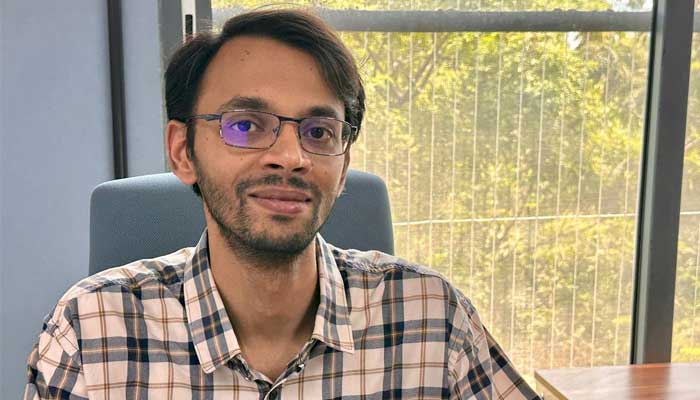
From early studies in aeronautical engineering to current work in robot motion planning at IIIT Hyderabad’s Robotics Research Center, Prof. Antony Thomas traces his research path from IIT Madras, through universities in Israel and Italy, to touch down at Hyderabad.
Growing up in Cochin with his father, a DRDO scientist and mother, a professor of Botany, meant that the available career options for the youngster was engineering or medicine. He chose engineering.
With a dual degree in Aerospace Engineering from IIT Madras, he moved to Technion – Israel Institute of Technology for M.Tech. in Aerospace Engineering. At Haifa, he worked with his advisor on robotics projects, making him eminently qualified for the Leonard and Diane Sherman Interdisciplinary Graduate School Fellowship (2016). Love for pure mathematics emboldened him to switch streams to Robotics and Autonomous Systems at the Università degli Studi di Genova in Italy for his PhD program.
He returned to India to join the Robotics Research Center at IIIT Hyderabad in 2025. Today, the interdisciplinary nature of his work in robotics allows him to work with other research centers as well.
From Aerospace engineering at IIT Madras to robotics research at Technion
When Antony Thomas landed at IIT Madras for his undergraduate studies in aerospace engineering, it was sweet success for the youngster, who had just a year earlier, reconciled himself to a different path. The timely advice of his father and a year of additional JEE coaching worked like a charm and changed the course of his research arc.
At IIT-M, he converted his B. Tech into a dual degree and joined Prof. Nandan Kumar Sinha’s lab for his dual degree project. Around graduation, he heard about Technion from Prof. Joel George, who had recently joined after his Post-doc from Technion.
Technion was an unusual launch pad for Antony’s future research. Prof. Vadim Indelman, his advisor during his M.Sc in Belief Space Planning (2015-2017), was also working in pure robotics research. “I had no prior background with robotics but the theoretical aspect seemed interesting. Somewhere along the way, I decided to pursue a PhD in this field”, observes Antony.
Ciao Genoa
It was his future advisor, Prof. Fulvio Mastrogiovanni who convinced Antony to join the Università degli Studi di Genova in Italy for his PhD (2017 – 2021) in Robotics and Autonomous Systems. The first half of his PhD was in task motion planning. He explains: Consider a simple task of a robotic arm, picking up a jar of yoghurt from the back of the refrigerator. What are the possible obstacles? For a robot’s task and sequence of pick-and-place actions, you need motion planning to understand these geometric aspects. That is the core idea.
The other part of his PhD research looked at computing collision probabilities. When location of objects is not precisely known, a model for probabilistic distribution uses sensors for estimation and computing different collision probabilities. “Accurate reaction values are time consuming but since it was math-heavy, I loved it”, says the school topper in Maths. He continued working with Prof. Fulvio Mastrogiovanni as a fixed term post-doctoral researcher.
In 2019, Antony married Maria, a diploma student in gynaecology and obstetrics. Since the pandemic lockdown coincided with Maria’s maternity leave, Antony continued his PhD work from India. Once lockdown protocols were lifted, he took his young family to Italy. Plans for a permanent move were thwarted by tedious administrative procedures for Dr. Maria’s medical degree accreditation. They toyed with the idea of returning to India.
At that point, an India – European Union project to establish robotics labs in Indian universities was under discussion. A study delegation of university professors visited Italy, and Antony was tasked with making a presentation. A casual chat with the IIIT delegation revealed that they were looking for faculty.
Interesting work at the Robotics research Center
Antony joined IIIT Hyderabad in 2025, chiefly because it was among the few robotics labs in India doing great work, and regularly publishing in top tier venues. Today his research at RRC is in robot motion planning, integrated task and motion planning, motion planning infeasibility, collision avoidance planning, and planning under uncertainty.
He elaborates. Picture an assistive robot in a home, hospital or cluttered search and rescue operation. It is working in a scenario full of obstacles. Robot motion planning involves the computation of a collision-free path for a robot from its start configuration to its goal. However, in many practical situations, no such path exists because obstacles block the way. Robots would become more useful if they could manipulate and move obstacles out of the way. This capability is particularly important for autonomous systems where successful task completion requires modification of the environment.
“Certifying infeasibility is an important aspect of my work, and a difficult problem because of computational complexities. It is scenario-specific and depends on the location, position and geometry of the objects itself”, explains the professor who teaches courses in Robot Motion Planning, Robot Kinematics and dynamics with Prof. Madhava Krishna and Dr. Harikumar Kandath. “We have received an ARG grant to develop a model on infeasibility, in collaboration with Dr. Girish Varma from CSTAR”, mentions Antony who received the Prime Minister’s early career research grant for a related proposal.
A confluence of minds and robotic vision
Antony points out that the ecosystem at IIIT-H allows multiple collaborations with students and faculty. “The faculty is most approachable and accommodating. Informal interactions over chai often lead to interesting collaborations”. Among interdisciplinary work, he cites a DRDO project with Dr. Hari Kumar, and Dr. Abhishek Srivastava from CVEST, and other projects with Dr. Vineet Gandhi from CVIT and Prof. Abhishek Singh from SERC. He continues to co-supervise a master’s thesis in the area of navigation among mobile obstacles, with his advisor in Italy.
Lessons learnt in foreign lands
The vibrant university environment at Technion Haifa was very conducive for Antony, who was changing his field from aeronautics to robotics. “There was a lot of learning to be done. In Israel, everything is so technologically advanced. What made the difference was my advisor, who was very supportive, always available and that really helped in the transition”.
An active Indian community of PhDs and Post-docs made for a good supportive environment from a research perspective. They bonded over games of cricket, festival celebrations and travel to historical destinations. A closer-knit group of post-docs lived outside the university campus. Their apartments became defacto venue for Friday Shabbat potluck dinners followed by games of Uno and dumb-charades. “We travelled around Israel on holidays; Christmas 2016 at Bethlehem, beautiful trips to Jerusalem and the most memorable vacations to the Negev Desert and Mitzpe Ramon with its mountains and hiking trials”.

Italy was a very relaxed environment for the scholar. His shared apartment was a seven-minute walk from his lab. “Yusha, an Indian PhD student and I enjoyed cooking and many impromptu dinner parties happened at home”, recalls Antony who, even today, enjoys whipping up Italian cuisine and biryani. “There were great trips to Milan, Florence and Venice”.

A few of his favourite things
A class topper and sportsman, Antony was part of his school’s athletics, football, cricket and volleyball teams. In IIT Madras, he played central defence on his hostel football team.

A humanities elective in film studies opened the world of international films and the wonders of Akira Kurosawa’s craft. Today, babysitting his two young children Joanna and Agnes has stretched a two-hour movie into a four-day watch activity, reports Antony who is partial to directors like Padmarajan, Martin Scorsese and Anurag Kashyap. Since his wife Dr. Maria Baby is currently completing her DNB studies in Hyderabad, both their parents take turns in joyfully discharging their grandparental roles.

Exciting on Prof. Antony Thomas’ s horizon is his work on infeasibility problems, since it has great relevance in the real world. In the future, the researcher looks forward to working on hardware, in real robot scenarios.
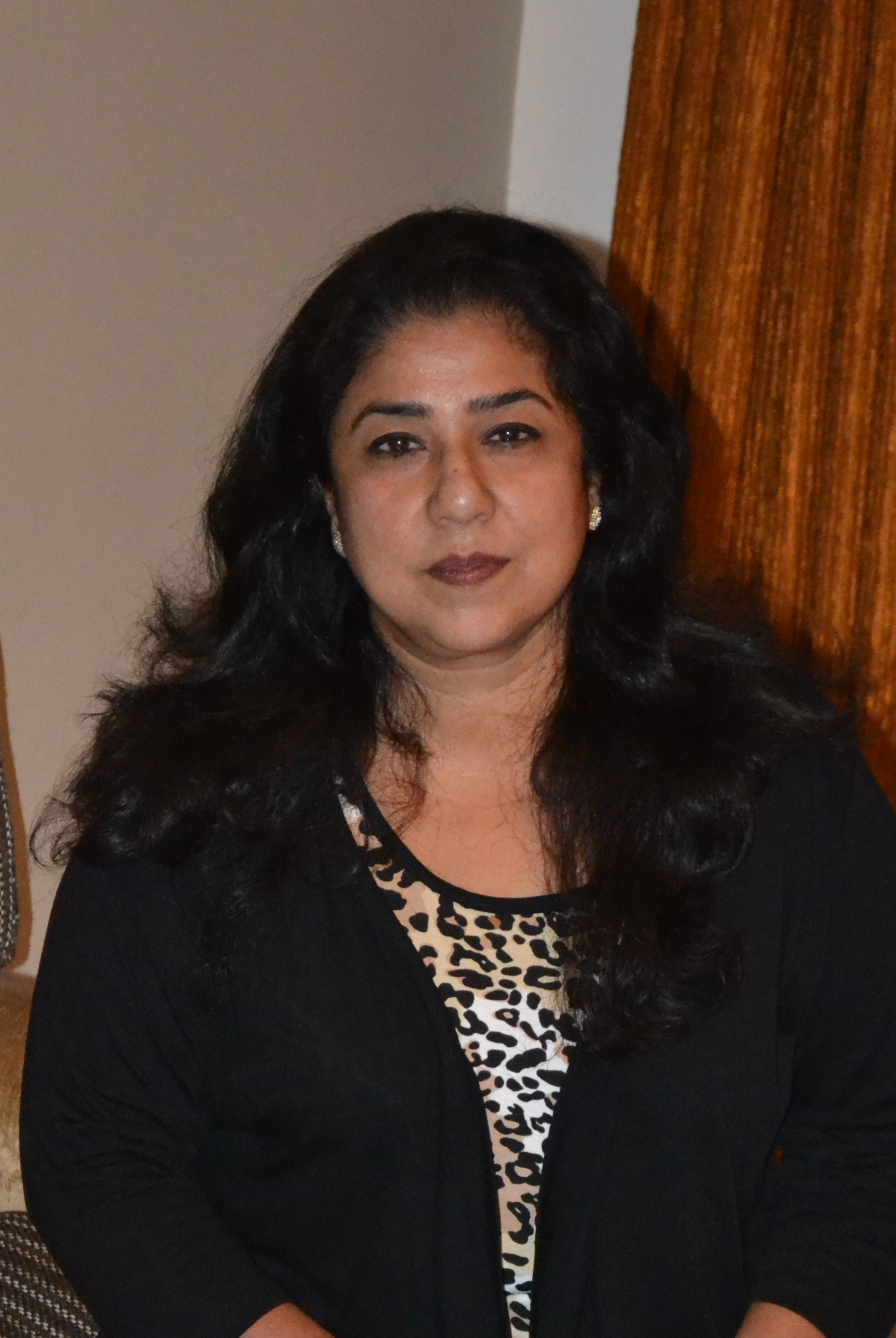
Deepa Shailendra is a freelance writer for interior design publications; an irreverent blogger, consultant editor and author of two coffee table books. A social entrepreneur who believes that we are the harbingers of the transformation and can bring the change to better our world.
Next post