
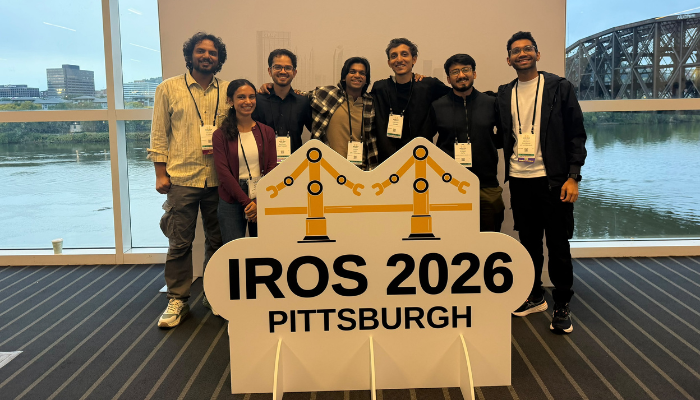
IIT Hyderabad’s research papers ran the gamut of robotic exploration and navigation, aerial manipulation, perception, dexterous grasping, control, and multi-drone mission planning. Here’s a summary of the papers.
Hosted in Pittsburg, a city the organizers themselves have nicknamed Roboburgh for being built around Carnegie Mellon University’s Robotics Institute – the oldest dedicated robotics academic department in the United States – IROS (International Conference on Intelligent Robots and Systems) is one of the two flagship annual robotics research conferences worldwide, alongside ICRA (International Conference on Robotics and Automation). It is co-sponsored by the IEEE Robotics and Automation Society and the Robotics Society of Japan. This year’s edition of IROS saw 19 keynote speakers over three days, 86 workshops and tutorials, nine official competitions, and 183 exhibiting organizations. The official keynote theme of the conference was ‘Open Problems and Perspective Shifts’. However, unofficially what underlay the various presentations, workshops and special sessions was the question of how one scales physical AI from a lab demonstration into real hardware in the field, and if scale alone is even the right answer.
Best Paper Award
The highlight of IIIT-H’s participation included winning the Best Paper Award for “Beyond Frontiers: Scene-Anomaly Guided Autonomous Exploration” at the “Bridging Perspectives in Navigation: Lessons Learned and Future Directions” workshop. The award carried a USD 500 prize sponsored by Field AI. Authored by Akash Kumbar and Abhinav Raundhal under the supervision of Prof. Madhava Krishna, the paper explores a framework called SCAGE that helps robots build more accurate 3D maps of unfamiliar environments by identifying areas they haven’t captured properly. Think of a partially mapped wall or table. Instead of simply exploring empty spaces, the robot focuses on these gaps, moving to better positions to observe and map them more clearly. This allows it to explore efficiently while creating more complete and detailed 3D representations of its surroundings. “Essentially, our paper proposes that exploration should be driven not just by where the robot has not been, but by what it has not understood,” explains Akash.
Separating Thinking From Action
The paper titled, “AERMANI-VLM: Structured Prompting and Reasoning for Aerial Manipulation with Vision Language Models”, authored by Sarthak Mishra, Rishabh Dev Yadav, Avirup Das, and Saksham Gupta, under the guidance of Profs. Wei Pan (NewCastle University, UK) and Spandan Roy, explores how a drone equipped with a manipulator follows natural-language instructions, such as finding, picking up and placing a specified object. “Recently, AI models that can understand both images and written language have made it possible to tell a robot what to do with simple commands. The robot can then use its camera to see what’s happening and act on it. But these models aren’t safe to use directly on flying robots with arms because they sometimes give inconsistent instructions, make things up, or suggest movements that a drone simply can’t do safely in the air,” says Sarthak. The researchers’ system AERMANI-VLM lets an existing AI model guide a flying robot with an arm, without retraining the AI for each new task. The key idea is to split the work in two: the AI does the thinking, and a separate set of pre-approved, safe moves does the acting. Because the AI’s thinking is kept separate from the drone’s actual motion, it can’t issue made-up or dangerous commands, and its choices are easy to follow and understand, keeping the drone steady and reliable while completing tasks.
Safe Pickup While Flying
When a robot is flying, simultaneously picking up an object is difficult when other objects block the view or the gripper’s path. Research supported partly by the “Edge-AI-GGCNN” project from Qualcomm Technologies and partly by the “UASAT” project sponsored by MeitY, found its expression in the paper titled, “AeroGrab: A Unified Framework for Aerial Grasping in Cluttered Environments”.Authored by Shivansh Pratap Singh, Naveen Nair, Samaksh Ujjwal, Sarthak Mishra, Soham Patil, and Rishabh Dev Yadav under the supervision of Prof. Spandan Roy, the paper presents a system, AeroGrab that helps a drone find an object, explore it from different angles, and choose the safest way to pick it up. Using a language instruction to identify the target, the system evaluates different ways of grasping it and selects one that is both practical and unlikely to cause a collision. The researchers conducted tests in real-world cluttered environments which showed that this approach helps drones grasp objects more reliably.
Using Radar To Detect Glass
Through their research supported by iHub-Data which is documented in the paper titled, “GlassFormer: Learning Real-time Glass Segmentation using Radar-Depth Fusion”, researchers Suhani Grover, Astik Srivastava, and Viswas Dinesh guided by Profs. Avinash Sharma and Madhava Krishna presented a solution to a problem commonly faced by robots. “Glass is hard for robots to detect: cameras see through it, while depth cameras may return missing or misleading measurements,” says Suhani. The team proposed GlassFormer which combines RGB-D images with 60.5 GHz millimetre-wave radar, using radar-guided attention to segment transparent surfaces even in poor lighting. Radar reflects strongly off glass precisely where vision and depth fail, giving a geometric cue that is insensitive to lighting. In tests conducted in low-light conditions, the system identified and separated objects from their surroundings more accurately, achieving a score of 0.59 compared with 0.49 for a vision-only model. The project also developed a dataset of 1,800 synchronised video frames and a system that can process visual information in real time using ROS 2, a robotics software platform.
Helping Aerial Robots Adapt
Autonomous aerial robots that can fly and pick up or move objects often struggle when their shape changes or when they carry loads of different weights. Their movements are affected by several interacting forces, and these forces can change rapidly. Traditional mathematical models and existing AI-based methods often fail to keep up with these changes. To address this, IIIT-H researchers Samaksh Ujjawal, Naveen Nair, Shivansh Pratap Singh, Rishabh Dev Yadav under the supervision of Profs. Spandan Roy and Wei Pan developed a new AI-based system that learns how these forces affect the robot and adjusts its control in real time. Their paper titled, “Learn Structure, Adapt on the Fly: Multi-Scale Residual Learning and Online Adaptation for Aerial Manipulators” explains how it can distinguish between immediate effects, such as sudden movements, and longer-term changes caused by airflow and other forces. It can also quickly adapt when the robot encounters an unfamiliar load, without having to relearn everything from scratch. When they tested on a real aerial robot, they found that the system predicted movement more accurately, responded faster to disturbances and followed its intended path more precisely than existing learning-based methods, while still operating fast enough for real-time use.
Helping Robots Detect Physical Contact
Robots need to know when they are touching an object to handle it properly. In the case of humans, we can tell when we are touching something by combining what we see with our sense of body movement and position. For many robots though, this ability is gained only through special touch sensors. Inspired by humans, IIIT-H researchers Soham Patil, Avirup Das, Sourabh Bhosale, guided by Prof. Spandan Roy developed NoContactNoWorries, a system that helps robots detect physical contact using cameras and information about their own movements, without needing dedicated touch sensors. The detailed research which has been published in the paper titled, “NoContactNoWorries: Estimating Contact through Vision and Proprioception for In-Hand Dexterous Manipulation” reveals test results of the system on different objects. The team found that it could help a robot learn to rotate objects in its hand, even when handling objects it had not encountered before. Tests in both simulated environments and on a real robot showed that this approach could offer a practical, more scalable alternative to traditional touch sensors.
Pixel-Level Shortcuts For Efficient Navigation
Topological maps help robots understand their surroundings and find their way around. However, researchers have paid less attention to how loop closures, or recognising a place the robot has visited before, can improve navigation using these maps. Conventional methods use loop closures mainly to correct a robot’s estimated position. But IIIT-H researchers introduce PixelLoop, a method that creates these connections directly between individual pixels in a visual map. In their paper titled, “PixelLoop: Shortcut Topological Navigation with Pixel-Level Loops”, authors Sarthak Chittawar, Vansh Garg, Aditya Vadali, Krish Pandya, Rohit Jayanti and Profs. Sourav Garg, K Madhava Krishna have demonstrated how instead of simply correcting the robot’s position, PixelLoop creates shortcuts that help it find more efficient routes. This allows robots to navigate between different points more reliably and choose paths that closely match the shortest routes available. In simulated tests, PixelLoop improved navigation success and route efficiency by more than 35 percentage points compared with methods based on image-level maps. Additionally, tests on real mobile robots also showed promising results, suggesting that PixelLoop could make visual navigation more reliable and efficient.
Calculating Efficient Drone Fleet Size
When there’s a fleet of inspection drones, there’s a corresponding requirement of spare drones to replace those that run out of battery and need recharging. Existing methods for deciding how many drones are needed often underestimate the number because they assume that replacements are requested at random and independently. But in real missions, several drones may run out of battery at nearly the same time, overwhelming the available spares. This can happen when drones follow efficient routes that give them similar workloads, causing their batteries to drain together. To address this problem, in their paper titled, “Robust Fleet Sizing for Multi-UAV Inspection Missions under Synchronized Replacement Demand”, researchers Prof. Antony Thomas and Vishal Ramesh propose a simple formula for calculating the required fleet size: the number of active drones multiplied by the sum of the recovery-to-operation time ratio (rounded up) and one. This has been documented in the paper titled,”This ensures there are enough spare drones to handle even situations where all active drones need replacement simultaneously.
When tested across five scenarios, the proposed method achieved 99.8% success, even with changing wind conditions as opposed to the existing methods that could achieve only 69.9% mission success. The researchers’ method required only four additional drones in the most challenging scenario, demonstrating that a small, carefully calculated spare fleet can significantly improve mission reliability.
Detecting Glass And Its Depth
Glass walls pose a major challenge for robots because their depth sensors often struggle to detect transparent surfaces resulting in inaccurate 3D maps and potential navigation hazards. While there are some specialised sensors that can detect glass, they require additional hardware. Similarly, AI-based methods that estimate depth from a single image offer an alternative, but they often fail in unfamiliar environments because there is limited real-world data of glass surfaces. To address this, a team comprising of Tarun R, Anuj Verma and Laksh Nanwani under the guidance of Profs. Sourav Garg and Madhava Krishna introduce SILICA, a system that uses knowledge learned by text-to-image AI models to identify glass surfaces and estimate their depth together. It does not require real-world images with depth annotations of glass. SILICA then uses the detected glass regions to correct errors in standard depth sensors, helping robots build more accurate 3D maps and avoid collisions. Tested using a new dataset called Mirage 18k, SILICA works well across a variety of previously unseen environments, outperforming existing methods by nearly 20%. This research has been published in the paper titled, “SILICA: Repurposing Diffusion Priors for Joint Glass Segmentation and Depth Estimation.”
Using Language For Object Placement
In the case of drones, placing objects at a precise location remains a challenge. Systems typically rely on the exact coordinates of the target location. But specifying the coordinates is cumbersome and unintuitive in real-world settings where people would naturally prefer to describe where they want the object placed using language. To address this, researchers Sarthak Mishra, Rishabh Dev Yadav and Naveen Nair under the guidance of Profs. Wei Pan and Spandan Roy developed AeroPlace-Flow, a framework that allows aerial robots to place objects based on natural language instructions, without requiring task-specific training. It uses RGB-D images (colour images combined with depth information) and AI image-editing models to imagine what the scene should look like after the object is placed. It then uses 3D geometry to determine the object’s target position and plan a collision-free path to get there. This research has been published in the paper titled,”AeroPlace-Flow: Language-Grounded Object Placement for Aerial Manipulators via Visual Foresight and Object Flow”.
Workshop Paper
In addition to the main conference track papers, there was a paper titled, “Image Frame Dynamic Object Segmentation and Ego Motion Estimation using Radar Image Fusion (Radar-Dot)” authored by Astik Srivastava, and Suhani Grover under the supervision of Profs. Avinash Sharma, K. Madhava Krishna, that was presented at the LTP (Long-Term Perception for Human-Centric Autonomy) workshop. The workshop website details how autonomy in highly dynamic human-centric real-world environments is a crucial challenge at the forefront of robotics. Following the success of the first LTP workshops in 2024, the organizers joined forces to bring together researchers across communities from Robotics, Computer Vision (CV), and Machine Learning (ML) on the LTP problem. The theme for this year was ‘Towards Undo for the Physical World’.
In keeping with the theme, the IIIT-H researchers addressed a challenge faced in autonomous driving. To estimate how a vehicle is moving, the system needs to identify stationary objects. But to identify stationary objects, it must first know how the vehicle is moving. In effect, it needs both dynamic object detection and vehicle motion estimation. For this, they presented Radar-Dot, a system that combines radar and camera images to solve both problems together. It uses radar measurements to estimate the vehicle’s motion and separate stationary objects from moving ones. This motion estimate is then combined with depth information and visual movement between frames to identify objects whose motion differs from that of the surrounding scene. When this was tested, results showed that radar can help self-driving cars better estimate their own movement and identify moving objects too.
Focused Sessions
An important component of the IROS conference includes Contributed Talks, which are presentations of peer-reviewed conference or journal papers. They are grouped into tightly themed sessions, with 4 talks to a Focused session (9 minutes each plus questions) and 7 talks to a Lightning session (3 minutes each, no questions). IIIT-H MS students from the RRC program Soham Sanjay Patil and Sarthak Mishra chaired focused sessions on Imitation and Demonstration Learning for Robot Skills and Building Memory into Vision-Language Robot Agents respectively.
Speaking about RRC’s presence at the conference, Prof. Madhava Krishna, Head, RRC, says,”The IROS results have been quite phenomenal. Not just because of the volume of the papers that got accepted but the strike rate was 100 percentage vis a vis the actual conference acceptance rate that was less than 37 percent.”

Sarita Chebbi is a compulsive early riser. Devourer of all news. Kettlebell enthusiast. Nit-picker of the written word especially when it’s not her own.
Next post