
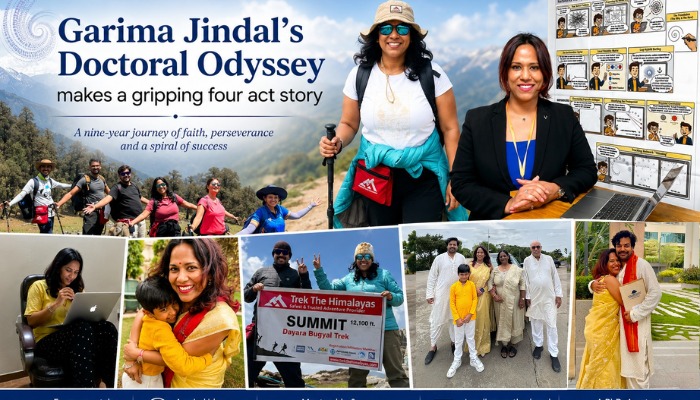
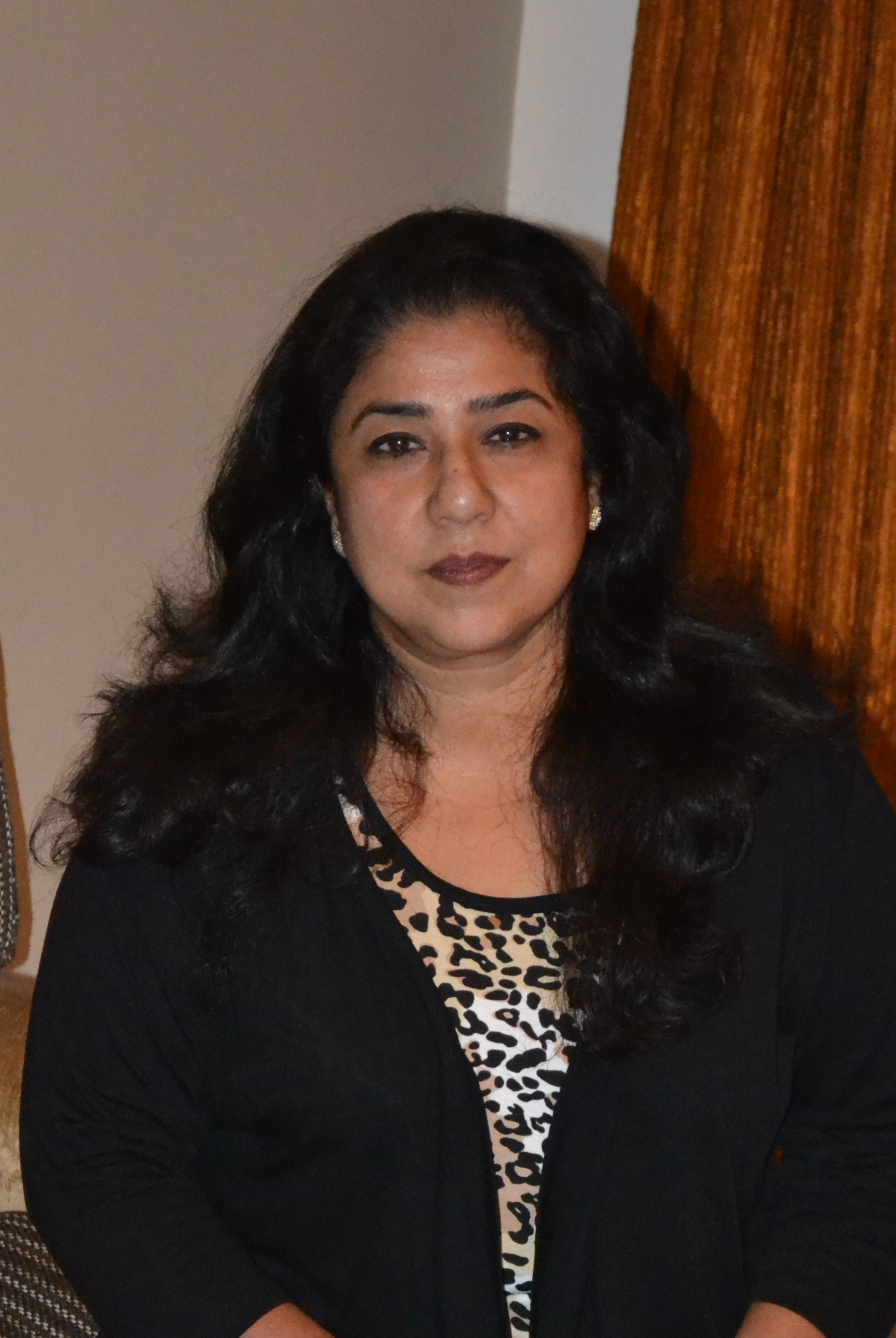
IIIT-H alumna Dr. Garima Jindal’s off-the-beaten track PhD journey is a lovely lesson in faith and perseverance. She walks us through an unusual nine-year long PhD saga, that involved marriage and maternity break, eureka moments, a novel idea and a last-minute topic change that would translate into an international publication and patent.
Four stories and a PhD
“Thank God I submitted my Thesis”, Garima Jindal thought to herself, as her life flashed before her eyes. In 2025, enroute to a well-earned family vacation, when her plane hit mid-air turbulence and was freefalling, it was a fleeting sense of relief that momentarily filled her mind. That was how much the PhD in Data visualization meant to her. More about that later.
Her PhD advisor, Prof. Kamalakar Karlapalem, an applied computer scientist at IIIT-H’s Data Sciences and Analytics Center (DSAC), who mentored her through the ups and down of her doctoral journey shares this. “Garima joined me as a PhD student around 2016 and she got married soon after that. We had initially started working on subspace clustering and visualization. But when that did not go well, she changed her topic to spiral visualization of large graphs. That was a turning point. It was a very interesting idea and a profound contribution to data visualization of large graphs. She singlehandedly worked on this project, published few papers and got a US patent. It is a great accomplishment in itself but more creditable because this was happening along with managing her family and taking care of her now seven-year-old child”.
For Garima, it was the crowning glory of nine years (2016-2025) of her association with DSAC, her unquestioned belief in herself, and faith in her mentor.
Her journey unfolds in three interesting stories and two Eureka moments. Her first patent materialized from a Eureka moment on a Shimla holiday, while the second was on a flight from Melbourne.
Compassion goes a long way
Garima joined NIT Surathkal for her M. Tech in CSE, where she would meet her future husband. With a year of industry experience at Hyderabad-based multi-national Cavium Networks, she was ready to pursue her PhD dream at IIIT Hyderabad.
A year into her PhD, there were a few happy disruptions in her academic life. First it was her marriage to fellow NITian Bhanu Pratap Singh and later a maternity break.
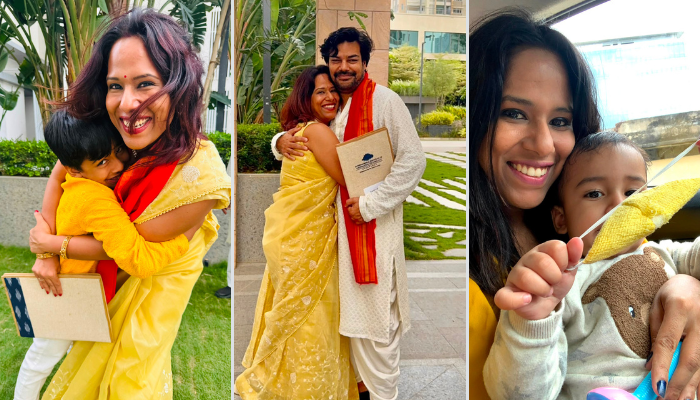
In July 2020, when their son shauryan was a few months old, she returned to her doctoral work and role as teaching assistant at DSAC. Like most mothers, it was difficult to balance research, motherhood and the sleepless nights. “I wondered if I could even continue my research”, she reminisces. It was then that Prof. Karlapalem came up with a solution”. The adjacent faculty room was converted into a makeshift nursery for her baby and nanny.
“That room became an important part of my PhD journey”, she remarks emotionally. “It reminded me that academic success is not achieved through hard work alone; it is also made possible by people who understand our circumstances and support us when we need it most. My professor did much more than provide a physical space. He created an environment in which I felt supported, both as a researcher and a mother. This thoughtful gesture strengthened my determination to continue, and it remains one of the most meaningful memories of my time at IIIT Hyderabad”.
Eureka moment in the Shivalik range
Four years into her PhD, Garima had still not finalized her problem statement. Managing COVID complexities and a young toddler was tough. “There was a lot of back and forth going on, test-driving different ideas”, she explains. “Prof. Karlapalem really pushed me to think out of the box. Every rejection and dejection was met with his constant refrain – Good ideas take time to marinate! I had come to a point where I had to either choose a topic soon or quit the PhD programme. I was working really hard and reading a lot of research papers and journals”.
When COVID restrictions eased up after the first lockdown, Garima took the opportunity to make a dash to Shimla for a short break.
And that was when she had her first Eureka moment. One morning, as her eyes idly followed the serpentine hill roads winding around the Shivalik range, a visual solution to a long-standing challenge in network visualization suddenly began to take shape. The spiral formation of the hill roads became a source of inspiration. “It suddenly hit me that several network properties could be mapped onto spiral representation. Sometimes good ideas come when you relax your mind and give it time to connect the dots”.
The initial spark later evolved into a major part of her PhD research. Since lockdown protocols were still in place, her apartment balcony was converted into her workspace. And the glass French windows became her blackboard, with ideas scribbled across it.
Community that helped earn the first patent
A quick draft submitted at a Graph drawing symposium received constructive feedback. However, it had to be reworked several times before the paper was accepted in IEEE VIS 2023. “Visualization is a domain with few Indian researchers working in it. The fact that we are able to produce work that international scientists are taking notice of, is in itself a great achievement, observes Garima. “IIIT-H’s strong research culture consistently encourages us to uphold the highest standards in our work,” she reflects.
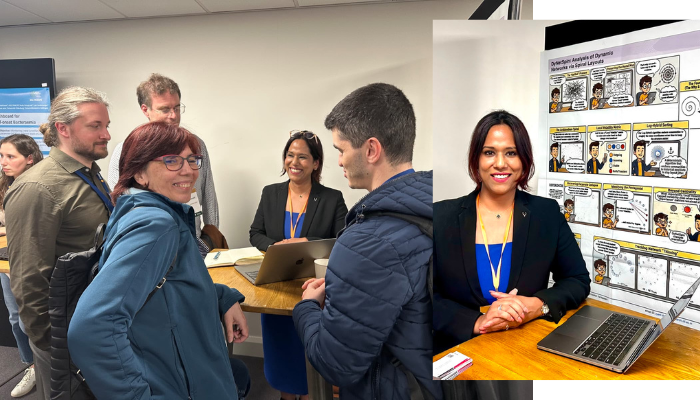
The IEEE VIS 2023 conference at Melbourne was a great networking opportunity that opened new avenues for collaborations and fresh ideas. “One exciting spinoff was a discussion with a professor who helped shape my second journal paper on the topic, that is currently under review”, she observes. A casual discussion with a BITS Pilani professor at GD24 conference in Vienna 2024, would result in Garima’s first faculty position. In May 2025, after her thesis submission, she joined BITS Hyderabad as an online course instructor in database design, data visualization and social media analytics.
Garima believes that it is Prof. Karlapalem’s encouragement at critical junctures, when despair overcame hope, that helped her. For instance, five years into her PhD, when her stipend stopped, the scholar was toying with the idea of part-time employment, when her advisor proposed a stipend to tide her over the speedbump. His support and magnanimity still brings tears to her eyes, she confesses. “When I finalized my problem statement, Prof. Karlapalem suggested that I buy a laptop; a small gesture, but to me, it was a powerful expression of his belief in my work and that encouraged me to remain focused. A PhD can often be a long and lonely journey, and having a mentor who supports you during moments of uncertainty can make all the difference.”
Travel to combat the travails
Internships at Indian Statistical Institute, Kolkata, the VGI Science Summer School at TU Dresden and the GD 2024 PhD School at Vienna, provided valuable insights into tools and techniques in graph drawing, visualization, geographic information retrieval and geovisual analytics.
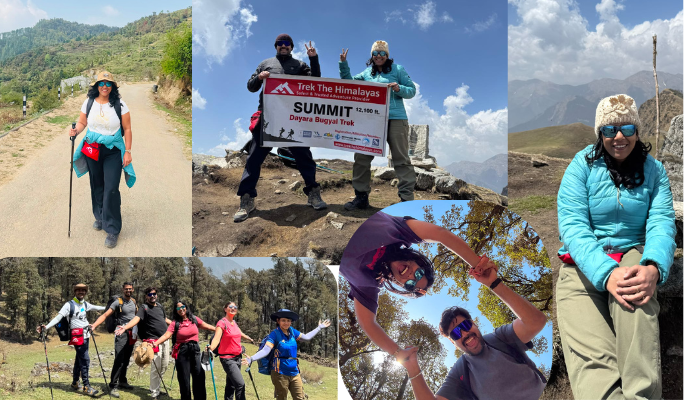
“After thesis submission in April 2025, my husband and I celebrated with a long awaited trek to Dayara Bhugyal (Dehradun). I was fortunately, alone on the Jaipur-Dehradun flight when the plane hit extreme turbulent weather. This was soon after the Air India crash. Two thoughts hit me at that tense moment. Thank God my husband and Shauryan are not on this flight. And thank God I submitted my Thesis”, laughs Garima.
Once a sportsperson at school level, the scholar now enjoys traveling and prefers mountains over beach holidays. She considers these breaks important to maintain balance in life, while juggling her roles as mother and scientist. In all this, she considers her friends circle as her support system and recharge stations.
Looking back with gratitude
Prof. Karlapalem who mentored her through her remarkable nine-year odyssey points out that Garima Jindal is a very good role model for mature students. “The manner in which she manages her family, work and other commitments is commendable. Let me be very frank. It is very difficult for a single student to actually build a system and get a publication in a major conference and manage to get a patent within a year. There is inherently a lot of hard work”.
Garima celebrated her doctoral success by gifting herself an unforgettable conference visit to EuroVis 2026 at Nottingham. She credits a lot of her success “to Prof. Karlapalem and IIIT Hyderabad’s inclusive environment. Beyond Institute policy dictating behaviour, it is the entire ecosystem that is encouraging you to manifest your best potential. If we have such people around us, no mother will need to choose between motherhood and being a scientist”, she sums up emotionally.
Deepa Shailendra is a freelance writer for interior design publications; an irreverent blogger, consultant editor and author of two coffee table books. A social entrepreneur who believes that we are the harbingers of the transformation and can bring the change to better our world.
Next post