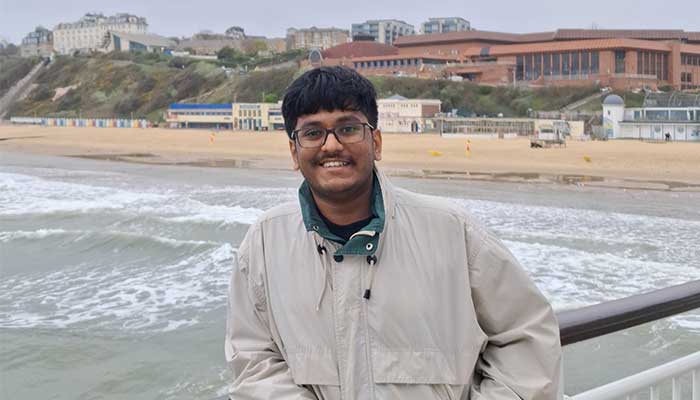
IIIT Hyderabad’s Sudha Tanay Doddi turned heads at BAFTSS with a bold, cross-disciplinary dive into the Hong Kong handover, mining local cinema for sharp computational insights.
The Handover of Hong Kong to the People’s Republic of China in July 1997, marked the end of 158 years of British colonial rule. Beneath the pomp and pageantry of the historical event, lay stories of disruption and adaptation.
Sudha Tanay, a final year student of IIIT Hyderabad’s inter-disciplinary CHD program recently grabbed the attention of film scholars at the prestigious British Association of Film, Television and Screen Studies conference at Bournemouth, UK. His unusual study was a computational representation of the socio-cultural ramifications of the Handover. Viewed through the lens of popular Hong Kong cinema of the era, the study focused on the works of Hong Kong-based directors like Wong Kar Wai and Peter Chan.
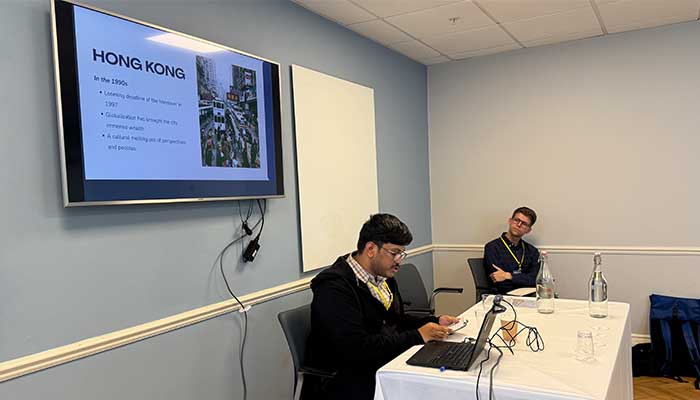
“It is a big deal for a non-traditional undergraduate engineering student, to crack that nut of getting his paper accepted in a full-fledged conference for the film industry. As the youngest in the food chain of degrees, doing his first presentation at that scale was pretty significant”, shares Dr. Sushmita Banerji, his advisor. The hospitality and networking opportunities at the April 2026 conference heightened the surreal experience for the undergrad+masters’ student who was rubbing shoulders with PhDs, authors, filmmakers and professors.
Film historians and computer scientists wrangle with data in different silos. Joining these two disparate domains is very rare, notes the dual degree student of B. Tech in Computer Science and Master of Science in Computing & Human Sciences by Research. “Almost everyone remarked that they had never seen such research”, observes Tanay of his BAFTSS interlude. Data analysis techniques spotlighted certain dimensions of these films from empirical data. Focal points like the use of colour, studied the impact of storytelling in the larger geopolitical discourse at the time.
Art & Algorithm – Can the Twain meet?
Can machines and algorithms be used to interpret film and art in general? Apparently, you can.
Joining via the UGEE channel, Tanay’s abiding interest in humanities and social sciences propelled his decision to join the new CHD program. At that point, his choices leaned more towards mainstream superhero and Marvel films, the standard staple of his generation. It was Dr. Banerji’s course in Introduction to Film that would unlock possibilities for research in an off-beat topic.
One fine afternoon in class, while several peers enjoyed a post-lunch nap, a screening of a Wong Kar Wai film as part of the course curriculum, grabbed his attention. It was a specific visual style in a sequence from the 1993 Chungqing Express that he found striking and mesmerizing.
Tanay, and his advisor Dr. Banerji at the Human Sciences Research Center, work at the confluence of computer science and film studies. Engineers often fail to grasp the scale and scope of social sciences as an influence in their lives. His research aims to bridge the technical aspects of computer science with the nuanced understanding that film studies offer. He points out that many students join engineering for the career stability and flashy packages. In time, they find themselves stuck in a rut, fixing bug reports and compiling spreadsheets. “A decade down the line, where are you going to hear stories that excite? That was my motivation for picking humanities”.
Prof. Banerji elaborates that social sciences centers like IIIT-H’s Human Sciences Research Center are well established at major technological institutes in India. Engineers need to understand the world they are building for, including different experiences of women and rural populations. As far back as the 1980s, MIT had established full-fledged humanities departments.
“With computational film studies, I have gained expertise handling non-conventional forms of data, like film and video formats”, notes Tanay who credits his advisor with improving his taste in films. At the start of the third year, he toyed with the idea of Marvel movies for his first research proposal. An aghast Dr. Sushmita retorted, “Please don’t. There is way more to film than that. Dr. Banerji opened up the world of Wong Kar Wai’s films, acclaimed for a very distinct visual style. It is thanks to her advice that I sent my abstract to the BAFTSS conference”, observes Tanay who hopes to extend his research to box-office analysis someday.
When Algorithms meet Auteur Cinema
Interpretation of art and film is subjective, based upon the viewer’s understanding of what happened. A terminal health condition in one film mirrors Hong Kong’s expiry date.
“As a student of CHD, my research aims to bridge the technical aspects of computer science with the nuances and interpretations that film studies offer. The idea was to lead in with a comparative approach of directorial styles and utilize my computer science skills to derive some interesting observations”, notes Tanay, a teaching assistant for Dr. Banerji.
The computer science angle crunches video into empirical data. Beyond nice vibes, it is colour and camera angles leveraged to prove a point. The film was broken into shots and run through python programs to derive certain insights like the usage of red and its connotation for the viewer. “I worked with seven Wong Kar Wai films and other directors like Peter Chan”, he adds. A westernised part of Asia, Hong Kong has a well-established film industry, home to world famous directors and action heroes like Bruce Lee and Jackie Chan. The new wave cinema of that era tended to be more introspective and contemplative, with subtler and more abstract themes.
Dr. Banerji explains that conferences like BAFTSS require building narratives and carefully picking, threading and structuring presentations, which would normally be difficult for an engineering student who was new to academic conferences. His presentation at the conference was widely lauded, for bringing together the yang of computational techniques and the yin study of cinema.
London calling
Uncertainty surrounding the Middle East war was a logistical quagmire for Tanay. But finally the uneventful flight to London and an exhilarating bus ride to Bournemouth made up for the initial hiccups.
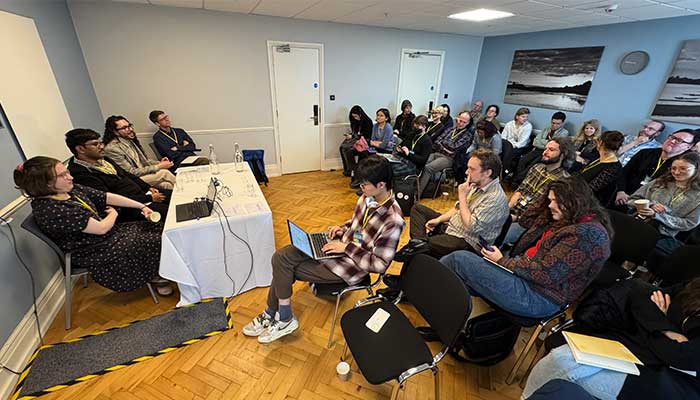
“My presentation at BAFTSS was slotted for the latter part of the second day. It was daunting to validate your research in front of academics and filmmakers, but surreal to meet authors encountered in my literature reviews”, he remarks. “I made my presentation to a packed room and the audience feedback was gratifying, especially the lively Q&A session”. A poster, summarizing his research findings was well received.
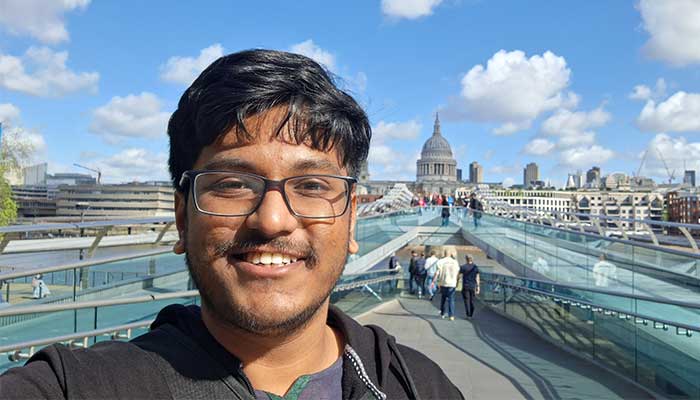
“The icing on the cake was the abridged sightseeing vacation after the conference with my father”, smiles Sudha Tanay, fourth in line to be named Sudha, after his parents Sudhakar, Sudha and brother Sudhanshu. “We did the regular tourist circuit of London, once an ancient Roman settlement”. Historical facts from textbooks and encyclopaedias came alive. The Rosetta Stone at the British Museum, Tower of London, Westminster Abbey, Tower Bridge, The Shard and art galleries were ticked off the list. Seagulls’ on Bournemouth’s coastline, a visit to the resting place of Mary Shelley, the author of Frankenstein, the hipster side of Shoreditch with its street art, the canals of North Camden and a trip to Greenwich were cherished snapshots, that wound down Tanay’s first foreign tour and a beautiful tenure at IIIT Hyderabad.
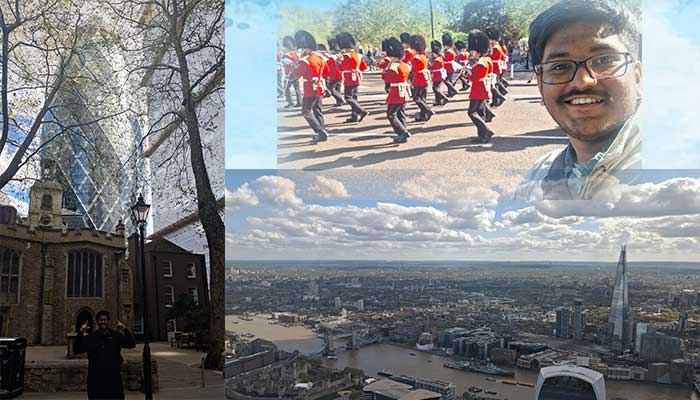
Winding down a chill tenure at IIIT-H
Looking back at his six-years in IIIT-H, Tanay says, “The two years of COVID was time stolen from us. The initial days seemed parasocial and weird, but fun. Being a part of the IIIT Hyderabad ecosystem was a privilege. I made most of the lockdown as coordinator for the Astronomy club and Quizmaster for online Felicity. When regular classes commenced, we made up for lost time, hanging out with friends’, quiz competitions, weekend trips to restaurants and exploring the city”.
Having tested the waters with BAFTSS, Tanay intends to expand his research focus, to the evolution of other directors. “But my immediate goal is to clock in some industry experience. I feel that my skills are best deployed in industrial R&D, non-profit or even co-research think tanks. These days, company recruiters do not want a mindless drone. To stand out, my passion project in film studies can be the deal-clincher”.
Prof. Banerji ties it together. “Coming from a pipeline of MCQs to reading three books on literature, it was a significant achievement to have a paper accepted at a full-fledged cine conference for an undergraduate engineering student. A hard worker, Tanay taught me what he was doing with data and colour concentration and it was fun to see him have that one extra flair. He has done a good presentation and dissertation and is well set for the next sequel in the corporate world”.
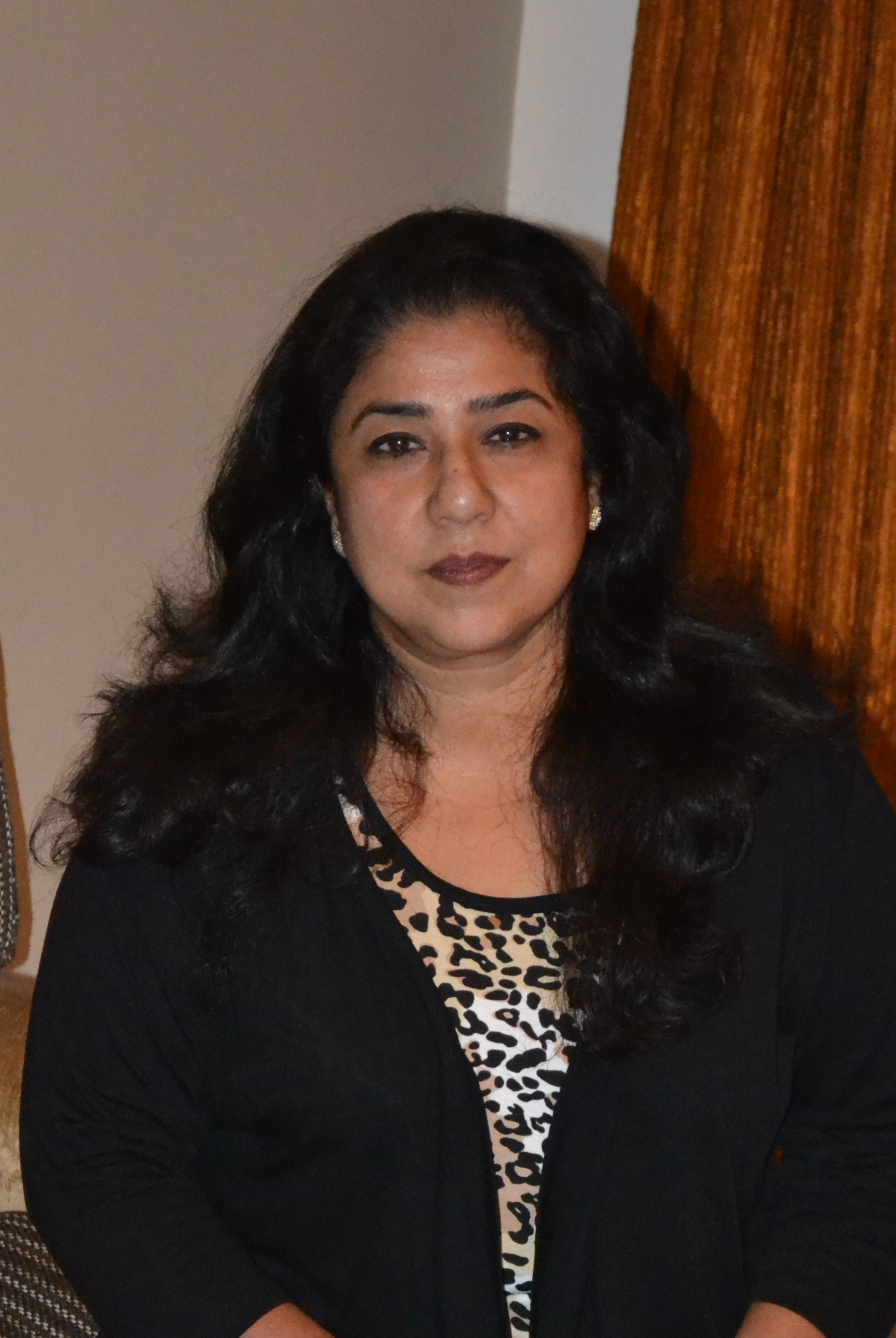
Deepa Shailendra is a freelance writer for interior design publications; an irreverent blogger, consultant editor and author of two coffee table books. A social entrepreneur who believes that we are the harbingers of the transformation and can bring the change to better our world.
Next post