
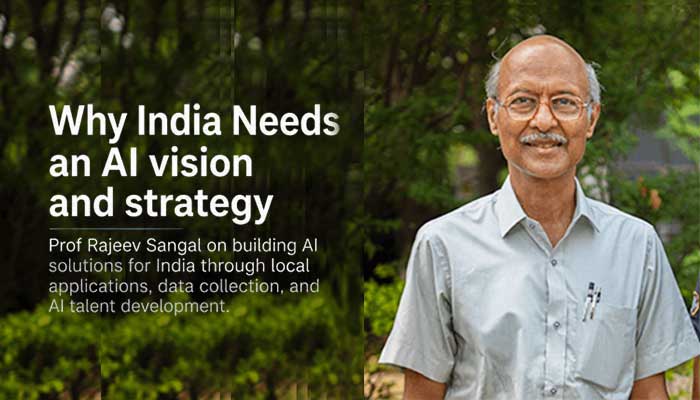
As India stands at the crossroads of technology and nation-building, Prof Rajeev Sangal stresses why AI must go beyond innovation for innovation’s sake. It must serve a larger national purpose. We need to build an India-led AI ecosystem rooted in inclusion, language accessibility, education, healthcare, meaningful employment, and the solving of real-world problems.
Despite all the hype around AI today, India still lacks a clear AI vision. We need a radical strategy that seeds AI work across thousands of local problems. By identifying relevant AI applications, investing seriously in data collection, and combining this with innovative approaches to machine learning, we can not only solve our own challenges but also create world-class AI manpower. This, in turn, can lead to the emergence of hundreds — perhaps even thousands — of AI startups.
A part of this strategy has already been tested through Mission Bhashini, India’s first AI mission, which successfully developed Indian language speech-to-speech translation technology. Today, it handles nearly 15 million inferences per day.
But the time has now come to go further. We need to mobilize social forces to contribute to AI development and create not merely an AI ecosystem, but an AI eco-sphere. Schools, colleges, community groups, startups, researchers, and ordinary citizens must all become participants in this national effort. If we can achieve this, India has the potential to emerge as a world leader in AI.
The Missing Vision
The AI Impact Summit held in Delhi in February 2026 generated significant excitement and publicity. Global industry leaders, representatives of governments, and technology companies gathered to discuss the future of AI, each advancing ideas aligned with their own interests.
India raised important concerns around hosting data and models within Indian data centres, context-aware evaluations, and AI sovereignty. However, sovereignty cannot be achieved merely through declarations. It requires a clear vision backed by a coherent strategy — and that, unfortunately, was missing.
The only visible direction seemed to focus on attracting foreign investment in compute infrastructure and building data centres controlled by multinational technology companies. . Is this how you build country’s sovereignty – by outsourcing your data? There were discussions around regulation, but very little articulation of what India itself wants to build.
As the host nation, India had a unique opportunity to present an AI vision not only for itself but also for other developing countries. Instead, we appeared content to follow the path set by Big Tech. Nations that merely follow rarely become leaders.
In my view, the government’s most important role is to define a national AI vision and develop a broad strategy to achieve it. This process must involve academic experts, R&D institutions, startups, industry, users, and social groups. A handful of bureaucrats sitting in air-conditioned offices cannot shape the future of AI for a country as vast and complex as India.
Still, it is not too late. India can — and must — define its own AI future.
Learning from the IT Revolition – and Going Beyond it
India’s IT services boom began in the 1990s and transformed the country into a global outsourcing hub. However, while we excelled at services, we struggled to create globally dominant products.
AI gives us another opportunity. Products emerge from solving real problems around us and then generalising those solutions. That requires closeness to the needs of people and society. Our IT outsourcing industry, largely serving Western markets from afar, could never fully achieve this.
AI development, however, must be rooted in Indian realities. If we want to become leaders in AI, we must begin by solving Indian problems. By doing so, we will not only generate impactful AI products but also create skilled AI manpower capable of identifying meaningful challenges and building innovative, cost-effective solutions.
The Six Pillar of India’s AI Ecosystem
Building a strong AI ecosystem requires six key elements:
1. AI Manpower India’s youth are already eager to enter the AI space, as was evident during the AI Impact Summit. But enthusiasm alone is insufficient. Students and professionals must be equipped with deep AI skills and training.
2. India Data AI systems require high-quality data relevant to Indian contexts and tasks. Today, such datasets are severely lacking. Building them will require collaborative efforts at multiple levels.
3. Compute Infrastructure India has begun investing in compute infrastructure, but such infrastructure must remain under Indian control.
4. Breakthrough Research We need research focused on machine learning with smaller datasets and lower compute requirements — similar to breakthroughs demonstrated by China’s DeepSeek. A crucial question is how AI can combine domain knowledge with data. Our higher education institutions can play a major role here, but only if they pursue path-breaking rather than incremental research.
5. Applications and Markets Research, manpower, data, and compute infrastructure come togher meaningfully when connected through real-world applications and markets. Together with policy support, these form the formal AI ecosystem.
6. Social Forces This sixth element is often ignored, but I believe it is transformative: mobilising society itself. Schools, colleges, community groups, and ordinary citizens can infuse energy into AI development and create a far larger eco-sphere around AI. We shall see it in greater detail later.
Leadership is earned through hard work and brilliance — not empty proclamations.
Why India Must Solve Indian Problems
India is sitting, I believe, on a goldmine of AI opportunities. Our challenges in water, energy, food, healthcare, education, agriculture, weather, transport, mining, culture, entertainment, and languages can each generate hundreds of AI applications. These vary across geography, climate, communities, festivals, and local conditions.
AI for Groundwater Prediction
Consider groundwater management. AI systems could predict groundwater availability in villages by analysing meteorological patterns alongside local pond conditions, usage patterns, and sowing data from nearby farms. Such locally grounded predictions would be far more accurate than broad regional predictions.
AI for Agricultural Disease Detection
Another example is the early detection of crop diseases. AI systems could track local crop types, sowing timelines, nearby outbreaks, and environmental conditions to provide timely warnings and recommendations tailored to local realities.
Importantly, these systems would improve continuously as farmers feed data back about outcomes and interventions. Human oversight would remain essential, but AI could become a powerful support tool for agriculture.
AI for Urban Transport
In cities, AI could continuously monitor roads, identify damaged stretches, analyse traffic patterns, and recommend optimal travel routes. The same systems could also help prioritise road repairs based on urgency and usage.
These applications require decentralised data collection and machine learning rooted in local contexts. Their impact may not arrive as one giant technological storm, but rather as a steady transformation improving everyday life across regions and communities.
Lessons from Mission Bhashini
Much of this vision has already been tested through Mission Bhashini.
Under this initiative, speech-to-speech translation technology covering 36 Indian languages and English was developed through a completely homegrown effort involving 70 research groups working collaboratively across the country. The project created large open-source datasets and AI models now being used by Indian AI companies — many of which were showcased during the AI Impact Summit.
Bhashini was first conceptualized in 2018–19 when the Prime Minister’s Science, Technology and Innovation Advisory Council (PM-STIAC) approached me to design a translation system for the science and technology domain. After consultations with leading researchers, I proposed something far more ambitious: speech-to-speech translation across all domains and languages.
At the time, we lacked both large-scale data and experience in building scalable AI systems comparable to companies like Google, Microsoft, Apple, and Amazon. Yet the mission moved forward. The strategy was simple but powerful: bring together expertise distributed across the country by funding consortia of academic institutions. Each consortium included six to ten institutions working collaboratively, alongside mechanisms for transferring technology to startups and industry.
Launched in February 2022 under the Ministry of Electronics and IT (MeitY), Bhashini became India’s first AI mission. Today, its APIs power applications generating nearly 15 million inferences daily, while its mobile app remains widely accessible.
Besides technology, however, its most important achievement may also have been human capital. Equally important outcome besides the development of cutting-edge technology was the creation of AI manpower – 70 research groups under 10 consortia projects spread over 30 academic institutions! Several hundred AI researchers got trained intensively, and several thousand continue to come out of them every year through teaching and projects in these areas.
If Bhashini, conceived six years ago with a limited budget, could achieve so much, imagine what an ambitious AI mission built today with a grand vision and strategy could accomplish.
From Ecosystem to “Eco-Sphere”
For a broad mission like AI which touches every area, one needs to mobilize not just the market forces but also the social forces. This would mean getting people to contribute to the AI effort, that is, tapping the energy of students in schools and colleges, utilizing people from community groups, and the common people who are inspired and willing to participate.
People get energized when they relate with the activity, and see that it is for their benefit; moreover, their role is also well defined. Ultimately, it can become their own activity, in other words, they take the ownership of the activity. This happens when the mission relates with their language, culture, community, village, city, or region. “Local” takes the meaning that it is “mine”, in the positive sense of taking responsibility for it.
Contribution of data is an important starting point for technology development. Such contributions are called crowd-sourcing, or more rightfully, community-sourcing. The data might be language content or pertaining to a locality in a city or a village or a group of villages.
Schools and colleges can add impetus to it, if suitable projects are defined at school level which relate the teaching of their subjects with real life data. For example, geography and physics may relate with data on water; biology and chemistry may relate with pollution; etc. School teachers can become the mentors of students for these projects, including data collection. Regional or national contests may also be organized to recognize outstanding contributions by schools. Based on the above, AI technology can be developed including new algorithms. Development of the latter can become a part of higher education projects and theses. Work on the latter can also be undertaken by experienced freelance community.
All this would require Ministries of Meity and Education to work together with startups and industry, for creating data sets, developing algorithms, and building AI applications. All those involved, including the social organizations and schools/colleges, can be called the eco-sphere of AI. This would naturally produce trained manpower also, which in future would start AI companies or take up AI jobs, and earn their livelihood from it.
Thus, when social forces are also taken into consideration, it leads to the development of the eco-sphere and not just the eco-system. Eco-system is the more formally organized part of the eco-sphere. So the AI vision should include the development of not just the eco-system but the much larger eco-sphere.
China has come up to compete with USA because it has connected technology development with its society in a much bigger way.
India’s AI Moment
India lacks a vision and a strategy for AI, as was apparent from the AI Impact Summit. Unlike the IT outsourcing wave in which India did well, the AI wave requires a different strategy. It cannot be based on working on problems of the West through outsourced manpower. It has to be firmly rooted on solving problems of India, which build experience that can lead towards AI products.
Fortunately, it is not too late, if we start without delay. We will have to focus on solving our local problems using AI, and this will generate not just solutions, but also data and trained manpower.
Combining the above activity with school teaching, particularly with data collection as a part of school curriculum, would generate data for the local AI problems. It can also make the school curricula less bookish, and connect it with real-life. Similarly, problems on new algorithsm design could be done in our higher education. The students would learn the power of group projects. And after they complete their school or college education, they can take up entrepreneurship, building applications, and fulfilling needs of society. Ten thousand start-ups would bloom!
The above would build an eco-sphere for AI in India, and place it at the forefront of nations in AI.
Prof. Rajeev Sangal is the former Director of IIT(BHU) Varanasi (2013-18) and the first regular Director of IIIT Hyderabad (2002-13). He is a Fellow of Indian National Academy of Engineering and of Computer Society of India. His research spans Natural Language Processing, Machine Translation, and Artificial Intelligence over 40+ years, starting from faculty position at IIT Kanpur (1982-99).
He is the architect of Mission Bhashini, the language translation mission of Meity, Govt. of India. It is the first AI mission of India, and has yielded speech to speech translation technologies for Indian languages and English. He conceptualized the Mission, and oversaw its implementation as the founding Chairman of the Executive Committe of the Mission (2021-26).
He designed and implemented Universal Human Values course as a regular part of academic curricula in engineering education. He designed the Student Induction Program in technical education. As the founding Chairman, National Coordination Committee, Student Induction Program, AICTE (2017-19), he oversaw the implementation of the program in technical institutions across the country.)

Prof. Rajeev Sangal is the former Director of IIT(BHU) Varanasi (2013–18) and the first regular Director of IIIT Hyderabad (2002–13). His research spans Natural Language Processing, Machine Translation, and Artificial Intelligence over 40+ years, starting from faculty position at IIT Kanpur (1982-99).
Next post