
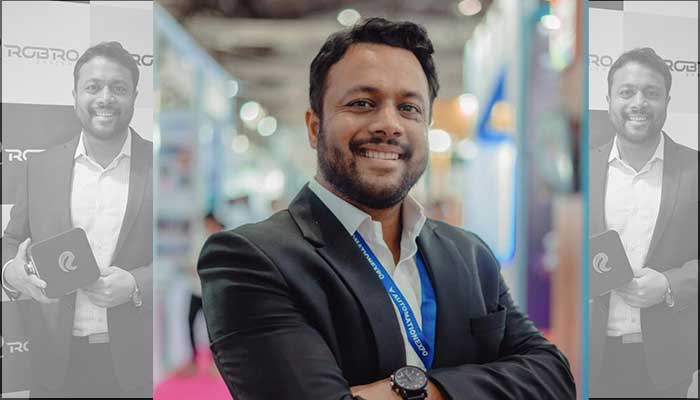
Harshit Sureka is a happy amalgam of legacy entrepreneurship and research capabilities. The Founder- CEO of Robro Systems talks about his new-age robotic tech startup and how IIIT Hyderabad directed his foundational understanding of machine vision and automation, to design bespoke tech-based solutions for specific manufacturing processes.
An entrepreneur rolled into the exploratory mind of a researcher and combined with the adventurous spirit of a backpacker. These are the hats that Harshit Sureka, a robotics engineer and start-up founder from Indore, wears with easy confidence.
The IIIT Hyderabad alumnus worked with the National Robotics Engineering Center in Pittsburgh, USA, on sensitive projects for the US Department of Defense (now Department of War). Along with strong exposure to advanced robotics, he got to experience a backpacker’s life when he took a six-month sabbatical to travel across South America, Europe and Southeast Asia. Later, at Bosch India, as Team Lead, he was tasked with building AI and ML capabilities to compete with their European principals. A strategic move to Sunjewels Group as General Manager-Robotics and Automation, would expose him to the inner mechanisms of the factory assembly line, the scope and challenges in its automation.
Harshit followed in the footsteps of his father and grandfather, who built Carryfast Group, their warehousing and logistics industries. Today, he juggles his roles as partner at Carryfast along with steering his robotics start-up, a diversification of the family business into new technology.
IIIT Hyderabad -Where real people do real work
It was a pretty typical journey for Harshit who followed the popular AIEEE path to IIIT Hyderabad. Back in 2012, the timely guidance of a coaching center senior would encourage the youngster to join the research Institute that stood out for its computer science-focus. He joined the integrated B. Tech-MS in Computer Vision program and found the campus homely, enriching and “a place that does real work with real people”.
Away from home for the first time meant getting used to hostel life, new friendships and smarter ways of doing things. Early exposure to programming concepts was driven through coursework and the visionary guidance of faculty like Prof. Kannan Srinathan, Prof. Kamal Karpalem, Prof. Harjinder Singh, Prof. Rajeev Sangal, Prof. Abhijit Mitra, Prof. Anoop Namboodiri, Prof. CV Jawahar and Prof. Madhava Krishna. “Each brought their unique personality into teaching spatial imaging and focused on the philosophical building up of things and oneself”, he recalls.
Courses on psychology and cognitive science with Prof. Bipin Indurkhya offered a tangential perspective. But beyond that, it was the philosophy of approaching work and defining the research problem that resonated. It taught him to study literature carefully, explore possibilities, iterate through failures and get behind the black box to fundamentally understand how things work. “I think that’s the core of research promoted at IIIT-H, that shaped me to pursue entrepreneurship, get a stronger handle on market research and innovative positioning”.
From his third year at CVIT, he describes Prof. P. J. Narayanan’s role as pivotal to shaping his future trajectory. “We were creating courses on computer vision, pattern recognition, machine learning and working on GPUs, that was pushing the boundaries at that time. Recently, when Prof. PJN visited my office, he was happy to note that we were continuing to work in computer vision and machine vision”.
Eggless Burji and other memories
There was never a dull moment on campus; organizing Felicity, publishing papers in premier conferences like ECCV and ICV, and a conference to Italy on a travel grant that would translate into a good placement. A specially whipped up masala egg burji for the vegetarian minus the eggs, the multiple cups of tea at the cafeteria, and inter-house football competitions are lingering campus memories. Life at the Old Boys Hostel was interesting, with smart guys learning from each other while binge-watching television series and video games with batch mates who still remain his core friends circle.
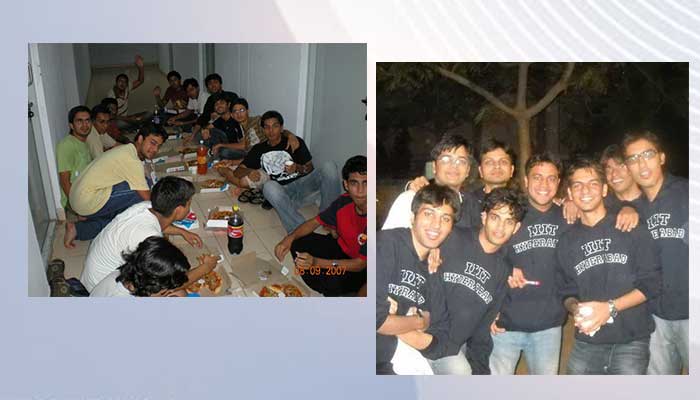
Ahoy Pittsburgh. Good friends and better projects
Coming from a strong business family background, big industry names did not enamor the scholar whose mind was set on doing something off the beaten track. During the application process to US-based companies, Harshit did a short internship at GE Healthcare, on virtual human body mapping with Neuro CT scan images, that bagged him a patent and the Imaging Technologies Intern Award.
A lucky break through Prof. PJN’s reference was a big turning point. In December 2012, Harshit joined the National Robotics Engineering Center (NREC) in Pittsburgh, USA, as a Robotics Engineer. Projects for the US Department of Defense gave him good exposure to advanced robotics; including one involving an autonomous helicopter dropping an autonomous military tank into territory. It was an exhilarating chapter in his life that he enjoyed thoroughly, forging deep friendship networks and savoring community life.
Backpacking through the continent
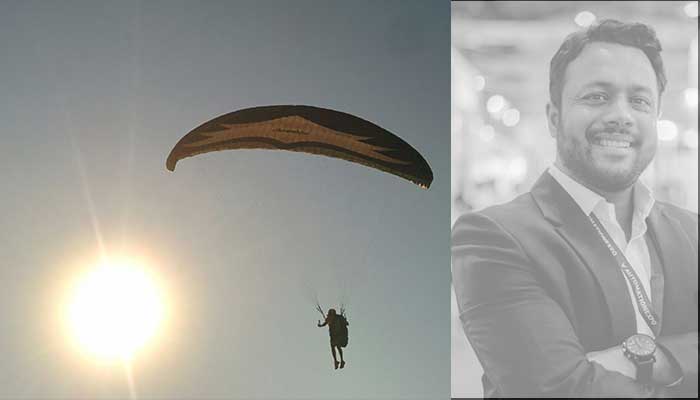
Twenty months later, bitten by the travel bug, Harshit quit his job to backpack across South America and South east Asia. The European sojourn alternated between working in a startup in Germany while traveling and immersing himself in the local culture. Given his expertise in working on complex applications in robotics, the six-month sabbatical was something that he could well afford.
God is in the details
With the intention of exploring an opportunity in medical robotics, he moved to his hometown Indore in 2015. While the project was a nonstarter, interesting freelance projects came along, including writing software for drones that would bring him up to date with the latest tech and open source software in robotics and AI ML.
He soon moved to Bosch, Bangalore as Team Lead of the Robotics department, to set up their ML team that would work on innovation projects. Working with vendors on basic tasks like pedestrian tracking and reading car license plates, Harshit realized that there was a big market for curated solutions, and a right fit for him.
A chance conversation with a family member led to a year of research at Sun Jewels, getting a real sense of jewelry manufacture, understanding opportunities and challenges in adopting automation. He explains, “Today we deploy cameras for quality control in diverse manufacturing environments. You don’t really need to chase very high-tech stuff. Our consultancy dives deep into the domain knowledge of the customer to define the problem statement that are amenable to tech-based solutions”.
Robro system gets wings
Harshit’s entrepreneurship style chose to pursue customers over pitch decks and angel investors. The philosophy was always to build a product company with a strong research focus, rather than a services company.
Robro systems was launched during the pandemic. It was an enabling era for companies who had started thinking about automation for quality inspection, that was historically heavily manual. The business went through three pivots; from offbeat projects like cameras to monitor hand-washing, a farming robot and a warehouse tracker to building tech-solutions for manufacturing processes, like an inventory system for makeup brushes. The current focus is on textile and fabric inspection, with strong scaling potential at a global level. In the technical textile domain, the focus is on reinforcement fabrics for tyre, windmill blades, airbags and parachutes.
Harshit’s sharp business acumen has won him several recognitions, including startup awards, a Top CEO award and a sizeable MSME grant for developing his platform. He has a few personal and company patents, for an inspection system and quality control of masala content on matchsticks and agarbattis. The company serves 50 plus clients. “While 80% focus is still India, Turkey and Indonesia are emerging as our core export markets”. Along with orders in the pipeline in the Middle East, expansion plans include Thailand, Vietnam, South American and European markets.
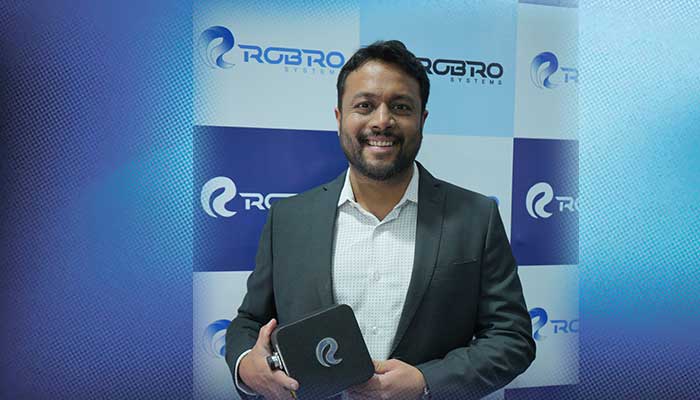
Enabling communities and close kinship
Machine vision especially cameras with immense AI capabilities have made rapid strides in areas like retail, manufacturing, product performance monitoring, efficiency optimization and defect reduction.
“We are trying to bring all stakeholders together to democratize manufacture, negotiate pricing with camera makers and build better software, by shifting focus to manufacturing and solving problems”, observes Harshit, who as President and charter member of the Indian Machine Vision Association seeks to expand Indian manufacturing capabilities, especially in lenses and lighting, that are currently imported. “Through IMVA we are also trying to build better academic and industry collaborations. Today, with the advent of Claude and AI-level coding, there is a shift towards understanding the customer and that is a human problem that no tech can solve”.
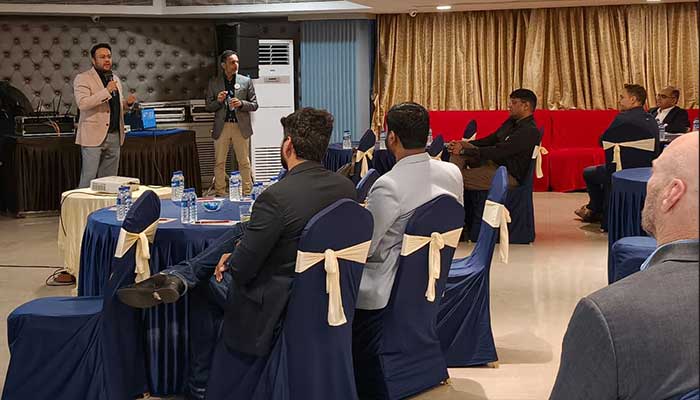
“A chief motivation for all the hard work I do is to splurge on traveling and explore the whole world with my wife and our two young boys”, he smiles. Morning yoga is a chief anchor in his life and a non-negotiable time.
Harshit who fondly remembers the camaraderie at the 2023 Alumni Meet says, “The IIIT-H alumni community plays a powerful part through WhatsApp support groups like the entrepreneurship group, for problem solving and academic connections. I have learnt a lot about balancing professional and personal life through these groups. Today, much of my time goes into strategy, team structuring, training and development. The company has proved that we can build a profitable business”. The next goalpost is to build a rugged organisation with stronger systems, better structure, a scalable model and talented hires attuned to the business philosophy.
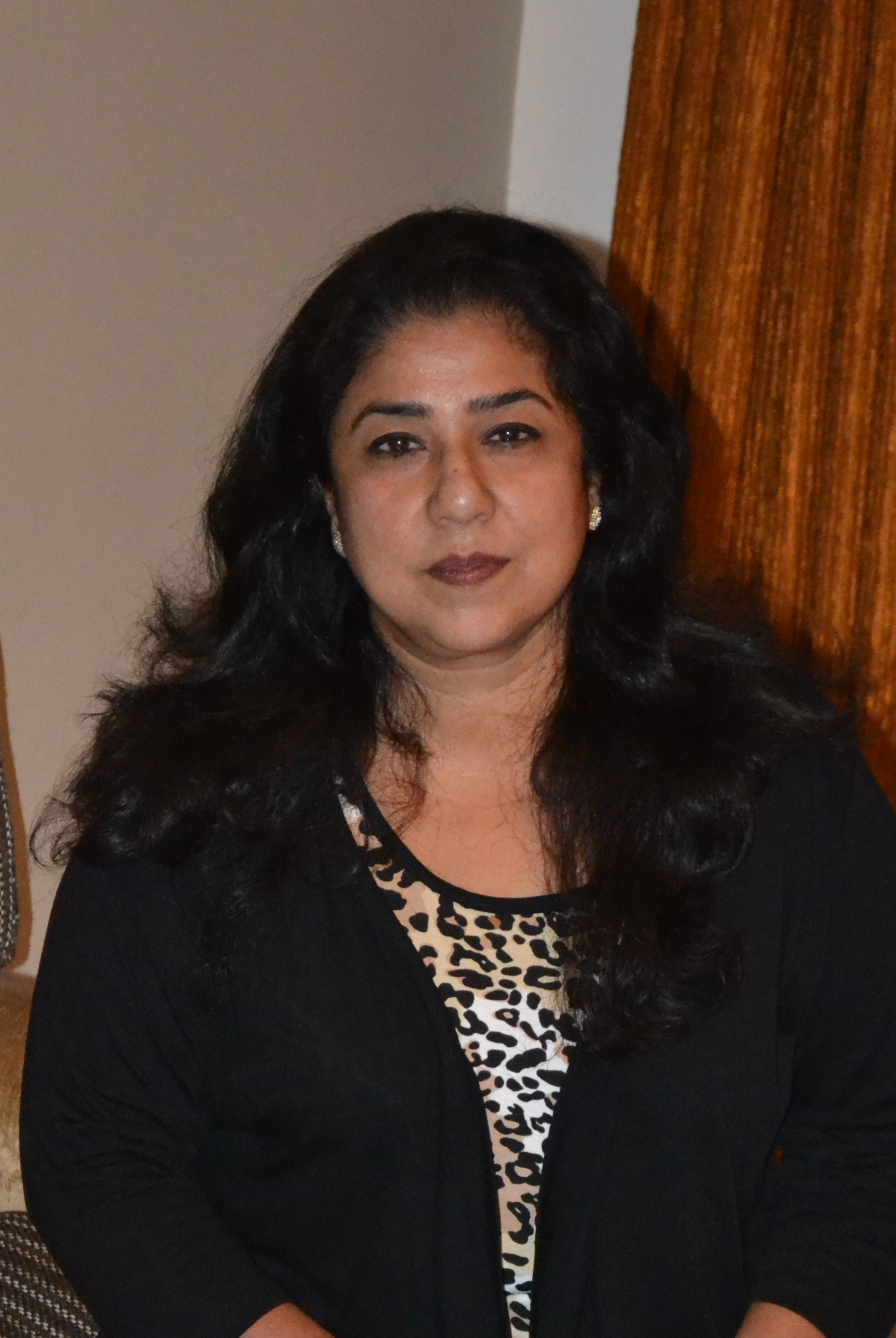
Deepa Shailendra is a freelance writer for interior design publications; an irreverent blogger, consultant editor and author of two coffee table books. A social entrepreneur who believes that we are the harbingers of the transformation and can bring the change to better our world.
Next post