
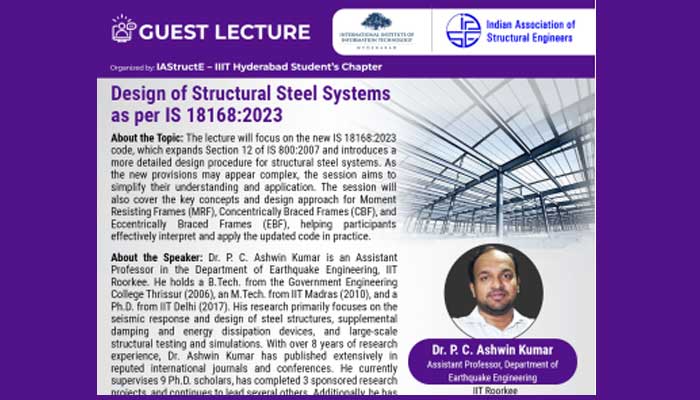
Dr. P C Ashwin Kumar, Assistant Professor, Department of Earthquake Engineering, IIT Roorkee gave an online expert lecture on Design of Structural Steel Systems as per IS 18168:202 on 19 November. The session provided valuable insights into the design philosophy, structural behaviour, and practical implications of the newly introduced IS 18168 code for the seismic design of steel structures. Dr. Ashwin explained how IS 18168 complements IS 800 by addressing seismic demands with enhanced clarity and precision, encouraging a transition from conventional strength-based design towards a more ductility-focused approach. He elaborated on the capacity design philosophy, clearly distinguishing between deformation-controlled and force-controlled elements, and emphasized the importance of establishing an appropriate hierarchy among structural components to ensure predictable, controlled, and repairable damage during seismic events.

Further, the lecture highlighted the material requirements essential for achieving ductile seismic performance. Dr. Ashwin discussed the importance of parameters such as ultimate-to-yield strength ratio, elongation capacity, fracture toughness, and welding quality in influencing cyclic behaviour and ensuring reliable performance under earthquake loading. He stressed that high-quality welding is critical, as it directly affects the structural integrity and ability of the system to dissipate energy during cyclic deformation. The session also covered the influence of section selection and member geometry on seismic performance. Dr. Ashwin highlighted the advantages of using doubly symmetric parallel-flange sections, owing to their superior resistance to cyclic demands, reduced susceptibility to premature buckling, and ability to provide the rotational capacity necessary for effective energy dissipation. He also discussed challenges related to analysis and detailing, including modelling complexities, brace configuration issues, instability, and behaviour at plastic hinge regions.
A comparative discussion of different structural systems, including Special Moment Resisting Frames (SMRF), Concentric Braced Frames (CBF), and Eccentric Braced Frames (EBF), provided clarity on their respective suitability in varying seismic zones. Dr. Ashwin also outlined a step-by-step workflow for implementing IS 18168 effectively in design practice, covering system selection, global analysis, identification of plastic mechanisms, capacity-based force calculations, and proper proportioning of both ductile and non-ductile elements. The lecture concluded with an interactive Q&A session, where participants engaged in discussions on system adaptability, Indian steel grades, connection behaviour, detailing challenges, and their practical applications in the field. Dr. Ashwin provided precise technical guidance and valuable real-world insights, making the session highly informative and engaging.

Overall, the lecture significantly enhanced the participants’ understanding of modern seismic design practices for steel structures and provided a comprehensive perspective on the effective application of IS 18168 in structural engineering.
YouTube Link: https://www.youtube.com/watch?v=9yLdzGvZTEE
November 2025