
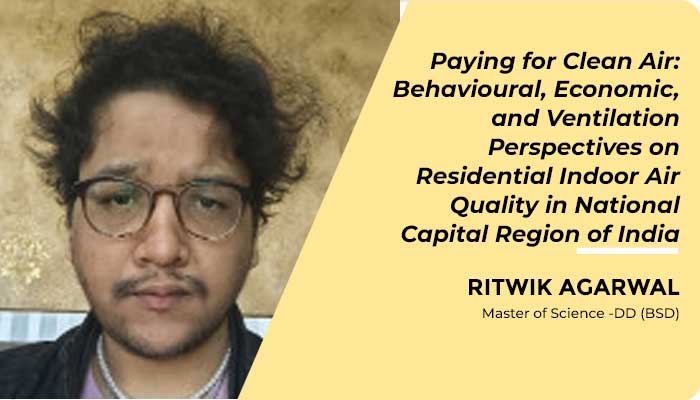
Ritwik Agarwal supervised by Prof. Vishal Garg received his Master of Science – Dual Degree in Building Science (BSD). Here’s a summary of his research work on Paying for Clean Air: Behavioural, Economic, and Ventilation Perspectives on Residential Indoor Air Quality in National Capital Region of India:
Air pollution is a growing concern in India, specifically in the National Capital Region (NCR) which is one of the world’s most polluted regions. Despite the recognized problem, there is a lack of research focusing on how people perceive air pollution, the specific actions they take to protect their well-being from its impact, and how effective these personal strategies really are. This thesis is designed to address these knowledge gaps by examining public awareness of air pollution in India and the effectiveness of solutions used to improve Indoor Air Quality (IAQ) and further explores how urban residents respond to degraded air quality through a combination of personal behaviours, technological interventions, and adaptive strategies such as change in window opening and closing behaviour in response to pollution, change in day-to-day lifestyle choices and willingness to invest in cleaner air. As part of the study, ethnographic in-person interviews were conducted to gather detailed socio-economic perspectives. A mixed methods approach was employed, involving interviews from 101 households in Delhi and its neighbouring cities like Ghaziabad and Noida. Both Qualitative and Quantitative methods were used to corroborate the statistical findings with descriptive accounts. The findings reveal widespread awareness of the Air Quality Index (88% are aware), but limited understanding of PM2.5 and its health implications (only 33% know about it). Air purifiers emerged as a common IAQ intervention, yet 40% of non-owners cited doubts about effectiveness or believe that IAQ in their house is sufficiently good. Cost and habitual behaviour to air purifiers were additional primary barriers. Among purifier owners, 75% reported perceived benefits, but many saw these as temporary or insufficient given the scale of outdoor pollution. Furthermore, aspects like frequency of purifier use and regular maintenance were assessed as they impact the efficacy of solution. Over 35% of surveyed households already own purifiers indicating revealed Willingness to pay (WTP), while an additional 23% showed interest if costs were subsidized or if they were offered a different plan scheme once given enough information about Indoor Air Quality. Estimated WTP for clean air interventions ranges from 10,000– 15,000 INR per household annually, depending on income and awareness levels. Similarly, when asked about trust in government mitigation programs to address air pollution, more than 60% of people revealed that they don’t trust the government to address these issues but around 58% of people still want to contribute a monthly amount to the government to improve public transportation and other programs that address vehicular pollution. The study also assesses how people respond to pollution and thus tries to bridge the gap between vi vii occupant behaviour and optimal Natural ventilation practice. The thesis proposes a pollution-aware natural ventilation (NV) strategy, guided by PM2.5 and PM10 thresholds. To evaluate its effectiveness and compare it with common practices, this strategy was modelled using EnergyPlus simulations. Simulation results indicate that aligning natural ventilation (NV) schedules with real-time pollution data can reduce energy consumption by up to 10.5%, compared to typical occupant behaviour during pollution episodes, while still maintaining acceptable indoor air quality. This approach promotes energy-efficient and occupant-centric ventilation practices even in high-pollution environments while making sure that IAQ is not compromised. The thesis concludes with recommending a multi-pronged approach: integrating sensorbased NV systems into residential buildings, scaling public awareness campaigns focused on PM2.5 literacy and IAQ awareness, and designing incentive programs to expand access to IAQ technologies including better usage practices of Air Purifiers. By combining interview-based behavioral insights, simulation-based optimization, and economic insights, this research offers actionable pathways for managing and improving Indoor Air Quality in polluted urban regions of India.
September 2025