
From taking root as a foundational step towards autonomous driving research, the Indian Driving Dataset continues to evolve to tackle a plethora of problems that are India-specific.
There’s a humorous encounter in Tintin in Tibet when Tintin and Captain Haddock who are breezing through Delhi en route to Kathmandu find a cow, blocking their path in a busy bazaar. Herge’s strong sense of humour notwithstanding, it also spotlighted his attention to detail that includes an accurate snapshot of Indian roads which are a chaotic traffic mix. Two wheelers, 3-wheelers – both motorized and non-motorized, trucks, cars, pedestrians, animals and more make up the heterogeneity that is uniquely Indian. It is this unstructured feature of Indian traffic that prompted researchers at IIITH to address research in autonomous navigation a little differently. They were quick to recognise that in the West, such technology catered to well-delineated roads, well-defined categories of vehicles, adherence to traffic rules and so on. “Most of the smart vehicles are designed for Western roads. They are tested, calibrated and verified on Western roads. We knew our roads are different but how different? We wanted to capture those differences objectively and decided to begin with the creation of a dataset,” explains Prof. C V Jawahar of the beginnings of the Indian Driving Dataset.
Competitions To Solve Problems
The initial goal of the group was to mimic Western data collection, only 5x larger. With generous support from Intel, it was a goal that was accomplished in a year’s time frame and was the first, open, large-scale, curated dataset on unstructured driving conditions. What were initially datasets on detection and segmentation grew to include other aspects of machine learning, deep learning and autonomous driving. There are now specific datasets in the IDD collection such as the multi-modal IDD, the ‘lite’ IDD – for use in resource-constrained setup especially useful for young researchers who lack access to big compute, IDD-3D, IDD for fine grained videos, IDD for missing traffic signs video and so on. When algorithms were tested on the Western datasets and the uniquely Indian ones, a distinct gap was found. “Today, in the AI space if we want the best of the brains working on problems, the way to go about it is to invite collaboration by throwing open the challenges to all,” reasons Prof. Jawahar. Hence a slew of competitions and workshops were organised at the top Computer Vision conferences such as CVPR, ICCV, and ECCV, to name a few, where participants’ insights helped in improving the current SOTA benchmarks on the datasets.
Bodhyaan Platform
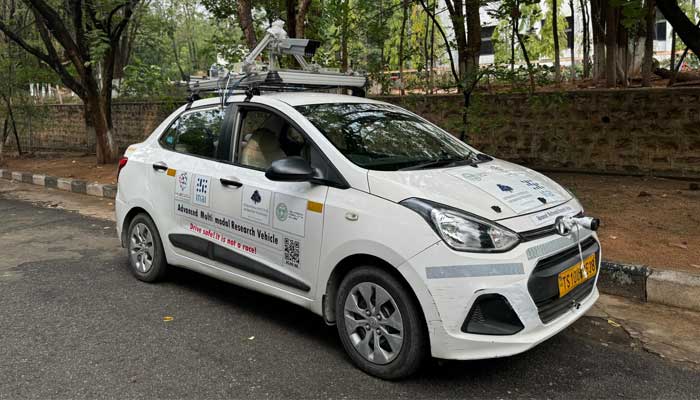
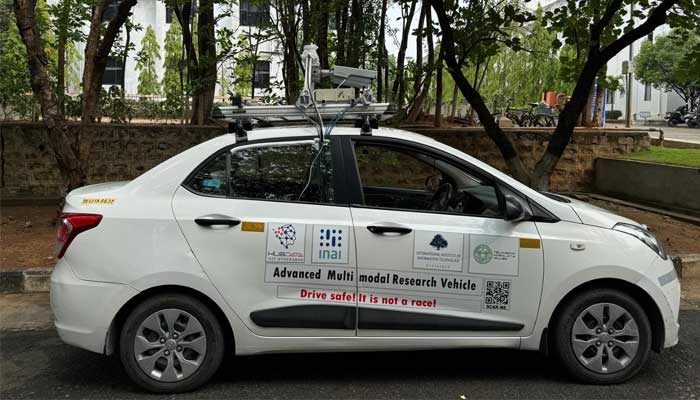
“We now have over 15,000 downloads with 10,000 IDD users spanning across 88 countries of the world,” remarks Dr. Anbumani Subramanian, AI researcher and Adjunct Faculty, IIITH, adding, “The datasets in IDD have helped many students, researchers and startups to learn and contribute to building new and improved algorithms and push the boundaries of cutting-edge research. Some startups in India have also benefited from the free and open nature of the dataset to explore problems related to unstructured driving conditions”. In addition to the dataset, iHub-Data at IIITH has also developed an advanced multimodal research vehicle platform which is essentially a data capturing platform equipped with multiple sensors and cameras. This vehicle is available to students, researchers, startups and others in the mobility ecosystem and is useful for experimenting with technology such as ML, computer vision, image processing, pattern recognition.
Same Tech, Multiple Uses
The advantage of this mobility research is that the same technology that makes self-driving cars possible through object detection can also detect pedestrians, analyse traffic flow and monitor the conditions of roads and other infrastructure. “It is also the same technology that enables identification of pot holes, and water logging on our roads,” exclaims Prof. Jawahar. This has spawned other interesting use cases like road inspection, damage estimation, infrastructure planning and more. “If we want to survey the area of Hyderabad after 2 days of relentless rain to assess its impact, existing civil engineering technology would take weeks or even months to complete it. One ought to be able to drive through the network of roads with a small dashcam or mobile phone, capture images, upload them onto a server, use AI algorithms and create an estimate which will tell us the areas requiring urgent intervention,” says the professor.
Inspired by the group’s efforts, the Telangana Government sought a similar computer vision-based solution to estimate the extent of green cover in Hyderabad city. “We could extend our simple algorithm that was originally counting cars and bikes to count trees instead,” states Prof. Jawahar. It was at this time that IDD moved into two different directions: One that continued to work on cutting edge algorithms and the other that targeted India-specific problems. “Whether it was pothole detection, tree counting or traffic violations detection, we demonstrated that these solutions which otherwise would have been point solutions could be deployed large-scale, at the national level,” says Dr. Subramanian.
Ground Level Facts
A recent white paper titled, ‘Autonomous Vehicles: Timeline and Roadmap Ahead’ published by the World Economic Forum states that early forecasts expected mass adoption of autonomous vehicles in the 2020s but in reality a large-scale rollout will be slower than anticipated due to technological, regulatory and operational challenges. “In India, the problem of adoption is even harder than one imagined,” states Prof. Jawahar. He goes on to explain how different levels of vehicle automation exist. “From Level zero, which is largely manual with the driver retaining all driving tasks albeit with the presence of automatic emergency braking system, all the way to Level 5 where the system drives in all conditions and requires no take-over by the driver at all. The levels in-between are concerned with different levels of assisted driving like ADAS, partially automated driving and so on. We may not have achieved full autonomy but our vehicles today are AI-enabled. They have many components that have come about as a result of autonomous navigation research,” he says. While complete autonomy in terms of driving remains the ultimate goal, the focus of the research group at IIITH has pivoted to more realistic everyday challenges.
Other Explorations
One of the aims of the group from the very start has been to invite collaborations with researchers and industry-alike to work on the dataset – an undertaking that hit a roadblock during the pandemic. “We would like to provide all the infrastructure and get the researchers to work here so that they not only develop algorithms but also work closely with us,” affirms Dr. Subramanian. One of the other goals is to simulate driving on Indian roads. “We have a simulator in the lab and have interesting initial results but we want to eventually have a larger, 3D system,” observes Dr. Subramanian. Another thought-provoking thread that has emerged from the research explorations concerns educating everyone about mobility. “If society needs to change, we need to start at different levels. In this case, it includes educating drivers, pedestrians, school-going children about road safety and traffic discipline. Similarly, videos on vehicle maintenance exist today but they are all Western-audience specific, available largely in English. We would like to have such information available in Indian languages,” mentions Prof. Jawahar.
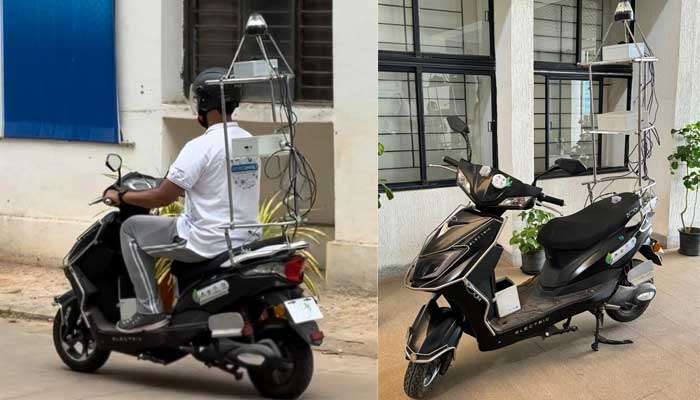
Perhaps one of the most important offshoots of the original IDD has been the dataset on 2-wheeler driving. Not only is India the world’s largest market for 2-wheelers, the latter form approximately 75% of the total registered vehicles in the country. “We are trying to understand mobility-related problems from the perspective of 2-wheelers which form the majority of our traffic. This dataset has now been included under the IDD collection. It aims to cover multiple aspects of 2-wheeler technology from the hardware side of developing cost-effective increased range of EV batteries to the software-related technologies such as fall detection, rider alert and assistance,” notes Dr. Subramanian. Drawing a parallel with the growth of a banyan tree known for its aerial roots that allow it to spread and cover vast areas, he reflects on the entire foray into the mobility space by calling it a “moonshot that had so many useful byproducts. There are so many threads that have come out of the initial research that any interested researcher can pick up and follow through.”

Sarita Chebbi is a compulsive early riser. Devourer of all news. Kettlebell enthusiast. Nit-picker of the written word especially when it’s not her own.
Next post