
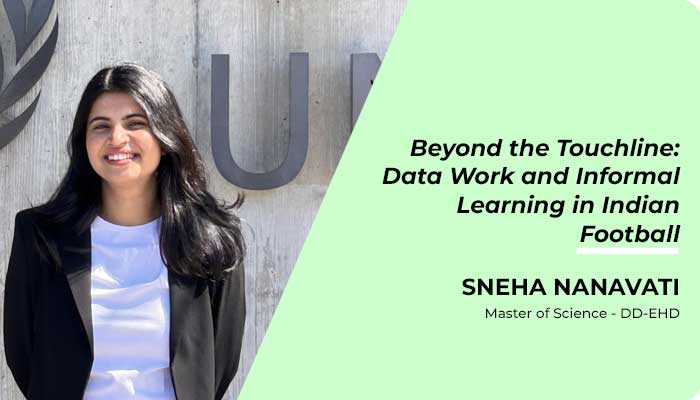
Sneha Nanavati supervised by Dr. Nimmi Rangaswamy received her Master of Science – Dual Degree in Exact Humanities (EHD). Here’s a summary of her research work on Beyond the Touchline: Data Work and Informal Learning in Indian Football:
Overview This thesis investigates how football analytics is adopted, adapted, and reimagined in under-resourced, institutionally marginalised contexts, specifically Indian men’s football and global women’s football. These settings challenge dominant narratives around data and sport, foregrounding alternative modes of innovation based on frugal infrastructures, informal peer learning, and decentralised knowledge networks.
Motivation and Background Football analytics has become integral to decision-making in elite clubs worldwide, offering granular insights through metrics like expected goals (xG), pitch control, and on-ball value. However, the uptake of analytics has been uneven. In India and women’s football, the absence of institutional support, investment, and infrastructure necessitates improvisation. Despite these constraints, analysts in these spaces are producing meaningful work through passion, experimentation, and public learning.
This thesis introduces the concept of “data sleuths” to describe India’s self-taught analysts who learn in public, publish on Twitter, and challenge conventional notions of expertise. It also highlights how frugal data practices and gender-aware tooling can disrupt long-standing infrastructural inequalities in football analytics.
Research Questions
Central Inquiry: How do infrastructural, institutional, and socio-cultural conditions shape the development and use of football analytics in resource-constrained settings, and in what ways are decentralised communities reimagining their possibilities for participation, legitimacy, and innovation?
Sub-questions:
- What infrastructural, institutional, and cultural barriers shape the adoption of football analytics in the Indian football ecosystem?
- How do informal digital communities and peer-led knowledge networks support skill-building, visibility, and career mobility among self-taught analysts?
- In what ways does analytics serve as a frugal innovation strategy in underfunded settings?
- What does the rise of fanalytics and decentralised data ecosystems reveal about emerging pathways for learning and labour in sport?
Methodology A qualitative, iterative-inductive ethnographic approach was used, drawing on:
- Semi-structured interviews with football club analysts, data journalists, and community members
- Social media shadowing (particularly Twitter/X)
- Observational field notes and asynchronous exchanges
Participant categories:
- Data Sleuths: Independent enthusiasts learning in public, often transitioning to professional roles
- Football Club Data Analysts: Professionals embedded in clubs, typically self-taught
- Football Writers & Journalists: Storytellers who use data to craft narratives
Key Findings
- Informal Learning and Peer Mentorship Analysts rely on self-directed learning, shared tools, and online communities. Knowledge circulates through blogs, repositories, YouTube videos, and social media, creating an informal apprenticeship network.
- Institutional Frictions Even as analytics gains visibility, institutional hierarchies and legacy cultures limit its integration. Analysts often operate on the fringes of decision-making, with limited access to data or influence.
- Frugal Innovation Infrastructural scarcity fosters improvisation. Analysts repurpose freely available tools, adapt workflows, and innovate around constraints to build robust models and visualisations.
- Social Media as Infrastructure Twitter/X serves as a learning pipeline, hiring platform, and visibility engine. However, it also creates pressures of self-performance and intensifies competition for attention.
Contributions This thesis contributes to multiple overlapping domains:
- To HCI: Offers grounded insights into informal knowledge production and participatory tech practices.
- To ICTD: Presents a case of frugal innovation and decentralised infrastructures in sport.
- To Sports Analytics: Brings a sociotechnical lens, highlighting how expertise and legitimacy are shaped by digital labour and community interaction.
More broadly, the study challenges assumptions that innovation must emerge from elite institutions. It argues that Indian football analytics exemplifies how digital platforms, peer mentorship, and frugality can create alternative futures for learning and labour.
Conclusion By centring the everyday practices of Indian football analysts, this research reveals an ecosystem that is simultaneously precarious and generative. It documents how decentralised infrastructures operate in the Global South, and how informality and care can fuel technological participation. The thesis ends with design-oriented suggestions for building more sustainable, equitable support systems for early-career analysts in sport.
August 2025