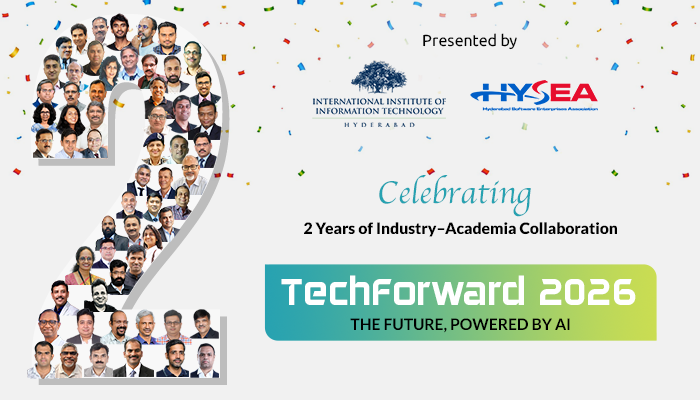
While a solid foundation and a great start for industry-academic collaboration across a broad spectrum of digital innovation has been made, the next phase of TechForward will focus on strengthening engagement, translating ideas into partnerships, and creating greater impact through deeper, more sustained collaboration.
TechForward is IIIT Hyderabad’s flagship industry-academia seminar series designed to create sustained dialogue between academic researchers and technology industry leaders. Conceived as a recurring platform around emerging technologies, the series brings together researchers, practitioners, product leaders, architects, startup founders, and business executives to explore technological frontiers and identify opportunities for collaboration.
The initiative emerged from a recognition that India possesses both world-class academic research capabilities and a rapidly growing technology industry, yet meaningful engagement between the two remains limited. “While on one side the tech industry has all tech majors building products in India, and on the other side we have the academic research doing some good world-class work, these two worlds rarely intersect. The industry doesn’t engage academia much, while the same companies may have university research engagements in the US and Europe. Partly it is mandate (or lack thereof) in the India entities, partly it is lack of visibility into the research works and capabilities, partly also no conversations to discover possibilities to engage, and in some cases it is simply the lack of right connections. A regular and recurring industry-academia dialog is needed to fix most of these issues. And fixing these is much needed if the tech industry must move up the value chain,” observes Ramesh Loganathan, Prof. and Dean of Research who also anchors industry outreach.
Where The Twain Met
TechForward was created precisely to address this gap by providing a regular forum where industry and academia could engage in meaningful conversations around cutting-edge technology trends, research directions, and real-world applications. Launched as a monthly seminar series, TechForward has evolved into a travelling forum hosted by leading technology companies, innovation centers, and research institutions across Hyderabad. Each edition focuses on a single emerging technology theme and combines academic perspectives with industry experience. Over time, the talks have also been distilled into monthly dispatches that serve as technology trend briefings for the wider ecosystem.
Positive Reactions
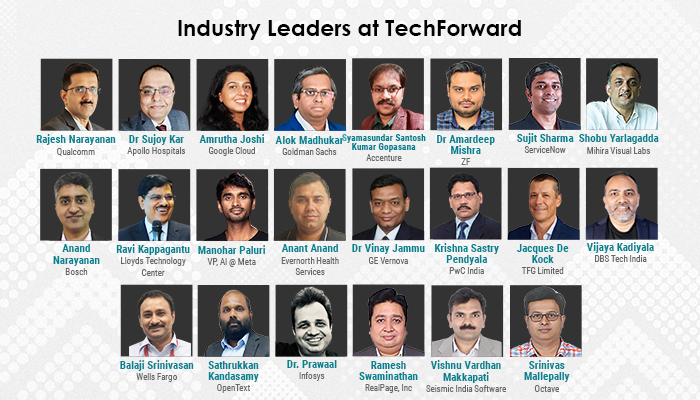
The industry response has been overwhelmingly encouraging. According to Prof. Loganathan, “Industry has been very positive about this – from the few senior leaders coming in as members of the Tech Forward Industry Advisory Council to every major company readily agreeing to host the monthly editions, to also bringing in senior leaders in their companies to the roundtables and seminars every month.” This enthusiasm has enabled participation from a broad spectrum of organizations including Qualcomm, Google, Meta, Goldman Sachs, Bosch, ServiceNow, Accenture, Evernorth Health Services, Lloyds Technology Centre, ZF India, ISB and several others.
Sweeping Overview of The Themes
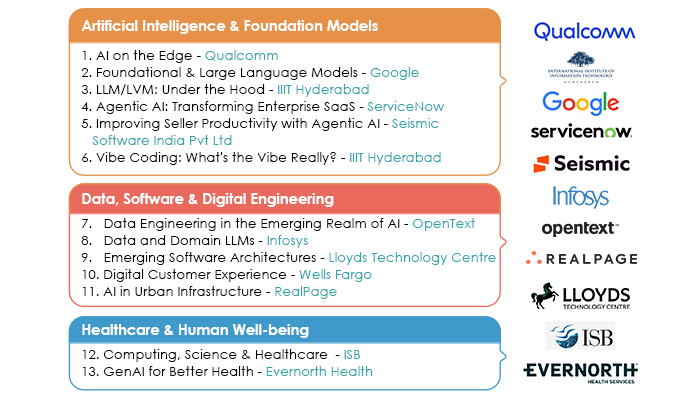
One of the defining characteristics of TechForward has been its breadth. Rather than focusing on a single discipline, the series has explored the technologies shaping the future of business, society, and innovation.
Artificial Intelligence and Large Language Models
AI has been a recurring theme throughout the series. The sessions have examined Enterprise adoption of LLMs, Generative AI applications, Agentic AI systems, AI-powered productivity tools, AI deployment in business environments and Human-AI collaboration. The series has evolved alongside the rapid advancement of AI, moving from foundational discussions around machine learning to newer themes such as autonomous AI agents and enterprise-scale AI systems.
Computer Vision and Intelligent Perception
Several editions have focused on how machines perceive and understand the physical world, covering Computer vision research, Image understanding, Visual intelligence systems, Industrial vision applications and Autonomous systems perception. These discussions have highlighted the journey from academic research breakthroughs to deployment in real-world systems.
Robotics and Autonomous Systems
The series has explored advances in robotics, intelligent automation, and autonomous decision-making, examining how AI, sensing technologies, and robotics are converging to create increasingly capable systems.
Quantum Computing
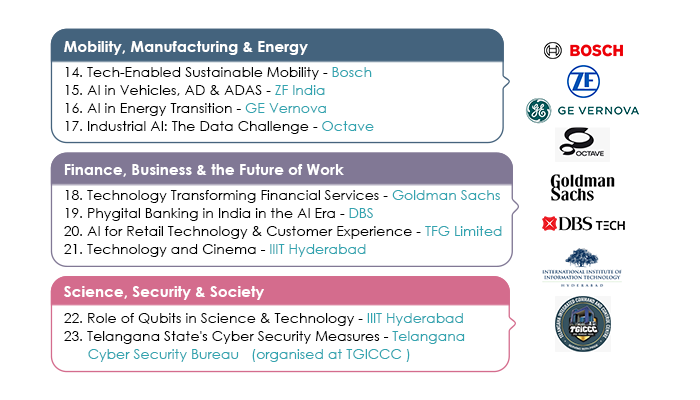
Recognizing the transformative potential of quantum technologies, TechForward included discussions on Quantum computing architectures such as future computational paradigms, research challenges, industry opportunities, as well as the long-term implications of quantum systems. These sessions helped demystify a field that is often viewed as highly specialized and inaccessible. Its relevance especially spans several critical areas from drug discovery to data security where it is shifting from a theoretical concept to an applied technology.
AI on the Edge
As intelligence increasingly moves closer to devices and sensors, TechForward examined Edge AI architectures, Embedded intelligence, Real-time inference systems, Resource-constrained AI deployment and Distributed intelligent systems. The theme highlighted the importance of bringing AI capabilities beyond the cloud and into operational environments.
Sustainable Mobility and Transportation
Mobility technologies featured prominently, including Intelligent transportation systems, AI-driven mobility, Connected vehicles, Sustainable transportation and Future mobility ecosystems. These discussions connected advances in AI, sensing, and systems engineering with broader societal challenges such as urban mobility and sustainability.
Healthcare Technologies
The healthcare editions explored how technology is transforming diagnosis, treatment, patient care, and health system operations through AI, data science, and digital platforms.
Financial Services and FinTech
The sessions focused on the evolving role of technology in financial systems, covering digital transformation, AI-driven decision-making, risk management, and the future of financial services.
Software Architecture and Engineering
Recognizing that innovation requires strong foundations, TechForward included discussions on Modern software architectures, Engineering at scale, Enterprise platforms, Product development practices and Engineering leadership. These conversations helped bridge research concepts and practical implementation challenges faced by technology organizations.
Cybersecurity
The series has addressed cybersecurity from both policy and technology perspectives, including discussions on state-level cyber resilience and emerging security challenges in an increasingly digital world.
Energy Transition and Sustainability
A dedicated edition examined the role of AI in energy transition, exploring how intelligent systems can support sustainability goals, improve efficiency, and accelerate the move toward cleaner energy ecosystems.
Retail Technology and Customer Experience
The retail-focused edition looked at how AI and digital technologies are reshaping customer engagement, personalization, and retail operations.
Industrial AI and Data Readiness
Recent discussions have focused on one of the most important challenges in enterprise AI: creating high-quality, AI-ready data foundations. The conversations explored data governance, industrial data architectures, contextual labeling, and scaling AI in complex enterprise environments.
Technology and Cinema
One of the most unique editions examined the intersection of technology, storytelling, visual effects, and digital content creation. The discussions showcased how advances in computing are reshaping creative industries and opening new frontiers for digital media innovation.
Impact and Outcomes
The primary success of TechForward has been creating sustained intellectual engagement between industry and academia. “While the Tech Forward series itself hasn’t yet triggered anything very tangible, it did trigger more awareness of the academic world in various companies, and some conversations have happened around joint projects. But it did trigger intellectual conversations,” reflects Prof. Loganathan. He also notes that meaningful industry-academia collaborations are possible when both sides engage deeply. A notable example from IIIT-Hyderabad is its long-running collaboration with Intel. “Specifically at IIIT-H, we have had a multi-year collaboration with Intel around creating India Driving Datasets for AD, ADAS and broader road safety. This is one of the most successful collaborations that has got very tangible IP, very significant research outcomes and very effective improvements in road monitoring and safety through government deployments in Nagpur and Hyderabad,” he notes.
This serves as an illustration of the type of long-term engagement that industry-academia partnerships can achieve when structured effectively.
Evolution of the Format
As the series has matured, organizers have recognized the need for deeper engagement beyond public seminars. Prof. Loganathan explains, “At the end of the first year we added a closed-door roundtable to each month’s edition to get deeper conversations before the main open seminar.”
The roundtable format enables senior industry leaders, researchers, and policymakers to engage in more focused discussions around opportunities, challenges, and potential collaborations.
Looking Ahead
TechForward’s first phase successfully established a trusted forum for dialogue and relationship-building across Hyderabad’s technology ecosystem. As Prof. Loganathan candidly notes, “As a series, while it did help get the tech industry leaders and academicians onto a common forum deliberating on latest technology and possibilities once a month, it didn’t lead to more tangible collaborations though, not yet at least.” The next phase aims to move beyond conversation toward action. “This year we will explore ways to initiate more specific and active collaborations each month. We will brainstorm with leaders to find ways to make this happen,” he says.
In many ways, this reflects the broader ambition behind TechForward itself: not merely to discuss emerging technologies, but to create the conditions where industry and academia can jointly shape the future of innovation in India.
Consequential Common Ground
TechForward has emerged as one of Hyderabad’s most significant platforms for industry-academia engagement. Across topics ranging from AI, robotics, quantum computing, computer vision, cybersecurity, healthcare, financial technologies, sustainable mobility, industrial AI, and digital creativity, the series has created a recurring space for thought leadership, knowledge exchange, and ecosystem building.
Its greatest contribution so far may be cultural: fostering conversations between communities that traditionally operate in parallel. As the series enters its next phase, the focus shifts toward converting those conversations into collaborations, projects, and innovation outcomes that can help India’s technology ecosystem move further up the value chain.

Sarita Chebbi is a compulsive early riser. Devourer of all news. Kettlebell enthusiast. Nit-picker of the written word especially when it’s not her own.
Next post