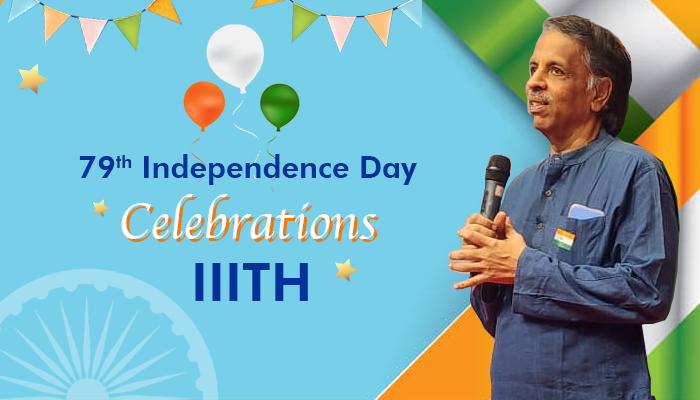
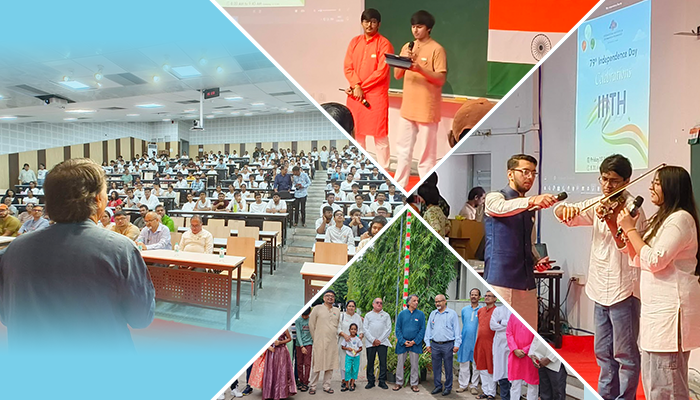
In his Independence Day address to the IIITH community, Prof P J Narayanan, Director, IIITH reiterated that democracy thrives on autonomy – but in today’s world, real independence also means freedom from digital dependence. He emphasised that the time has come for India to build its own secure technological foundation.
Greetings to all on the occasion of India’s 79th Independence Day. August 15th is a very important day for every Indian, as it is the day we attained political independence. An important characteristic of our freedom struggle was its non-violent nature.
We built a vibrant democracy that is the envy of the world. But democracy is not only about electing representatives; it’s also about the autonomy to make decisions at local, community, and institutional levels. We should ask ourselves if our autonomy is increasing or decreasing and if we are including everyone in the decision-making process. This is a big challenge for our maturing democracy.
Technological Independence
Today, I want to talk about independence and autonomy on another front — one that has become very important. Geopolitics has taken a definite turn for the worse. There are tariff wars and real wars, and we now know that wars are fought less with traditional weapons and more with software and drones. The real war, it seems, is in cyberspace.
Information and Communication Technology (ICT) has changed the world and is at the base of effectively everything, including modern warfare. All banks, power systems, trains, and buses run on ICT-based hardware and software. Unfortunately, a very small number of companies, from practically a single country, control these systems today.
This situation raises a critical question: will India fare well if these companies turn off their cloud services or AI services? We saw this recently when cloud services were stopped for one company under the guise of sanctions. These are real possibilities and can happen due to malice or a government’s diktat.
Attaining Technological Sovereignty
How do we attain sufficient technological sovereignty and autonomy? India does not have an operating system, a database, or a compiler controlled or maintained by us. We don’t have software that we can certify as safe. However, it is not difficult to create our own safe versions from the open-source world. Open-source software is a collective gift of society to itself, made with a mission to keep it open and safe.
A decent group of people can create an operating system where every bit of the code is known and verified. A group of 50 professionals could achieve this in a few months. However, continuous maintenance and improvement are critical for software to be used widely. The key lies with us, the users. If enough users are willing to put up with an OS that is a little behind and support it, it will be viable to update it for the long term.
This is a big challenge. We at IIIT Hyderabad, as IT professionals, are at the centre of the solution, while everyone else is at the centre of the problem. We must embrace the mission to create the necessary software and hardware to free India from this debilitating dependence. This is too big a task for one institution, but it is not too big if many institutions, students, and professionals put their minds to it. The way clearly exists; what is lacking is the will.
The Path Forward
We must collectively embrace the mission of technological independence. It requires heightened awareness and advanced preparation, with years of planning and decades of execution. It is clear we have no other option. IIIT Hyderabad can and should play a strong role in this mission. We are uniquely placed in terms of talent, expertise, and intent. We must revitalize open-source software activities. The global open-source movement has become less visible because everything is open-source in some sense today. The real control is now through the cloud and data, even when the software itself is open source. Android is open source. Linux that runs on every server in the world is open source. In the changed dynamics, open source as a reaction to closed source is no longer relevant. Twenty years ago, open source was almost a socio-political movement.
Our journey to political independence was defined by non-violence, and our quest for technological sovereignty should follow a similar ethos, through open source. This is not about opposing others, but about supporting ourselves. The goal is to build our own secure digital foundation, ensuring our nation’s security and prosperity. A new movement for autonomy or sovereignty in software should begin. We have the power and the capability; we need the will as an institution and as a nation. The first version can be created quickly, but the true secret is keeping it updated and relevant for the long term. Our desire for true independence in the technological space should drive us forward. Let’s collectively march toward true independence and autonomy in a non-violent manner, supporting ourselves without opposing others.
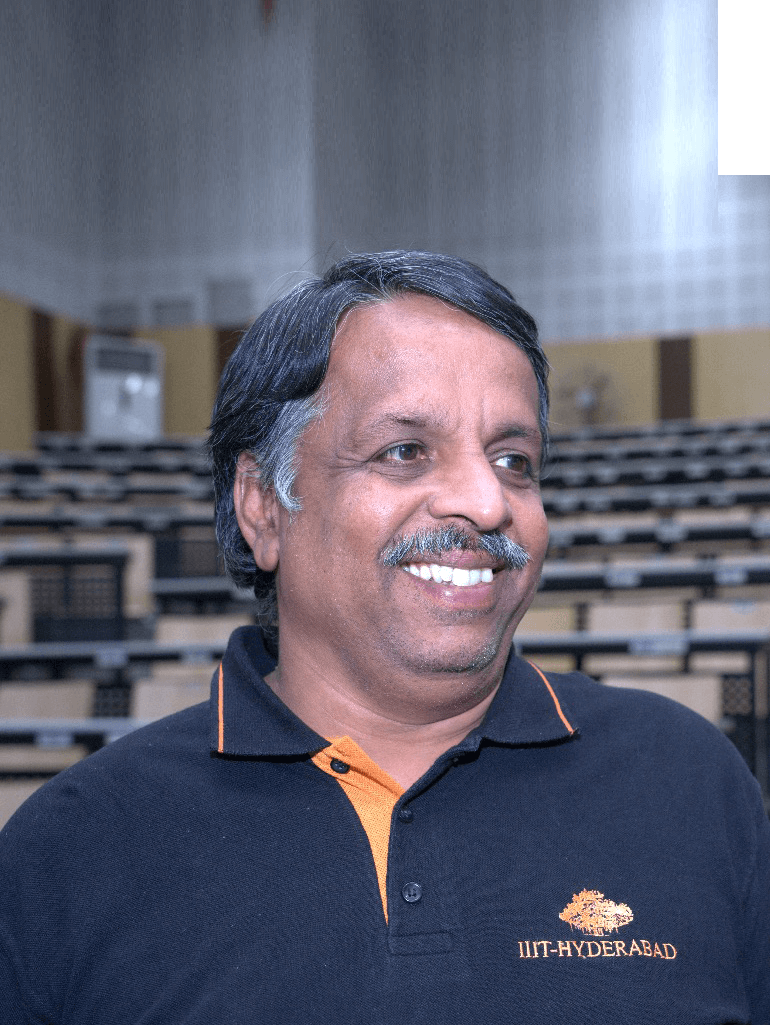
Prof P. J. Narayanan, Director, IIITH, is known for his work in computer vision (3D reconstruction, structure-from-motion, computational displays), computer graphics (ray-tracing of implicit surfaces, dynamic scenes), and parallel computing on the GPU (graph algorithms, string sorting, ML techniques like graph cuts, ANN and clustering, as well as several computer vision tasks).
Next post