
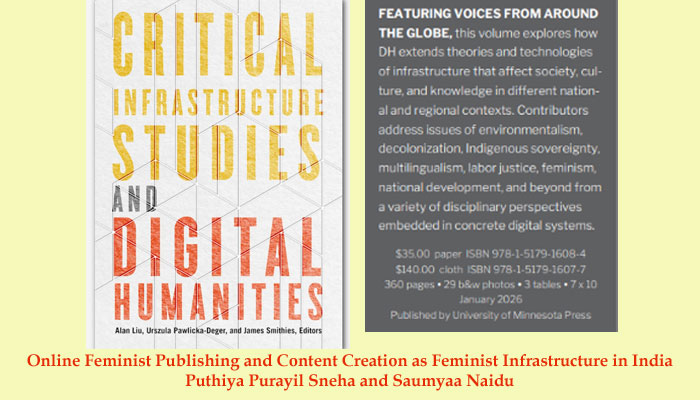
Puthiya Purayil Sneha Puthiya Purayil, Senior Research Manager, Open Knowledge Initiatives, RCTS, and Saumyaa Naidu have co-authored a book chapter titled Online Feminist Publishing and Content Creation as Feminist Infrastructure in India in the volume Critical Infrastructure Studies and Digital Humanities, published by University of Minnesota Press. The book is edited by Alan Liu, Urszula Pawlicka-Deger, and James Smithies.
Questions of infrastructure have been central to work in the digital humanities (DH), particularly in the context of the Global South, where digital divides remain widely prevalent. As a field premised on the ‘digital’, the growth of technologies is germane to the development of DH scholarship, practice, and pedagogy. Over the last decade, an emerging but substantive body of critique on DH, especially its Anglo-centric origin stories have also illustrated how this rubric of ‘infrastructure-building’ predates the field, and in fact is intertwined in complex, colonial histories of knowledge production. Several efforts to ‘decolonise DH’, in recent years have highlighted visible knowledge gaps and the need to create a diverse, multilingual, and accessible field. Intersections with feminist theory are particularly relevant here as an important precursor to discussions on infrastructure. The concept of a feminist internet, and forms of feminist infrastructures have emerged as a way to understand how engagement with digital spaces has been both enabling and challenging for structurally marginalised communities. The role of digital infrastructures that are open, inclusive, accessible and multilingual have been crucial in facilitating meaningful access and use of digital platforms.
This book chapter draws upon learnings from an exploratory study on feminist publishing and content creation spaces in India, and how they have informed contemporary discourse feminism, gender and sexuality. While the term feminist infrastructures is relatively new in academic and policy discourse, here we refer to digital spaces and technological infrastructures that are inclusive, accessible and developed with an ethic of care. This is with the understanding that infrastructure is inherently political, and determined by structures of power and privilege. The study therefore engages with feminist content production and curation spaces, including publishing houses, digital magazines, blogs and individual content creators working with social media, across diverse multimedia formats. The role of ethical design principles/feminist design thinking in creating digital infrastructures is also critical here, as it impacts the way in which diverse communities access these platforms. Learnings from the study are represented here as an essay and creative visualisation. Importantly, in seeking to understand how the growth of digital infrastructures mediates contemporary feminist work and politics, it looks at how such efforts may engage with and inform broader fields such as critical infrastructure studies and DH.
Link to the book- https://www.upress.umn.edu/9781517916084/critical-infrastructure-studies-and-digital-humanities/
March 2026
Puthiya Purayil Sneha Puthiya Purayil, Senior Research Manager, Open Knowledge Initiatives, RCTS, and Saumyaa Naidu have co-authored a book chapter titled Online Feminist Publishing and Content Creation as Feminist Infrastructure in India in the volume Critical Infrastructure Studies and Digital Humanities, published by University of Minnesota Press. The book is edited by Alan Liu, Urszula Pawlicka-Deger, and James Smithies.
Questions of infrastructure have been central to work in the digital humanities (DH), particularly in the context of the Global South, where digital divides remain widely prevalent. As a field premised on the ‘digital’, the growth of technologies is germane to the development of DH scholarship, practice, and pedagogy. Over the last decade, an emerging but substantive body of critique on DH, especially its Anglo-centric origin stories have also illustrated how this rubric of ‘infrastructure-building’ predates the field, and in fact is intertwined in complex, colonial histories of knowledge production. Several efforts to ‘decolonise DH’, in recent years have highlighted visible knowledge gaps and the need to create a diverse, multilingual, and accessible field. Intersections with feminist theory are particularly relevant here as an important precursor to discussions on infrastructure. The concept of a feminist internet, and forms of feminist infrastructures have emerged as a way to understand how engagement with digital spaces has been both enabling and challenging for structurally marginalised communities. The role of digital infrastructures that are open, inclusive, accessible and multilingual have been crucial in facilitating meaningful access and use of digital platforms.
This book chapter draws upon learnings from an exploratory study on feminist publishing and content creation spaces in India, and how they have informed contemporary discourse feminism, gender and sexuality. While the term feminist infrastructures is relatively new in academic and policy discourse, here we refer to digital spaces and technological infrastructures that are inclusive, accessible and developed with an ethic of care. This is with the understanding that infrastructure is inherently political, and determined by structures of power and privilege. The study therefore engages with feminist content production and curation spaces, including publishing houses, digital magazines, blogs and individual content creators working with social media, across diverse multimedia formats. The role of ethical design principles/feminist design thinking in creating digital infrastructures is also critical here, as it impacts the way in which diverse communities access these platforms. Learnings from the study are represented here as an essay and creative visualisation. Importantly, in seeking to understand how the growth of digital infrastructures mediates contemporary feminist work and politics, it looks at how such efforts may engage with and inform broader fields such as critical infrastructure studies and DH.
Link to the book- https://www.upress.umn.edu/9781517916084/critical-infrastructure-studies-and-digital-humanities/
March 2026