
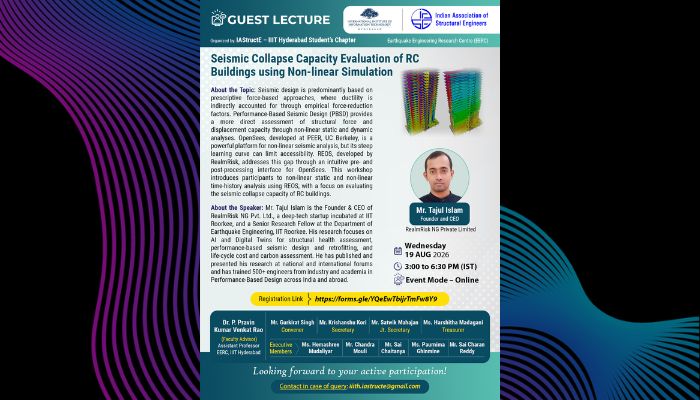
The IAStructE-IIIT Hyderabad Students’ Chapter organized an online expert lecture on “Seismic Collapse Capacity Evaluation of RC Buildings using Non-linear Simulation”, delivered by Tajul Islam, Founder & CEO, RealmRisk NG Private Limited, on 19 August 2026. The lecture provided insights into contemporary approaches for evaluating the seismic response and collapse capacity of reinforced concrete (RC) buildings using non-linear numerical simulations. The speaker introduced the principles of performance-based seismic design (PBSD) and highlighted its advantages over conventional prescriptive, force-based approaches, particularly its ability to directly evaluate structural force and displacement capacities under seismic loading.
The session commenced with an overview of the limitations of conventional seismic design approaches, in which ductility is indirectly incorporated through empirical force-reduction factors. Tajul explained how PBSD provides a more rational framework by explicitly accounting for the non-linear behaviour of structural systems. He introduced OpenSees, a widely used platform for non-linear structural and seismic analysis, and discussed its capabilities for simulating structural response under progressively increasing seismic demands. The lecture also introduced REOS, developed by RealmRisk, as an intuitive pre- and post-processing interface that facilitates the practical implementation of OpenSees for advanced seismic analysis.
The session further focused on the application of non-linear static analysis and non-linear time-history analysis for evaluating the collapse capacity of RC buildings. Mr. Tajul discussed key aspects of structural modelling, representation of non-linear component behaviour, and interpretation of analytical results to characterise the progression of structural response with increasing seismic demand. He demonstrated how these computational approaches can be used to identify critical structural behaviour and evaluate the capacity of RC buildings beyond the elastic range. The practical workflow presented during the session provided participants with an understanding of how advanced numerical tools can support the implementation of performance-based seismic assessment in engineering practice.
The session also emphasised the role of non-linear analysis in evaluating structural safety and resilience under severe earthquake demands. Such simulations enable engineers to investigate potential failure mechanisms, evaluate structural response across different performance levels, and develop a more comprehensive understanding of collapse behaviour. The session concluded with an interactive Q&A session, during which participants discussed non-linear modelling, analysis procedures, interpretation of results, and the practical application of REOS and OpenSees for seismic assessment. The speaker addressed the queries with detailed technical explanations and practical insights, contributing to an informative and engaging learning experience.
Overall, the session enhanced participants’ understanding of performance-based seismic assessment and non-linear simulation techniques while demonstrating their practical application in evaluating the seismic response and collapse capacity of RC buildings.
YouTube Link: https://youtu.be/fD-GqtUo8Wg?si=FswQSxPFR0NV_XCL
August 2026