
Dr. P Pravin Kumar Venkat Rao has published a research paper on Displacement-Based Performance Framework for Seismic Assessment and Repair of Earthquake-Damaged Masonry Buildings in Structures – A flagship journal of The Institution of Structural Engineers (IStructE), published by Elsevier. The paper presents a displacement-based framework for the seismic assessment of earthquake-damaged masonry structures and for guiding repair and retrofitting decisions based on defined performance objectives. The proposed approach integrates mechanism-informed assessment procedures with practical implementation considerations to support engineering decision-making. By linking performance-based evaluation with repair strategies, this work contributes to improving seismic safety and enhancing the long-term resilience of masonry buildings.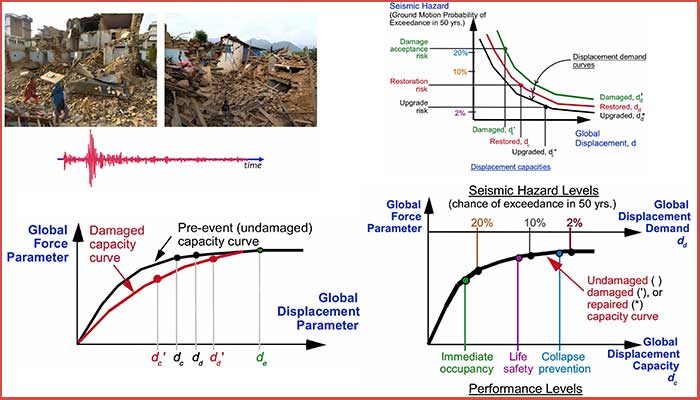
This publication reflects the ongoing research efforts at EERC aimed at advancing performance-based seismic assessment methodologies and developing practical solutions for the safety and rehabilitation of masonry structures.
 Here is the summary of the paper:
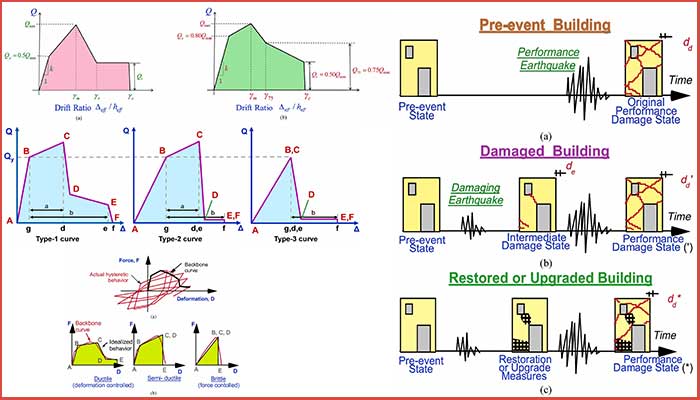
Unreinforced masonry (URM) buildings, prevalent in seismic-prone regions, have historically demonstrated poor performance during earthquakes due to inherent material and construction deficiencies, heterogeneity, and inadequate seismic detailing. This study presents a comprehensive, performance-based framework for the post-earthquake evaluation and repair of damaged URM structures. It employs a displacement-based methodology to quantify structural behaviour and residual performance accurately. Mechanism-based analytical tools, including capacity-demand ratios, normalized displacement indices, and performance loss metrics, are employed to quantify structural behaviour under intact, damaged, and repaired (or retrofitted) conditions. Crucially, the framework integrates component-level technical assessments with policy-oriented decision-making through three post-earthquake pathways: accepting existing damage, restoring pre-event performance, or upgrading to higher resilience. It bridges the gap between analytical predictions and real field conditions by incorporating empirical observations, mechanism-specific damage indicators, and construction-specific limitations. The framework classifies intervention strategies into cosmetic repairs, structural repairs, and structural enhancements, and summarizes key repair/retrofitting techniques. Each intervention is guided by defined performance objectives, from restoring essential functionality to enhancing seismic capacity. The study emphasizes the need for standardized, mechanism-informed and context-sensitive repair protocols that support efficient and resilient recovery. By promoting transparent, performance-based, and evidence-informed decision-making, the proposed methodology contributes to improving the safety and long-term resilience of masonry buildings in seismic regions.
Weblink: https://www.sciencedirect.com/science/article/pii/S2352012426002481?dgcid=author#fig0020
February 2026