
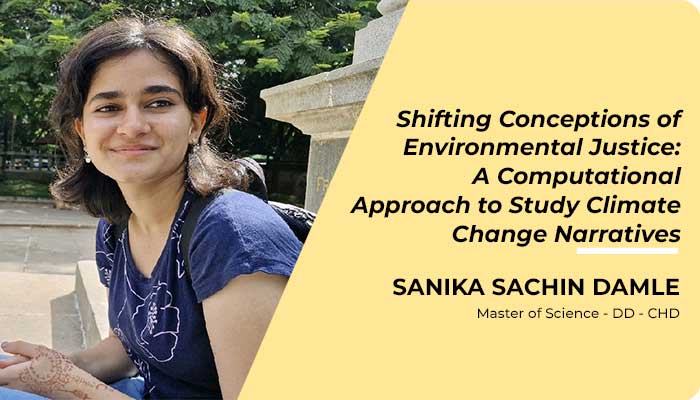
Sanika Sachin Damle supervised by Dr. Radhika Krishnan received her Master of Science – Dual Degree in Computing and Human Sciences (CHD). Here’s a summary of her research work on Shifting Conceptions of Environmental Justice: A Computational Approach to Study Climate Change Narratives
Climate change discourse varies across contexts, influenced by political priorities, developmental goals, and social conditions. One important aspect of this variation is the divide between the Global North and Global South, which shapes how conversations about responsibility, equity, and climate action are understood and debated. However, this dimension remains insufficiently explored in computational analyses of online communication. To address this gap, this thesis examines how these variations appear in platform-mediated discourse on YouTube and extends the analysis to institutional climate narratives within the Indian think tank space. Using a mixed-methods computational approach, the study analyzes a dataset of YouTube video transcripts and their associated comments, collected around key moments in global climate governance, including major international agreements and conferences. Topic modeling, sentiment analysis, and large language model (LLM)-based stance detection are used to examine how climate issues are framed in video content and how audiences engage with these narratives. The findings reveal systematic differences between Global North and Global South discourse. Content from the Global North tends to emphasize technological solutions, emissions reduction, and policy frameworks, while Global South narratives highlight development priorities, vulnerability, and questions of equity and historical responsibility. Audience engagement further reflects these divides, with high levels of polarization shaping how narratives are received and debated. To complement this analysis, the study examines institutional climate discourse through Indian think tank publications, focusing on how the concept of a “just transition” is framed within policy contexts. Rather than directly engaging with the Global North-South divide, these documents frame climate concerns through domestic priorities such as development, energy transitions, and internal inequalities. The analysis examines how different dimensions of climate justice, including distributive, reparative, representative, and restorative justice, are represented, offering insight into how justice is articulated within national policy discourse. By bringing together digital and institutional analyses, this study demonstrates that climate discourse is not uniform but is shaped by platform structures, geopolitical contexts, and policy environments. While the Global North–South divide is more visible in online narratives, institutional discourse focuses on domestic concerns. Overall, the findings highlight the importance of context-sensitive approaches to studying climate communication and offer insights into how narratives of responsibility, equity, and climate action are constructed and contested across different domains.
June 2026