
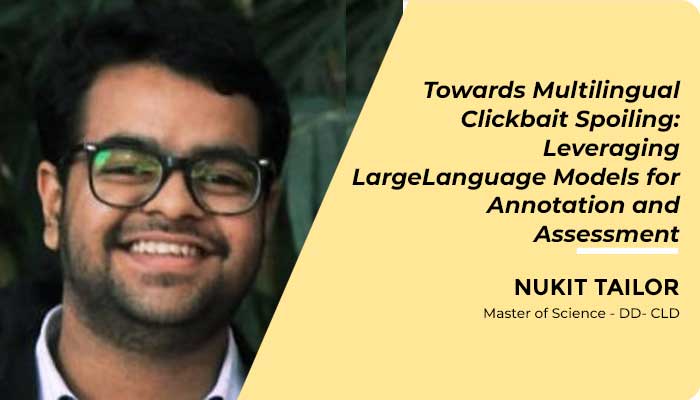
Nukit Tailor supervised by Dr. Radhika Mamidi received his Master of Science – Dual Degree in Computational Linguistics (CLD). Here’s a summary of his research work on Towards Multilingual Clickbait Spoiling: Leveraging LargeLanguage Models for Annotation and Assessment:
Clickbait articles have become a prevalent part of online media, often designed to mislead or exaggerate content to drive user engagement. While they may boost clicks, such headlines and articles compromise reader trust and contribute to the spread of misinformation. Tackling clickbait thus represents not just a technical challenge but also a crucial step toward improving the quality and transparency of online information. To address this, recent research has introduced the task of clickbait spoiling, where we attempt to ”spoil” the headline by generating the key information the article withholds. Our work contributes to this growing area by firstly engaging with the clickbait spoiling task in English using modern Large Language Models (LLMs) and secondly, in Hindi, where we extend this task into a vastly underexplored linguistic space. The spoiling task is especially meaningful because it does not attempt to censor or suppress content; instead it just simply makes it more honest, giving users the context they need upfront to make informed choices about what they click. From the evaluations on the English dataset it is revealed that LLMs, particularly when prompted with a few-shot setup, can be highly effective at generating relevant and informative spoilers. This demonstrates the potential of prompting-based systems to perform sophisticated reasoning and summarization tasks, even in cases where training data may be limited. Building on these insights, we make a significant contribution by shifting focus to Hindi, a language that has been critically underrepresented in this field of NLP research despite being spoken by hundreds of millions. We curate the first-of-its-kind Hindi clickbait dataset, using automatically generated annotations from multiple powerful LLMs. This dataset will not only address a huge gap in multilingual clickbait research but also lay a foundation for future work in Hindi misinformation and media literacy. We also observed notable inconsistencies in the behavior of certain large language models. Hermes-3, in particular, exhibited significant divergence in both its clickbait classification judgments and its assigned ratings. It was unable to understand explicit instructions and hence in light of this unreliability, we made a principled decision to take it off the annotator lineup. This screams for quality control whenever using LLMs for such tasks. We then extended the spoiling task to Hindi using this dataset by introducing a selection process based on agreement across models, combined with manual curation, resulting in a dataset that captures the diverse forms of Hindi clickbait. We also classify spoiler types and evaluate LLM performance in zero-shot and few-shot settings. Our findings reveal clear patterns: model performance varies widely, prompting strategies significantly affect outcomes, and certain models (like Deepseek-R1) demonstrate robust generalization even in zero-shot settings.
July 2025