
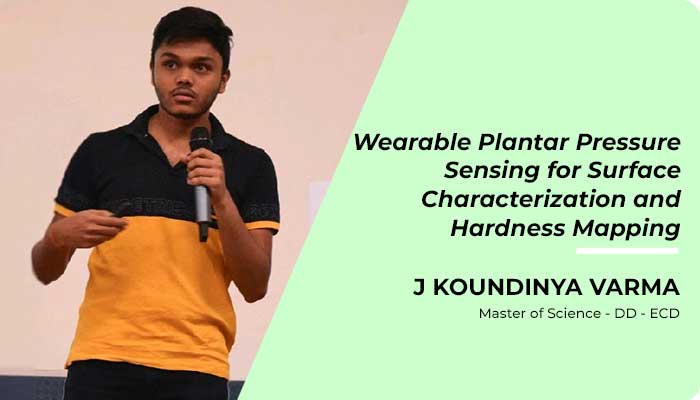
Jampana Koundinya Varma supervised by Dr. Aftab M. Hussain received his Master of Science by Research – Dual Degree in Electronics and Communication Engineering (ECD). Here’s a summary of his research work on Wearable Plantar Pressure Sensing for Surface Characterization and Hardness Mapping
Wearable plantar pressure measurement systems have become important in biomechanics, rehabilitation, and gait analysis. By capturing foot–ground interaction data, these systems enable researchers and clinicians to evaluate balance, diagnose pathological gait, design personalised footwear, and monitor patient recovery. Existing research in this domain has predominantly focused on extracting insights about the human body, with applications centred on musculoskeletal health, motor control, and performance assessment. However, despite the rich information embedded in plantar pressure signals, their potential to characterise properties of the external environment, particularly the surfaces on which humans walk, has received little to no attention. This thesis addresses this unexplored dimension by investigating whether plantar pressure data can be leveraged to infer surface characteristics, explicitly focusing on hardness. Unlike conventional approaches to surface analysis, which rely on specialised equipment or destructive testing, wearable plantar pressure systems provide a low-cost, portable, and unobtrusive means of measurement. The central research question guiding this work is whether pressure patterns generated by the foot during locomotion can be systematically mapped to the mechanical properties of the underlying surface. To explore this question, we developed a low-cost in-shoe sensor array capable of capturing plantar pressure distributions in real time. Experiments were conducted by collecting walking trials across surfaces of varying hardness, ranging from soft foam and natural ground to rigid concrete and tiled flooring. The recorded plantar pressure profiles were then analysed to identify distinctive signatures associated with different surface types. Statistical and machine learning techniques were employed to classify surfaces based on the extracted features, enabling quantitative assessment of surface hardness from wearable data. The results demonstrate that surface hardness exerts a measurable influence on plantar pressure distribution, and that these differences can be reliably captured through the proposed in-shoe system. Our findings establish, for the first time, that wearable plantar pressure measurements can be repurposed for surface characterisation. This represents a conceptual shift in how wearable sensing technologies are perceived, broadening their utility from human biomechanics to context-aware environmental interaction. The implications of this work extend across several domains. In rehabilitation and sports science, knowledge of surface properties can inform safer training and recovery protocols. In robotics, surface characterisation through human–robot shared sensing could improve terrain adaptation strategies. From an urban perspective, large-scale deployment of such systems could support real-time monitoring of ground conditions in public spaces. Overall, this thesis contributes a methodological innovation and a new application space for wearable plantar pressure systems, bridging the gap between human-centered sensing and surface characteristics.
June 2026