

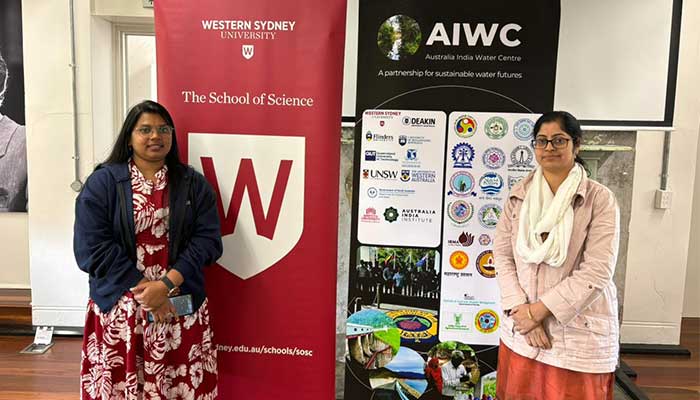
Dr. Rehana Shaik. Prof. K S Rajan and their students Gangothri C J, Ataur Rahman, Satish Kumar Mummidviarapu presented a paper on Multi-Criteria Geospatial Analysis of Rainwater Harvesting Potential Zones and Susceptibility of Built-up Regions in Hyderabad City, India at the 4th International Conference on Water and Environmental Engineering (iCWEE), held from 19 – 21 November at Western Sydney University, Australia.
Here is the summary of the paper as explained by the authors: This study aimed to develop an integrated framework for the identification of Rainwater Harvesting Potential Zones (RWHPZs) of Hyderabad city in India by using Remote Sensing (RS), Geographic Information System (GIS), and the Analytic Hierarchy Process (AHP) techniques. This framework utilized the various data layers, such as Digital Elevation Model (DEM), slope, Topographic Wetness Index (TWI), Drainage Density (DD), Drainage Network (DN), Land Use/Land Cover (LUCL), and Rainfall as the critical factors in the AHP technique, followed by the Weighted Overlay Analysis. This study’s findings divided the Hyderabad city into five potential (very low, low, moderate, high, very high) zones. The findings were then superimposed with OpenStreetMap building footprints to study the susceptibility of built-up regions to RWHPZ. About 93.73 sq. km is used for buildings out of Hyderabad’s 680.36 sq. km perimeter, and is ideal for rooftop rainwater collection, whereas 586.62 sq. km is good for rainwater collection structures (which even include the water bodies), according to the overlayed map. Build-up regions can still contribute by transforming impermeable surfaces into collecting zones using rooftop rainwater harvesting and storage systems. According to the analysis of the RWHPZ map, the very low potential zone, which makes up to 17.85% of the area without buildings and 18.72% of the built-up area, is best suited for runoff collection. In contrast, the low potential zone, which makes up to 43.98% of the area without buildings and 57.01% of the built-up area, is ideal for rooftop rainwater collection and recharge. While extremely high potential zones, which account for only 7.29% of the land, offer ideal conditions for rainwater harvesting, moderate and high potential zones, which comprise 30.9% of the area, are suitable for implementing efficient rainwater collection solutions.
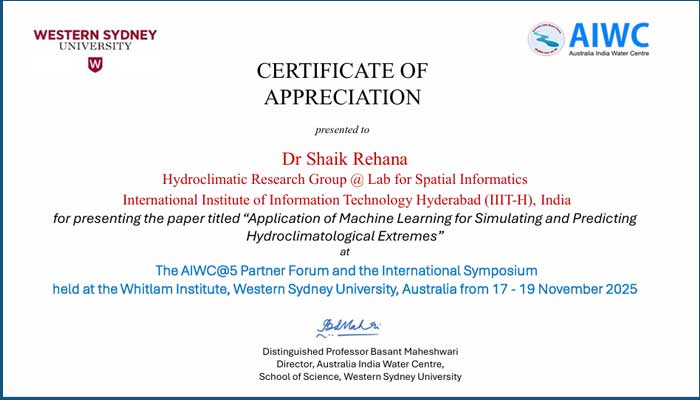
Dr. Shaik Rehana also gave a keynote lecture on the Application of Machine Learning for simulating and Predicting Hydro climatological Extremes at iCWEE-2025. In her keynote, Dr. Rehana highlighted the growing relevance of data-driven approaches in understanding complex hydroclimatic processes under accelerating climate variability. She discussed the integration of machine learning algorithms with traditional hydrological modelling to improve the detection, simulation, and prediction of extreme events such as floods, droughts, and extreme rainfall. Her presentation underscored the importance of using advanced learning techniques to address uncertainties in hydrological forecasting and to support climate-resilient water resources planning.
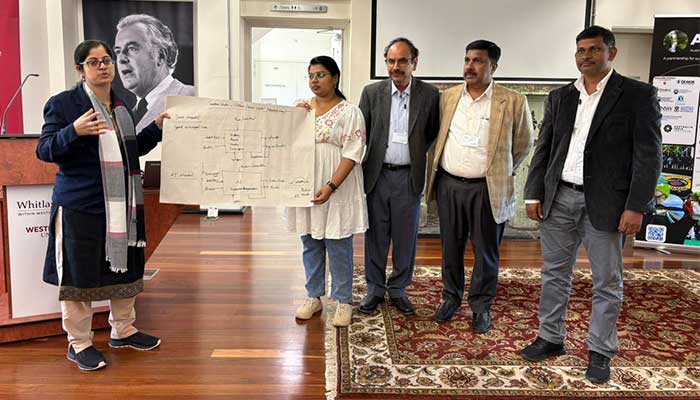
Dr. Rehana also actively participated in the Australia India Water Centre (AIWC) event, conducted at Western Sydney University. She engaged in expert discussions, shared her extensive experience on AI-enabled water management, and contributed to collaborative dialogues aimed at strengthening Indo-Australian partnerships in water science and innovation.
 December 2025