
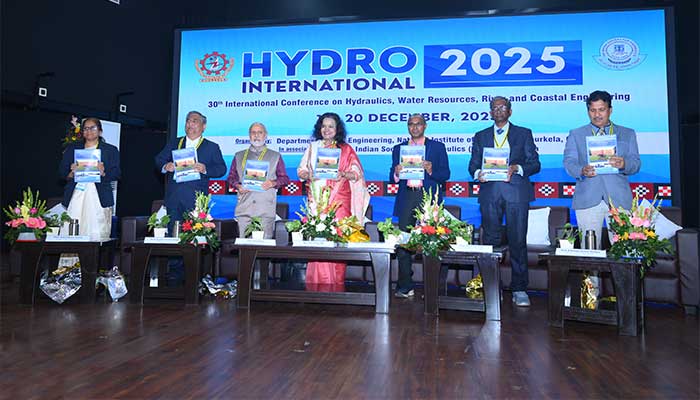
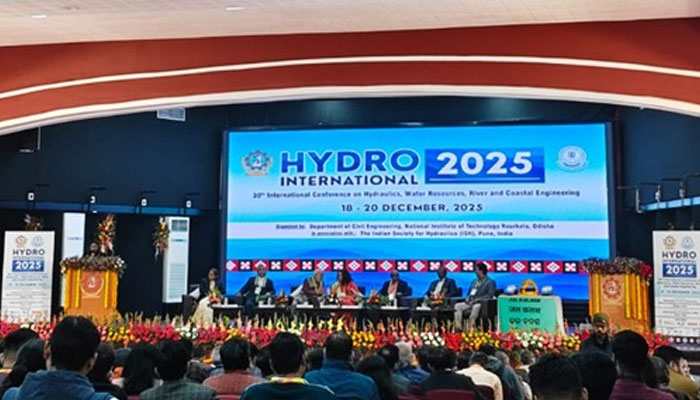
Dr. Shaik Rehana, Dr. Sachin Chaudhari and their students presented their research works in HYDRO International 2025 – the 30th International Conference on Hydraulics, Water Resources, River and Coastal Engineering, held at the National Institute of Technology (NIT) Rourkela, Odisha, India, from 18–20 December 2025.
The presented studies span urban water systems, groundwater sustainability, rainwater harvesting, smart drainage, climate extremes, and rainfall prediction, reflecting the Hydroclimatic Research Group’s interdisciplinary strengths in IoT, remote sensing, climate modelling, and data-driven hydrology.
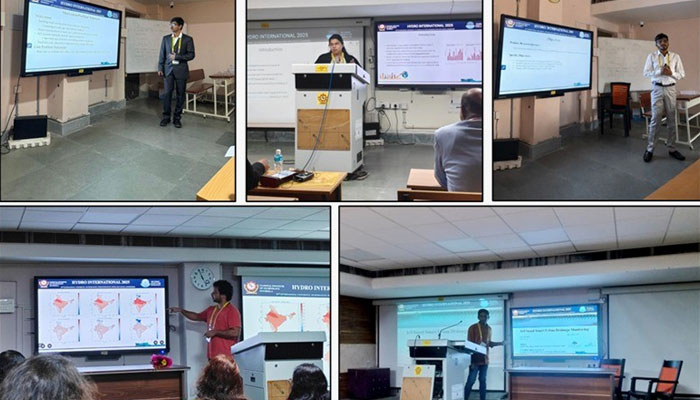
Papers Presented from IIIT Hyderabad are as follows:
- Remote Sensing–AHP-Based Delineation of Rainwater Harvesting Potential Zones of Hyderabad, India – Gangothri C J, Rehana Shaik, Ataur Rahman (Presented by Gangothri C J)
Focusing on Hyderabad’s growing urban water demand, this research identified potential rainwater-harvesting zones using remote sensing, GIS, and the Analytic Hierarchy Process (AHP). Multiple thematic layers, including rainfall, slope, soil, land use/land cover, and topographic wetness index, were integrated to classify zones by suitability. The findings provide critical inputs for urban stormwater management and sustainable water planning.
- Comprehensive Multi-Criteria Ranking of CMIP6 Models for Hot and Cold Extreme Indices over the Indian Subcontinent – Harshvardhan, Sunil Kumar, Rehana Shaik, Anurag Mishra, K. Sachin Prakash (Presented by Harshvardhan)
This study introduced a multi-criteria ranking framework to evaluate 36 CMIP6 global climate models based on their ability to simulate hot and cold temperature extremes over India. By analysing extreme indices across monsoon and post-monsoon seasons, the framework objectively identifies the most reliable climate models for regional climate impact studies and downscaling applications, supporting improved climate adaptation planning.
- Rainfall Prediction in India: A Comprehensive Analysis of Statistical Downscaling with CMIP6 Data and Machine Learning – Surendra Kumar Reddy Gopireddy, Harshvardhan, Rehana Shaik, Anurag Mishra, K. Sachin Prakash (Presented by Surendra Kumar Reddy)
This paper presented a statistical downscaling framework for daily rainfall prediction over India using CMIP6 climate model outputs and NCEP reanalysis data. Multiple regression and machine learning models were evaluated. While the framework produced high-resolution rainfall projections, the results highlighted challenges in capturing extreme rainfall events, emphasizing the need for advanced deep learning and hybrid modelling approaches for improved rainfall prediction.
- IoT-Based Smart Urban Drainage Monitoring – Sahil Padole, Srujan Reddy, Sachin Chaudhari, Rehana Shaik (Presented by Srujan Reddy)
The research proposed an IoT-driven real-time drainage monitoring framework to address urban flooding. High-resolution rainfall and drainage water-level data enabled accurate estimation of runoff lag times and identification of diurnal and seasonal patterns. Machine learning models were used to predict drainage behaviour and classify flood risk, supporting proactive flood management for smart cities.
- IoT-Aided Managed Aquifer Recharge Storage Transfer and Recovery for Sustainable Groundwater Management – Jagan Reddy, Tarun Pragada, Sachin Chaudhari, Rehana Shaik, Kalpana Ramesh (Presented by Jagan Reddy)
This study addressed groundwater depletion through Managed Aquifer Recharge (MAR) and Aquifer Storage, Transfer, and Recovery (ASTR) using IoT-based monitoring. Continuous observations revealed strong hydraulic connectivity between recharge and extraction borewells, confirming the effectiveness of IoT-enabled MAR–ASTR systems for sustainable groundwater management in hard rock aquifers.
- IoT-Based Estimation and Reduction of Water Age in Drinking Water Coolers – Aakash Terala, Nitin Rajasekar, Sachin Chaudhari, Rehana Shaik (Presented by Aakash Terala).
This study analysed the freshness of drinking water in building-scale storage systems using long-term IoT-based flow monitoring. The results revealed prolonged water residence times under existing operating conditions. The study demonstrated that demand-aware refilling strategies and reduced storage capacity can substantially decrease water age, thereby improving drinking water quality without major infrastructure modifications.
February 2026