
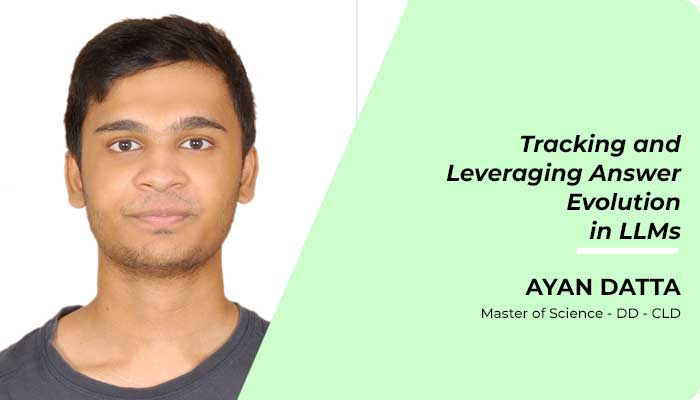
Ayan Datta supervised by Dr. Radhika Mamidi received his Master of Science – Dual Degree in Computational Linguistics (CLD). Here’s a summary of his research work on Tracking and Leveraging Answer Evolution in LLMs
This thesis investigates the dynamics of answer formation in Large Language Models (LLMs) along two dimensions: vertically across network layers, and horizontally across sequential reasoning tokens. To evaluate vertical evolution, we apply layer-wise linear probes to open-weight models on a controlled character-counting task. The probing results show that early and middle layers reliably encode sub-token character counts. Late-stage network components, specifically the penultimate and final multilayer perceptrons, actively suppress this information and default to degenerate prediction strategies. The models thus fail at utilization, despite having the required representational capacity. For horizontal evolution, we introduce Forced Answer Completion (FAC) to extract a model’s intermediate answer commitment at each step of its chain-of-thought trace. Across multiple-choice, numeric, and search tasks, FAC shows that models decide their final answer long before the reasoning trace concludes. After filtering out Transient Answer Flips (TAFs) with a causal smoothing operator, we find that nearly half of all reasoning tokens are generated after the model’s decision has stabilized. These late-stage tokens function primarily as post-hoc justification. These findings enable direct interventions in LLM inference. Vertical tracking isolates suppressed knowledge, providing targets for structural adjustments. Horizontal tracking supports lightweight earlystopping gates by training linear probes on intermediate hidden states, we predict when an answer has stabilized and halt generation. Testing on the Qwen3 architecture demonstrates that this early-stopping method saves hundreds of tokens per query with a marginal drop in accuracy.
July 2026