
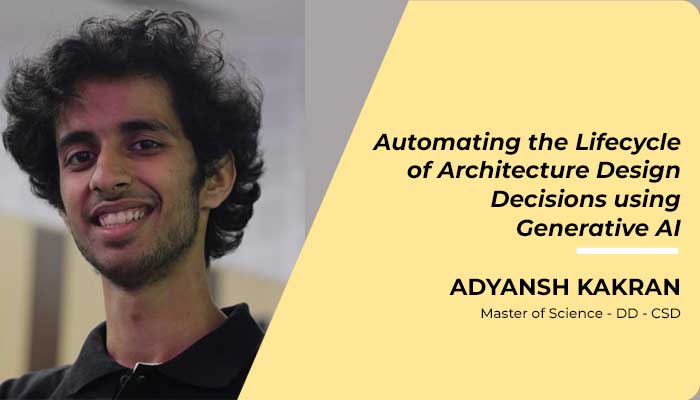
Adyansh Kakran supervised by Dr. Karthik Vaidhyanathan received his Master of Science – Dual Degree in Computer Science and Engineering (CSD). Here’s a summary of his research work on Automating the Lifecycle of Architecture Design Decisions using Generative AI
Software architecture is shaped by the design decisions made throughout a system’s lifecycle. These decisions influence the structure and quality of the system, and when the reasoning behind them is not preserved, future maintenance becomes more difficult and error-prone. An effective way of capturing this reasoning and the decision in a structured manner has been the use of architectural decision records. However, keeping these records up to date requires sustained manual effort, which often leads to incomplete or missing entries as project timelines tighten. Beyond individual decisions, assessing whether an architecture as a whole meets its quality goals requires organising dedicated review sessions with multiple stakeholders, a process that is difficult to fit into the pace of most development cycles.
Generative AI has shown practical value in supporting software engineering tasks such as code generation and requirements analysis. Because architecture knowledge management relies heavily on writing and interpreting text, these models are a reasonable fit for this area. However, current uses of LLMs in software architecture tend to rely on basic prompting strategies, which often fall short when tasks require project-specific context or consistent, structured reasoning. As a result, the manual effort involved in managing architecture design decisions has remained largely unaddressed.
This thesis investigates how LLMs and agentic workflows can be applied to reduce the manual effort across the architecture design decision lifecycle. It proposes a structured approach to help developers draft complete architectural decision records from brief inputs. To support the ongoing quality of these records, the work examines automated assessment techniques using different language model configurations. These ideas are then extended to whole-architecture evaluation through a multi-agent framework designed to simulate established review processes.
The work is grounded in a dataset of open-source architectural decision records and published architecture case studies. The results show that combining model fine-tuning with historical examples supports the generation of concise records that align reasonably well with human writing patterns. The automated assessment configurations offer a practical way to flag unclear or incomplete records without requiring continuous human review. The multi-agent evaluation framework shows some ability to identify structural risks and tradeoffs, and can reduce the initial effort required for scenario-based architecture reviews.
Overall, the thesis suggests that combining domain-adapted language models with structured agentic workflows can provide a useful foundation for managing architecture design decisions. By lowering the effort involved in recording and evaluating decisions, these approaches support more consistent documentation practices and easier long-term system maintenance.
July 2026