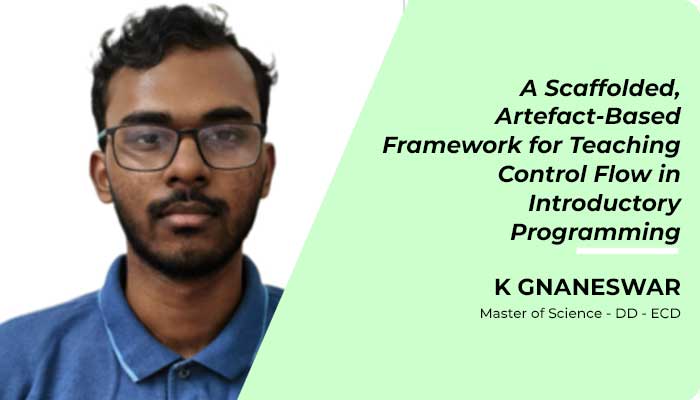
K Gnaneswar supervised by Prof. Venkatesh Choppella received his Master of Science – Dual Degree in Electronics and Communication Engineering (ECD). Here’s a summary of his research work on A Scaffolded, Artefact-Based Framework for Teaching Control-Flow in Introductory Programming
The ability to comprehend and trace program execution is a foundational skill in computer science. Yet, it remains a significant hurdle for novices. Existing pedagogical methods often prioritise tracking variable states, leaving a critical gap in teaching the explicit control-flow path of a program’s execution. This thesis introduces and evaluates a novel pedagogical framework designed to address this gap by making control flow the central object of study. The framework consists of a simplified subset of Python and a set of six scaffolded, hand-drawn artefacts that guide students in representing a program’s static structure and dynamic execution. The framework was implemented as a large-scale classroom activity in a first-year programming course with 368 students. Detailed analysis of the artefacts constructed by 84 students yielded a mean score of 74.56%, demonstrating the framework’s efficacy as a structured methodology for tracing. Exploratory factor analysis of the scores identified four latent variables that influence student performance: Structural Abstraction Proficiency, Sequential Control Flow, Condition-Dependent Control Flow, and Procedural Control Flow. Furthermore, the study identified prevalent misconceptions, particularly related to procedural control transfer and error handling. These findings, along with the observed limitations, provide insights into the mental models students develop about program execution and offer a foundation for refining the teaching of control flow in program execution.
July 2026