
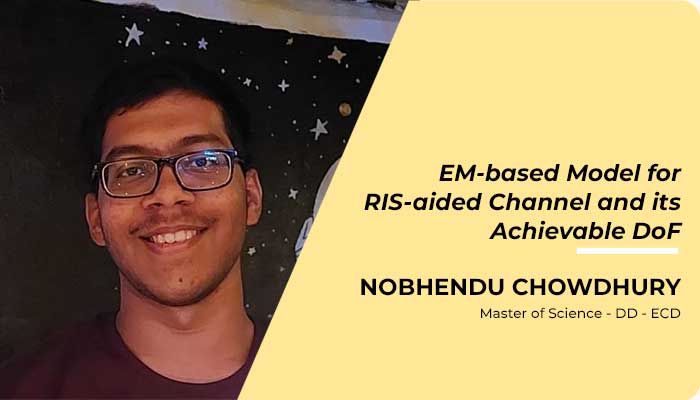
Nobhendu Chowdhury supervised by Dr. Praful Mankar received his Master of Science – Dual Degree in Electronics and Communication Engineering (ECD). Here’s a summary of his research work on EM-based Model for RIS-aided Channel and its Achievable DoF
This thesis presents a physically consistent electromagnetic (EM) framework for the design and modelling of reconfigurable intelligent surfaces (RIS) in 6G wireless networks. Moving beyond simplified ray-tracing approximations, we establish a wave-based model grounded in the inhomogeneous Helmholtz equation to characterize the interaction between incident fields and programmable surfaces in the wavenumber domain. We demonstrate that the RIS acts as a spectral-domain mixer, where the reflected field is governed by a 2D spectral convolution constrained by the free-space propagation disk and the RIS is programmed to achieve a target field desired at the receiver.
To quantify the information-carrying capacity in RIS-aided channels, we adopt a set-theoretic approach based on the space-bandwidth product and the Brunn-Minkowski inequality. We derive universal mathematical bounds on the spatial degrees of freedom (DoF) and introduce a spectral realizability factor, ω, to evaluate the efficiency of spectral expansion relative to the boundary of the propagation disk. This theoretical development motivates a two-stage wavefront engineering strategy, involving a linear centring operation to maximize spectral budget, followed by deterministic diffusion to enrich the channel rank.
Numerical results validate the framework by analysing the scenarios of isotropic RIS expansion and multibeam synthesis. For the former, we quantify the quadratic decay in ω caused by inefficient RIS design strategies. For the latter, we identify the discrete spectral thresholds at which synthesized components fail to travel into the far-field. The observations confirm that the proposed centring and diffusion paradigm effectively preserves channel dimensionality, enriching shadowed and rank-deficient environments. This work provides the fundamental analytical tools required to maximize the spatial multiplexing potential of RIS-aided communication systems.
July 2026