
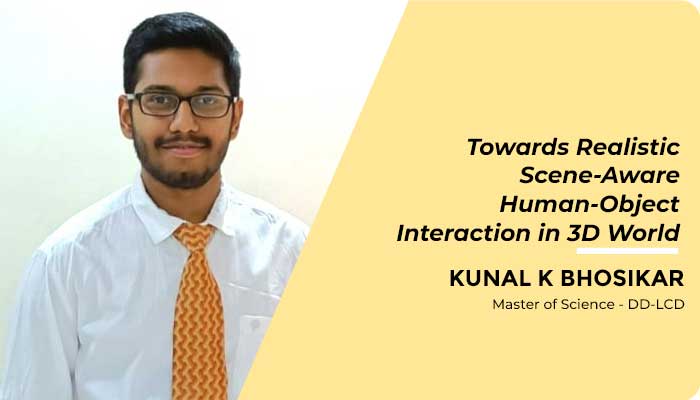
Kunal Kamalkishor Bhosikar supervised by Dr. Charu Sharma received his Master of Science – Dual Degree in (LCD). Here’s a summary of his research work on Towards Realistic Scene-Aware Human-Object Interaction in 3D World:
Modeling realistic human-object interaction in three-dimensional environments is a fundamental challenge in computer vision, with broad implications for robotics, virtual reality, and embodied artificial intelligence. Despite significant progress in human motion generation and 3D scene understanding, existing approaches often treat motion, interaction, and environment as separate problems, limiting their ability to generate physically plausible and context-aware behavior. This thesis addresses this challenge through a unified perspective on scene-aware human-object interaction, grounded in both real-world systems and data-driven modeling. We begin by developing a system for real-time human pose understanding and interaction analysis based on joint-level reasoning, formalized in our published patent application. This system demonstrates how structured representations of human motion can enable robust, interpretable, and deployable interaction-aware applications. Building on this foundation, we introduce a large-scale dataset and benchmark for full-body human motion with object interaction in realistic 3D scenes. This dataset enables the study of scene-aware grasping and exposes key limitations of existing methods in handling interaction under environmental constraints. We then propose a learning-based framework for generating physically plausible, sceneaware human-object interactions that explicitly models the interplay between body motion, object manipulation, and scene geometry. To enable scalable deployment of such systems, we further develop a fast and robust geometry processing framework based on feature-aware mesh simplification, which preserves interaction-relevant geometric properties while significantly reducing computational complexity. We also explore the extension of interaction-aware modeling to conditional settings, including multimodal human motion generation. In particular, we highlight the role of object interaction in ensuring consistency between generated motion and environmental constraints, demonstrating that naive integration of motion and interaction leads to physically implausible results. Through extensive experiments and evaluations, we demonstrate that the proposed approaches significantly improve the realism, physical plausibility, and scalability of human-object interaction in 3D environments. By bridging real-world systems, data-driven modeling, and geometry processing, this thesis contributes towards the development of integrated frameworks for human-centric 3D understanding and interaction.
May 2026