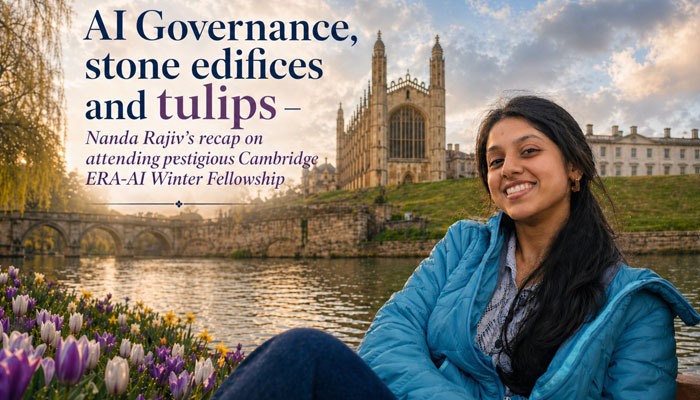
One among thirty international students selected for a fully funded Cambridge ERA-AI Fellowship, IIIT-H student Nanda Rajiv walks us through her two-month tenure as a Technical AI Governance Research Fellow, where fresh insights and new direction was gained amidst blooming daffodils and ancient stone buildings.
Did Nanda Rajiv manifest a second visit to Cambridge University? When the fifth year student of CHD was chosen from 3000 candidates globally for the eight-week Cambridge ERA-AI fellowship, it was doubly special for the fiesty scholar who had visited the Wolfson College four-months prior, to present her research paper.
The Cambridge ERA-AI Fellowship
The 8-week immersive experience held between Feb 2nd and March 27th 2026 seeks to shape responsible technology for the future, by empowering researchers like Nanda with independent thinking capabilities. It offered three application tracks (Technical AI Governance, AI Governance, and Technical AI Safety), to work in core areas such as AI safety or tech-policy, as well as interdisciplinary research”, explains Dr. Aakansha Natani, Nanda’s advisor at IIIT-H’s Human Sciences Research Centre.
Nanda’s choice of technical AI governance fit in well with her CHD background. “Our cross-disciplinary curriculum combines very technical computer science concepts, projects and courses along with abstract concepts in philosophy, history and literature”. The five-year dual degree (B. Tech in Computer Science and Master of Science in Computing & Human Sciences by Research) bridges that epistemological and methodological gap between computer science and social sciences. The intention is to produce a new genre of student- researchers to lead specialized areas like AI ethics, digital society etc, using computational methods to solve social science problems.
“The three-stage application process for the fellowship constituted a written stage; a research proposal and short essay on our approach to different frameworks and problems”, she explains. An asynchronous interview to test technical knowledge was followed by a formal online interview, where the research problem was stress-tested, and general technical aspects of the field discussed.
Given her natural oratory skills as a school and college level debater, the former IIIT-H Debate Society coordinator found Cambridge to be “a really cool experience”. A regular 10 am to 5pm office day was packed with talks by experts, workshops and paper presentations for the cross-cultural cohort drawn from nations like USA, Malaysia, Singapore, Czech Republic, UK and India. Each fellow worked on a solo project, supervised by an in-house manager and an external expert mentor, with regular reviews of key learnings and findings.
Nanda’s project on estimating AI chip lifecyle
Her project on estimating AI chip lifecycles – from design, fabrication to obsolescence and decommissioning was a gateway to learning about hardware enabled mechanisms and manufacturing, supply chains and compute governance, an emerging area in technical AI governance.
In AI Compute governance, the focus is on controlling AI through hardware especially high-performance chips like GPUs and TPUs. How do you put rules of governance, either imbedding rules physically as a device or controlling the supply chain to prevent illicit access?
This is a very exciting and current research topic, reveals Nanda. “Currently we do not have systems to govern these agents within our existing legal framework. I really enjoyed looking at compute and AI because my thesis work with Dr. Aakansha combines international relations and technical policy.
“A working document summarizing the findings was my deliverable at the end of the fellowship, that I presented at a research symposium in London along with other student presentations”, adds the scholar.
Gaga about Cambridge
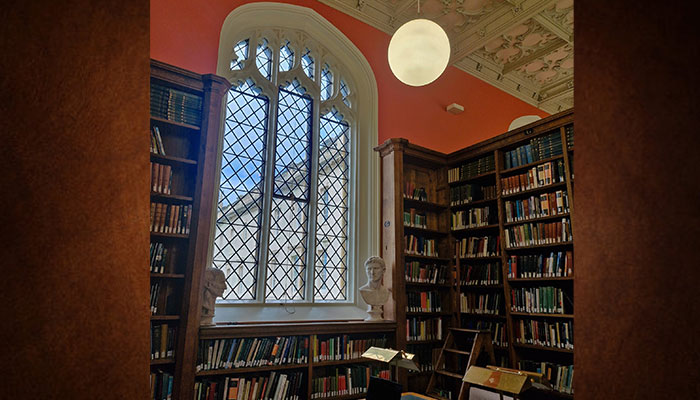
Evenings at Cambridge was about networking and enjoying the fun icebreaking events hosted by the ERA team. Forging deep connections happened over karaoke, board games, guided campus tours of its historical colleges, and of course punting in the river, a very Cambridge thing. “Our reading sessions over dinner would lead to animated discussions on papers ranging from national security and legal AI to reinforcement learning, all very interesting and most memorable. Each of us worked on independent projects, but feedback, collaborations and frequent interactions made the experience really amazing”, she states. Every conversation cut through trivial niceties and zoned immediately into deep topics. Part of getting very close very quickly was the underlying awareness of the ‘looming eight-week deadline’.
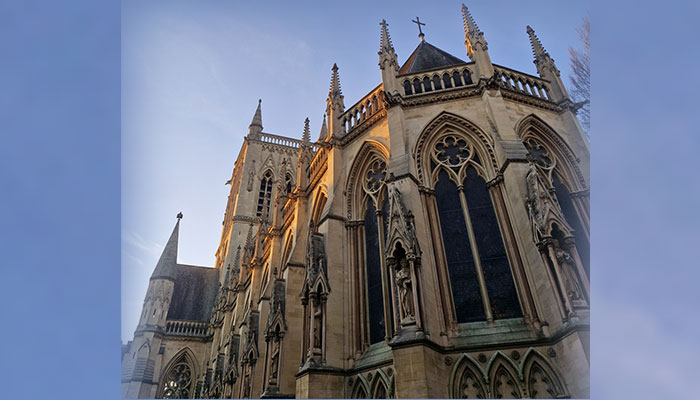
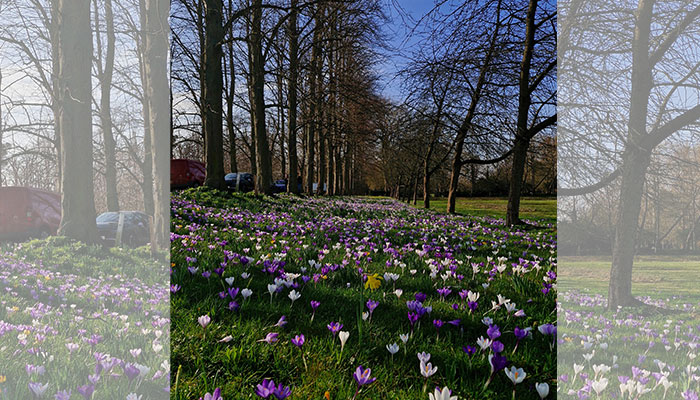
The beautiful university town hums with youthful energy, gushes the youngster. “Arriving at the end of their winter meant experiencing the famous cloudy-rainy English weather. By the third week of February, the seasons changed. Spring unlocked slowly and as the rains reduced, the daffodils came out, followed by tulips and other flowers, unleashing new colors every three days. It was a magical experience”.
Intellectual pioneers. Confluence of Yin and Yang at CHD
Nanda Rajiv’s advisor Prof. Aakansha Natani elaborates that “Nanda’s current research is focused on locating structural dependencies in the global digital economy through analyzing technical, policy and regulatory standards in cross border data-flows and data governance regimes”. A Dean List 1 awardee (top 5%) for the last 4 consecutive semesters in college, the student’s work was earlier presented at IIT Bombay’s IPPN conference 2024, AWL Humanities Initiative International Symposium 2025 at IIIT Delhi; IPSA World Congress 2025 at Seoul, the 2025 International Conference at Wolfson College, University of Cambridge and the STS Italia Conference 2025”.
The CHD vision is to train students in technical aspects and in abstract ideas of the humanities and social sciences, points out Nanda, a UGEE fourth rank-holder who was awarded the Reliance Foundation Scholarship to fund her academic expenses. “From lectures in automata theory to philosophy of technology, political essays followed by technical computer science papers; these cross connections are special experiences that unlocks the brain in weird ways”.
“I worked with Dr. Raman Saxena on a significant project in my second year on formulating policy for metaverse devices. That cross-cutting tech policy project and his LoR definitely helped me to go to Cambridge” mentions Nanda. Her electives span the spectrum, from developmental economics, cognitive science, experimental design, internet and democracy, international relations, EU related courses, philosophy of technology to advanced natural language processing related courses. Her interest in economics and technical topics made the CHD program the perfect fit. Now more than ever, it is a pretty useful skill to be a generalist who can connect topics from different areas, she believes.
Football and Oggy’s Penguins on a cool campus
Guitar and football are twin passions for the youngster who took online guitar classes for younger children during the pandemic lockdown. As a member of Oggy & the Penguins, the IIIT-H band has won a few Battle of the Bands competitions. The football player also enjoys tennis and running. She was judged the most valuable player in the inter-house and inter-batch football tournaments for four years.
“Apart from being my advisor, Dr. Aakansha Natani is someone to model yourself on, to strengthen your work ethic,” remarks the grateful student who points out that beyond the ‘typical’ advisor-advisee aspects of research and working together, her mentor demonstrates how to have a long horizon vision, and organise yourself to work towards that. “She sets up an environment for students to excel within our research group, through sharing opportunities with us and regular check-ins on all aspects (be it academics, TAship, internship, career, etc.), which was extremely valuable”.
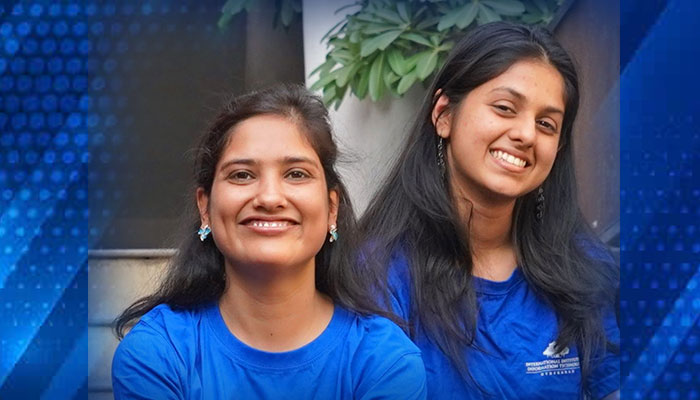
In a world racing ahead with AI, Nanda Rajiv, part engineer and part philosopher left Cambridge with more than a fellowship. And now as the CHD degree draws to a close, Nanda looks forward to the next Chapter in building code with a conscience.
April 2026
One among thirty international students selected for a fully funded Cambridge ERA-AI Fellowship, IIIT-H student Nanda Rajiv walks us through her two-month tenure as a Technical AI Governance Research Fellow, where fresh insights and new direction was gained amidst blooming daffodils and ancient stone buildings.
Did Nanda Rajiv manifest a second visit to Cambridge University? When the fifth year student of CHD was chosen from 3000 candidates globally for the eight-week Cambridge ERA-AI fellowship, it was doubly special for the fiesty scholar who had visited the Wolfson College four-months prior, to present her research paper.
The Cambridge ERA-AI Fellowship
The 8-week immersive experience held between Feb 2nd and March 27th 2026 seeks to shape responsible technology for the future, by empowering researchers like Nanda with independent thinking capabilities. It offered three application tracks (Technical AI Governance, AI Governance, and Technical AI Safety), to work in core areas such as AI safety or tech-policy, as well as interdisciplinary research”, explains Dr. Aakansha Natani, Nanda’s advisor at IIIT-H’s Human Sciences Research Centre.
Nanda’s choice of technical AI governance fit in well with her CHD background. “Our cross-disciplinary curriculum combines very technical computer science concepts, projects and courses along with abstract concepts in philosophy, history and literature”. The five-year dual degree (B. Tech in Computer Science and Master of Science in Computing & Human Sciences by Research) bridges that epistemological and methodological gap between computer science and social sciences. The intention is to produce a new genre of student- researchers to lead specialized areas like AI ethics, digital society etc, using computational methods to solve social science problems.
“The three-stage application process for the fellowship constituted a written stage; a research proposal and short essay on our approach to different frameworks and problems”, she explains. An asynchronous interview to test technical knowledge was followed by a formal online interview, where the research problem was stress-tested, and general technical aspects of the field discussed.
Given her natural oratory skills as a school and college level debater, the former IIIT-H Debate Society coordinator found Cambridge to be “a really cool experience”. A regular 10 am to 5pm office day was packed with talks by experts, workshops and paper presentations for the cross-cultural cohort drawn from nations like USA, Malaysia, Singapore, Czech Republic, UK and India. Each fellow worked on a solo project, supervised by an in-house manager and an external expert mentor, with regular reviews of key learnings and findings.
Nanda’s project on estimating AI chip lifecyle
Her project on estimating AI chip lifecycles – from design, fabrication to obsolescence and decommissioning was a gateway to learning about hardware enabled mechanisms and manufacturing, supply chains and compute governance, an emerging area in technical AI governance.
In AI Compute governance, the focus is on controlling AI through hardware especially high-performance chips like GPUs and TPUs. How do you put rules of governance, either imbedding rules physically as a device or controlling the supply chain to prevent illicit access?
This is a very exciting and current research topic, reveals Nanda. “Currently we do not have systems to govern these agents within our existing legal framework. I really enjoyed looking at compute and AI because my thesis work with Dr. Aakansha combines international relations and technical policy.
“A working document summarizing the findings was my deliverable at the end of the fellowship, that I presented at a research symposium in London along with other student presentations”, adds the scholar.
Gaga about Cambridge
Evenings at Cambridge was about networking and enjoying the fun icebreaking events hosted by the ERA team. Forging deep connections happened over karaoke, board games, guided campus tours of its historical colleges, and of course punting in the river, a very Cambridge thing. “Our reading sessions over dinner would lead to animated discussions on papers ranging from national security and legal AI to reinforcement learning, all very interesting and most memorable. Each of us worked on independent projects, but feedback, collaborations and frequent interactions made the experience really amazing”, she states. Every conversation cut through trivial niceties and zoned immediately into deep topics. Part of getting very close very quickly was the underlying awareness of the ‘looming eight-week deadline’.
The beautiful university town hums with youthful energy, gushes the youngster. “Arriving at the end of their winter meant experiencing the famous cloudy-rainy English weather. By the third week of February, the seasons changed. Spring unlocked slowly and as the rains reduced, the daffodils came out, followed by tulips and other flowers, unleashing new colors every three days. It was a magical experience”.
Intellectual pioneers. Confluence of Yin and Yang at CHD
Nanda Rajiv’s advisor Prof. Aakansha Natani elaborates that “Nanda’s current research is focused on locating structural dependencies in the global digital economy through analyzing technical, policy and regulatory standards in cross border data-flows and data governance regimes”. A Dean List 1 awardee (top 5%) for the last 4 consecutive semesters in college, the student’s work was earlier presented at IIT Bombay’s IPPN conference 2024, AWL Humanities Initiative International Symposium 2025 at IIIT Delhi; IPSA World Congress 2025 at Seoul, the 2025 International Conference at Wolfson College, University of Cambridge and the STS Italia Conference 2025”.
The CHD vision is to train students in technical aspects and in abstract ideas of the humanities and social sciences, points out Nanda, a UGEE fourth rank-holder who was awarded the Reliance Foundation Scholarship to fund her academic expenses. “From lectures in automata theory to philosophy of technology, political essays followed by technical computer science papers; these cross connections are special experiences that unlocks the brain in weird ways”.
“I worked with Dr. Raman Saxena on a significant project in my second year on formulating policy for metaverse devices. That cross-cutting tech policy project and his LoR definitely helped me to go to Cambridge” mentions Nanda. Her electives span the spectrum, from developmental economics, cognitive science, experimental design, internet and democracy, international relations, EU related courses, philosophy of technology to advanced natural language processing related courses. Her interest in economics and technical topics made the CHD program the perfect fit. Now more than ever, it is a pretty useful skill to be a generalist who can connect topics from different areas, she believes.
Football and Oggy’s Penguins on a cool campus
Guitar and football are twin passions for the youngster who took online guitar classes for younger children during the pandemic lockdown. As a member of Oggy & the Penguins, the IIIT-H band has won a few Battle of the Bands competitions. The football player also enjoys tennis and running. She was judged the most valuable player in the inter-house and inter-batch football tournaments for four years.
“Apart from being my advisor, Dr. Aakansha Natani is someone to model yourself on, to strengthen your work ethic,” remarks the grateful student who points out that beyond the ‘typical’ advisor-advisee aspects of research and working together, her mentor demonstrates how to have a long horizon vision, and organise yourself to work towards that. “She sets up an environment for students to excel within our research group, through sharing opportunities with us and regular check-ins on all aspects (be it academics, TAship, internship, career, etc.), which was extremely valuable”.
In a world racing ahead with AI, Nanda Rajiv, part engineer and part philosopher left Cambridge with more than a fellowship. And now as the CHD degree draws to a close, Nanda looks forward to the next Chapter in building code with a conscience.
April 2026
One among thirty international students selected for a fully funded Cambridge ERA-AI Fellowship, IIIT-H student Nanda Rajiv walks us through her two-month tenure as a Technical AI Governance Research Fellow, where fresh insights and new direction was gained amidst blooming daffodils and ancient stone buildings.
Did Nanda Rajiv manifest a second visit to Cambridge University? When the fifth year student of CHD was chosen from 3000 candidates globally for the eight-week Cambridge ERA-AI fellowship, it was doubly special for the fiesty scholar who had visited the Wolfson College four-months prior, to present her research paper.
The Cambridge ERA-AI Fellowship
The 8-week immersive experience held between Feb 2nd and March 27th 2026 seeks to shape responsible technology for the future, by empowering researchers like Nanda with independent thinking capabilities. It offered three application tracks (Technical AI Governance, AI Governance, and Technical AI Safety), to work in core areas such as AI safety or tech-policy, as well as interdisciplinary research”, explains Dr. Aakansha Natani, Nanda’s advisor at IIIT-H’s Human Sciences Research Centre.
Nanda’s choice of technical AI governance fit in well with her CHD background. “Our cross-disciplinary curriculum combines very technical computer science concepts, projects and courses along with abstract concepts in philosophy, history and literature”. The five-year dual degree (B. Tech in Computer Science and Master of Science in Computing & Human Sciences by Research) bridges that epistemological and methodological gap between computer science and social sciences. The intention is to produce a new genre of student- researchers to lead specialized areas like AI ethics, digital society etc, using computational methods to solve social science problems.
“The three-stage application process for the fellowship constituted a written stage; a research proposal and short essay on our approach to different frameworks and problems”, she explains. An asynchronous interview to test technical knowledge was followed by a formal online interview, where the research problem was stress-tested, and general technical aspects of the field discussed.
Given her natural oratory skills as a school and college level debater, the former IIIT-H Debate Society coordinator found Cambridge to be “a really cool experience”. A regular 10 am to 5pm office day was packed with talks by experts, workshops and paper presentations for the cross-cultural cohort drawn from nations like USA, Malaysia, Singapore, Czech Republic, UK and India. Each fellow worked on a solo project, supervised by an in-house manager and an external expert mentor, with regular reviews of key learnings and findings.
Nanda’s project on estimating AI chip lifecyle
Her project on estimating AI chip lifecycles – from design, fabrication to obsolescence and decommissioning was a gateway to learning about hardware enabled mechanisms and manufacturing, supply chains and compute governance, an emerging area in technical AI governance.
In AI Compute governance, the focus is on controlling AI through hardware especially high-performance chips like GPUs and TPUs. How do you put rules of governance, either imbedding rules physically as a device or controlling the supply chain to prevent illicit access?
This is a very exciting and current research topic, reveals Nanda. “Currently we do not have systems to govern these agents within our existing legal framework. I really enjoyed looking at compute and AI because my thesis work with Dr. Aakansha combines international relations and technical policy.
“A working document summarizing the findings was my deliverable at the end of the fellowship, that I presented at a research symposium in London along with other student presentations”, adds the scholar.
Gaga about Cambridge
Evenings at Cambridge was about networking and enjoying the fun icebreaking events hosted by the ERA team. Forging deep connections happened over karaoke, board games, guided campus tours of its historical colleges, and of course punting in the river, a very Cambridge thing. “Our reading sessions over dinner would lead to animated discussions on papers ranging from national security and legal AI to reinforcement learning, all very interesting and most memorable. Each of us worked on independent projects, but feedback, collaborations and frequent interactions made the experience really amazing”, she states. Every conversation cut through trivial niceties and zoned immediately into deep topics. Part of getting very close very quickly was the underlying awareness of the ‘looming eight-week deadline’.
The beautiful university town hums with youthful energy, gushes the youngster. “Arriving at the end of their winter meant experiencing the famous cloudy-rainy English weather. By the third week of February, the seasons changed. Spring unlocked slowly and as the rains reduced, the daffodils came out, followed by tulips and other flowers, unleashing new colors every three days. It was a magical experience”.
Intellectual pioneers. Confluence of Yin and Yang at CHD
Nanda Rajiv’s advisor Prof. Aakansha Natani elaborates that “Nanda’s current research is focused on locating structural dependencies in the global digital economy through analyzing technical, policy and regulatory standards in cross border data-flows and data governance regimes”. A Dean List 1 awardee (top 5%) for the last 4 consecutive semesters in college, the student’s work was earlier presented at IIT Bombay’s IPPN conference 2024, AWL Humanities Initiative International Symposium 2025 at IIIT Delhi; IPSA World Congress 2025 at Seoul, the 2025 International Conference at Wolfson College, University of Cambridge and the STS Italia Conference 2025”.
The CHD vision is to train students in technical aspects and in abstract ideas of the humanities and social sciences, points out Nanda, a UGEE fourth rank-holder who was awarded the Reliance Foundation Scholarship to fund her academic expenses. “From lectures in automata theory to philosophy of technology, political essays followed by technical computer science papers; these cross connections are special experiences that unlocks the brain in weird ways”.
“I worked with Dr. Raman Saxena on a significant project in my second year on formulating policy for metaverse devices. That cross-cutting tech policy project and his LoR definitely helped me to go to Cambridge” mentions Nanda. Her electives span the spectrum, from developmental economics, cognitive science, experimental design, internet and democracy, international relations, EU related courses, philosophy of technology to advanced natural language processing related courses. Her interest in economics and technical topics made the CHD program the perfect fit. Now more than ever, it is a pretty useful skill to be a generalist who can connect topics from different areas, she believes.
Football and Oggy’s Penguins on a cool campus
Guitar and football are twin passions for the youngster who took online guitar classes for younger children during the pandemic lockdown. As a member of Oggy & the Penguins, the IIIT-H band has won a few Battle of the Bands competitions. The football player also enjoys tennis and running. She was judged the most valuable player in the inter-house and inter-batch football tournaments for four years.
“Apart from being my advisor, Dr. Aakansha Natani is someone to model yourself on, to strengthen your work ethic,” remarks the grateful student who points out that beyond the ‘typical’ advisor-advisee aspects of research and working together, her mentor demonstrates how to have a long horizon vision, and organise yourself to work towards that. “She sets up an environment for students to excel within our research group, through sharing opportunities with us and regular check-ins on all aspects (be it academics, TAship, internship, career, etc.), which was extremely valuable”.
In a world racing ahead with AI, Nanda Rajiv, part engineer and part philosopher left Cambridge with more than a fellowship. And now as the CHD degree draws to a close, Nanda looks forward to the next Chapter in building code with a conscience.
April 2026
One among thirty international students selected for a fully funded Cambridge ERA-AI Fellowship, IIIT-H student Nanda Rajiv walks us through her two-month tenure as a Technical AI Governance Research Fellow, where fresh insights and new direction was gained amidst blooming daffodils and ancient stone buildings.
Did Nanda Rajiv manifest a second visit to Cambridge University? When the fifth year student of CHD was chosen from 3000 candidates globally for the eight-week Cambridge ERA-AI fellowship, it was doubly special for the fiesty scholar who had visited the Wolfson College four-months prior, to present her research paper.
The Cambridge ERA-AI Fellowship
The 8-week immersive experience held between Feb 2nd and March 27th 2026 seeks to shape responsible technology for the future, by empowering researchers like Nanda with independent thinking capabilities. It offered three application tracks (Technical AI Governance, AI Governance, and Technical AI Safety), to work in core areas such as AI safety or tech-policy, as well as interdisciplinary research”, explains Dr. Aakansha Natani, Nanda’s advisor at IIIT-H’s Human Sciences Research Centre.
Nanda’s choice of technical AI governance fit in well with her CHD background. “Our cross-disciplinary curriculum combines very technical computer science concepts, projects and courses along with abstract concepts in philosophy, history and literature”. The five-year dual degree (B. Tech in Computer Science and Master of Science in Computing & Human Sciences by Research) bridges that epistemological and methodological gap between computer science and social sciences. The intention is to produce a new genre of student- researchers to lead specialized areas like AI ethics, digital society etc, using computational methods to solve social science problems.
“The three-stage application process for the fellowship constituted a written stage; a research proposal and short essay on our approach to different frameworks and problems”, she explains. An asynchronous interview to test technical knowledge was followed by a formal online interview, where the research problem was stress-tested, and general technical aspects of the field discussed.
Given her natural oratory skills as a school and college level debater, the former IIIT-H Debate Society coordinator found Cambridge to be “a really cool experience”. A regular 10 am to 5pm office day was packed with talks by experts, workshops and paper presentations for the cross-cultural cohort drawn from nations like USA, Malaysia, Singapore, Czech Republic, UK and India. Each fellow worked on a solo project, supervised by an in-house manager and an external expert mentor, with regular reviews of key learnings and findings.
Nanda’s project on estimating AI chip lifecyle
Her project on estimating AI chip lifecycles – from design, fabrication to obsolescence and decommissioning was a gateway to learning about hardware enabled mechanisms and manufacturing, supply chains and compute governance, an emerging area in technical AI governance.
In AI Compute governance, the focus is on controlling AI through hardware especially high-performance chips like GPUs and TPUs. How do you put rules of governance, either imbedding rules physically as a device or controlling the supply chain to prevent illicit access?
This is a very exciting and current research topic, reveals Nanda. “Currently we do not have systems to govern these agents within our existing legal framework. I really enjoyed looking at compute and AI because my thesis work with Dr. Aakansha combines international relations and technical policy.
“A working document summarizing the findings was my deliverable at the end of the fellowship, that I presented at a research symposium in London along with other student presentations”, adds the scholar.
Gaga about Cambridge
Evenings at Cambridge was about networking and enjoying the fun icebreaking events hosted by the ERA team. Forging deep connections happened over karaoke, board games, guided campus tours of its historical colleges, and of course punting in the river, a very Cambridge thing. “Our reading sessions over dinner would lead to animated discussions on papers ranging from national security and legal AI to reinforcement learning, all very interesting and most memorable. Each of us worked on independent projects, but feedback, collaborations and frequent interactions made the experience really amazing”, she states. Every conversation cut through trivial niceties and zoned immediately into deep topics. Part of getting very close very quickly was the underlying awareness of the ‘looming eight-week deadline’.
The beautiful university town hums with youthful energy, gushes the youngster. “Arriving at the end of their winter meant experiencing the famous cloudy-rainy English weather. By the third week of February, the seasons changed. Spring unlocked slowly and as the rains reduced, the daffodils came out, followed by tulips and other flowers, unleashing new colors every three days. It was a magical experience”.
Intellectual pioneers. Confluence of Yin and Yang at CHD
Nanda Rajiv’s advisor Prof. Aakansha Natani elaborates that “Nanda’s current research is focused on locating structural dependencies in the global digital economy through analyzing technical, policy and regulatory standards in cross border data-flows and data governance regimes”. A Dean List 1 awardee (top 5%) for the last 4 consecutive semesters in college, the student’s work was earlier presented at IIT Bombay’s IPPN conference 2024, AWL Humanities Initiative International Symposium 2025 at IIIT Delhi; IPSA World Congress 2025 at Seoul, the 2025 International Conference at Wolfson College, University of Cambridge and the STS Italia Conference 2025”.
The CHD vision is to train students in technical aspects and in abstract ideas of the humanities and social sciences, points out Nanda, a UGEE fourth rank-holder who was awarded the Reliance Foundation Scholarship to fund her academic expenses. “From lectures in automata theory to philosophy of technology, political essays followed by technical computer science papers; these cross connections are special experiences that unlocks the brain in weird ways”.
“I worked with Dr. Raman Saxena on a significant project in my second year on formulating policy for metaverse devices. That cross-cutting tech policy project and his LoR definitely helped me to go to Cambridge” mentions Nanda. Her electives span the spectrum, from developmental economics, cognitive science, experimental design, internet and democracy, international relations, EU related courses, philosophy of technology to advanced natural language processing related courses. Her interest in economics and technical topics made the CHD program the perfect fit. Now more than ever, it is a pretty useful skill to be a generalist who can connect topics from different areas, she believes.
Football and Oggy’s Penguins on a cool campus
Guitar and football are twin passions for the youngster who took online guitar classes for younger children during the pandemic lockdown. As a member of Oggy & the Penguins, the IIIT-H band has won a few Battle of the Bands competitions. The football player also enjoys tennis and running. She was judged the most valuable player in the inter-house and inter-batch football tournaments for four years.
“Apart from being my advisor, Dr. Aakansha Natani is someone to model yourself on, to strengthen your work ethic,” remarks the grateful student who points out that beyond the ‘typical’ advisor-advisee aspects of research and working together, her mentor demonstrates how to have a long horizon vision, and organise yourself to work towards that. “She sets up an environment for students to excel within our research group, through sharing opportunities with us and regular check-ins on all aspects (be it academics, TAship, internship, career, etc.), which was extremely valuable”.
In a world racing ahead with AI, Nanda Rajiv, part engineer and part philosopher left Cambridge with more than a fellowship. And now as the CHD degree draws to a close, Nanda looks forward to the next Chapter in building code with a conscience.
April 2026