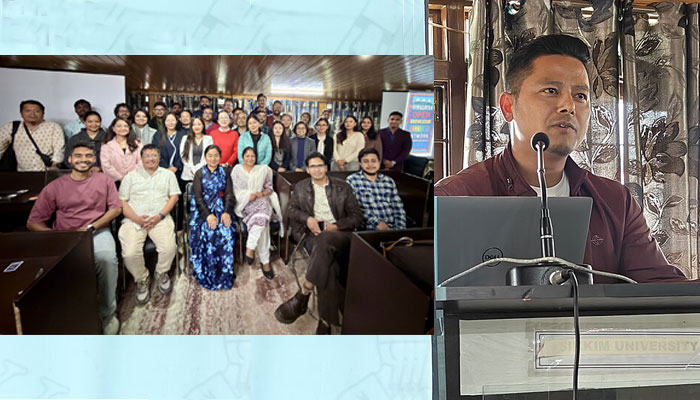
The Highland Histories Lab at Human Sciences Research Centre (HSRC) in collaboration with the Open Knowledge Initiatives (OKI) programme at Raj Reddy Center for Technology and Society (RCTS) , the Wikimedia Foundation, and the Department of Geography at Sikkim University, organised a two-day hands-on workshop on 1–2 April in Gangtok, Sikkim. The workshop brought together 36 participants from diverse regions, including various parts of Sikkim, West Bengal, Himachal Pradesh, Nepal, and beyond.
Marking an important step in extending open knowledge initiatives to the Eastern Himalayas, the workshop convened participants from communities such as Lepcha, Gurung, Limbu, Nepali, and Bengali. The group included students, researchers, historians, filmmakers, and educators, representing a wide range of experiences and perspectives. The multilingual learning environment—featuring Nepali, Lepcha, Bhutia, Limbu, and Bangla—reflected the rich cultural diversity of the region.
The workshop was facilitated by Dr. Aniket Alam (Highland Histories), Nitesh Gill (OKI, IIIT Hyderabad), Satdeep Gill (Wikimedia Foundation), and Kuldeep Singh (Punjabi Wikimedia community coordinator), with strong support from Sikkim University faculty and local coordinators, Prof. Sohel and Dr. Uttam Lal.
A key contribution came from participants Rajani, Sapna, and Yogender, who not only supported the workshop but also led a session, sharing practical insights from their previous experiences. Their involvement demonstrated how earlier participants are evolving into contributors and trainers within the network.
The sessions combined hands-on training on Wikimedia platforms—particularly Wikimedia Commons—with broader discussions on documenting local knowledge. Participants learned to upload photographs, videos, and written content, focusing on capturing local histories, cultures, and everyday life. A dedicated session on integrating Wikimedia Commons with Wikipedia further strengthened their understanding of contributing to open knowledge ecosystems.
More than just a training programme, the workshop fostered a collaborative space where participants began to see themselves not only as learners, but as active contributors to documenting the histories and knowledge of their own communities. It reflects a growing shift towards locally grounded, participatory knowledge creation practices in the Himalayan region.
Aligned with the Himalayan Network’s vision of shared stewardship of knowledge, similar workshops are planned in the Highlands of Ladakh this June.
For a long time, knowledge about the Himalayas has largely been produced from outsider perspectives—by colonial surveyors, distant institutions, and archives—often marginalising the region’s own voices. Initiatives like this workshop signal a quiet yet significant shift, enabling communities that were once subjects of documentation to become its authors.
April 2026