Learning Beyond Physical Labs: The Virtual Labs Initiative – Enabling Higher-Order Thinking through Virtual Experimentation
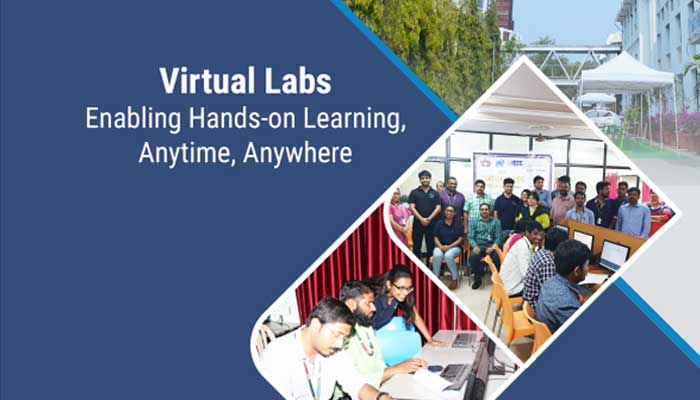
What if every student could access a fully equipped laboratory anytime, anywhere—and experiment without limits? Virtual Labs, a consortium project with 11 leading institutes of the Ministry of Education, makes this possible, bringing over 2,000 experiments across 13 domains to a single online platform used by millions in 190+ countries. At IIIT Hyderabad, a core team has been playing and continues to play a key role since 2009, in building, managing, and continuously evolving this platform—driving innovation in how experimental learning is delivered at scale. The result is a powerful, value-adding system that enables students to explore, repeat, and deepen understanding through interactive, hands-on experimentation beyond the constraints of physical labs.
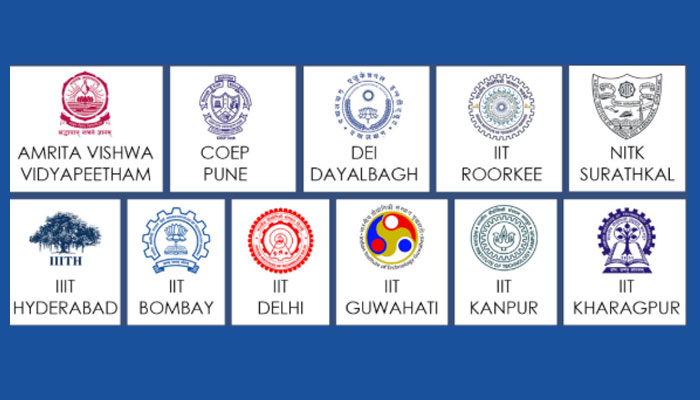 Participating Institutes
Why Virtual Labs and What the Platform Offers
Virtual Labs provide free, 24×7 access across engineering and science disciplines, enabling anytime, anywhere learning beyond the constraints of physical labs. The platform offers a scalable and cost-effective experimentation to even institutions with limited infrastructure to conduct experiments across domains. Supported by structured learning materials, interactive simulations, and self-assessment tools, it enables students to perform, repeat, and explore experiments at their own pace, strengthening conceptual clarity and higher-order thinking, providing a safe environment for experimentation and deeper learning. Faculty contributions to experiment development and expertise enrich the platform, bringing curriculum-aligned and research-informed experiments, making Virtual Labs a powerful resource for both academic learning and practical skill development.
Impact and Reach
The impact of Virtual Labs extends beyond scale to meaningful academic adoption and capability building. Across institutions, it has enabled the integration of experiments into regular coursework, supplementing and, in many cases, substituting for limited physical lab infrastructure. The platform supports continuous, self-paced learning, allowing students to revisit and deepen their understanding through repeated experimentation. Regionally, sustained outreach efforts have helped build long-term institutional engagement through the Nodal Centre model, currently with 1531 colleges (50+ from IIIT-H geography), creating a structured ecosystem for adoption, tracking, and reporting. Internally, the initiative has also served as a strong platform for student and faculty engagement at IIIT Hyderabad, fostering skill development, collaborative engineering, and innovation in educational technology.
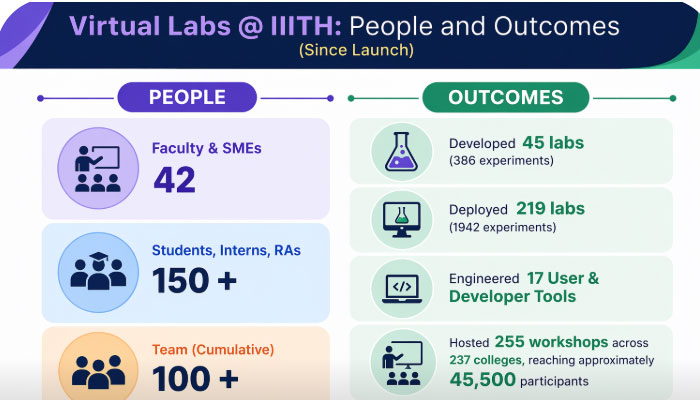
How Colleges Use Virtual Labs
Colleges use Virtual Labs as an integral part of their teaching and learning process by incorporating experiments into regular coursework, lab sessions, and assignments. Faculty conduct workshops and guided sessions to familiarise students with the platform, after which students independently perform experiments and submit feedback. Many institutions adopt the Nodal Centre model to systematically drive usage, track participation, and report outcomes. Virtual Labs are also used to supplement physical labs, bridge infrastructure gaps, and enable continuous learning beyond scheduled lab hours.
Research Perspectives
Virtual Labs is evolving into a research-driven platform for studying learning effectiveness, scalable pedagogy, and AI-enabled experimentation. Research has been a core pillar of Virtual Labs, leading to significant academic and technological contributions. The team led by Dr Venkatesh Choppella has published over 20 Virtual Lab-related conference papers, conducted Hackathons, developed tools and methodologies that strengthen the Virtual Labs ecosystem.
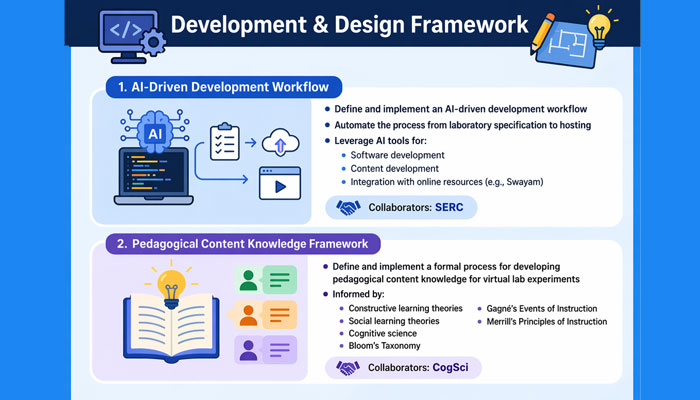
AI-driven automation of experiment creation and learning analytics positions Virtual Labs at the intersection of pedagogy and intelligent systems. Building on this foundation, Virtual Labs is now entering a new phase of AI-enabled, research-driven innovation. Current efforts focus on AI-driven workflows for automated experiment creation, content generation, and seamless integration with digital learning platforms, guided by robust pedagogical frameworks. The project is also advancing empirical studies on learning effectiveness, along with large-scale multilingual and localisation capabilities. Closely aligned with IIIT Hyderabad’s research ecosystem, these initiatives position Virtual Labs as an intelligent, adaptive, and data-driven platform for next-generation learning.
Future directions for the project would focus on validating learning effectiveness features in the portal through portal modifications and by aligning with demographic parameters, and the National Credit Framework (NCrF) (under NEP 2020), making it a reliable learning ecosystem.
Success Journey of Virtual Labs @ IIIT Hyderabad
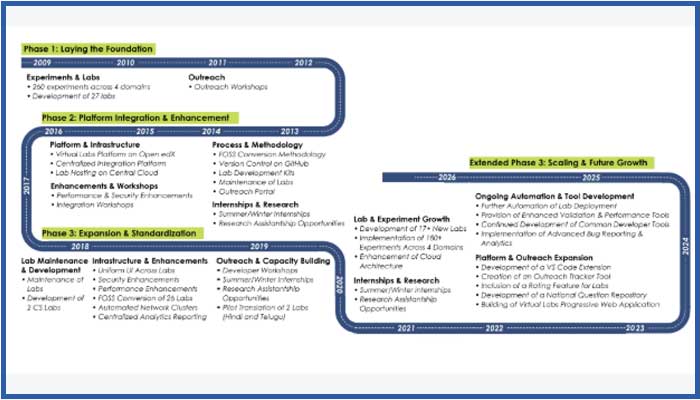
Since its inception in 2009, Virtual Labs at IIIT Hyderabad has evolved into a large-scale digital learning ecosystem with significant national and global impact. The journey began with experiment development and outreach through workshops (2009–2012), followed by the creation of processes, platforms, and infrastructure for the consortium (2013–2017). Phase III (2018–2023) focused on expansion, standardisation, and scaling. In the current phase, the emphasis is on advanced tool development, cloud infrastructure optimisation, research, and adoption of emerging technologies such as GenAI and LLMs, along with automated hosting and student skill development.
Today, Virtual Labs has deployed over 250 labs and 2200 experiments, reaching more than 20 million users and generating over 150 million page views across 190+ countries. Outreach efforts have led to over 25,000 workshops and 1.7 million learners trained through a network of 1530+ Nodal Centres across India With usage now exceeding 46 lakhs workshop usages (push mode), 21.2 million users and 157 million page views(push + Pull mode), supported by 300+ contributors and strong institutional engagement, Virtual Labs at IIIT-H continues to expand access to high-quality experimental learning at scale, especially for institutions with limited infrastructure.
Key Benefits to Students and Faculty
Virtual Labs enhance the teaching–learning experience for both students and faculty. Students benefit from hands-on, repeatable experimentation without the need for physical labs, strengthening conceptual clarity. Virtual experiments are used by college faculty as teaching aids, gaining access to ready-to-use, visually supported experiments that are easy to integrate into courses, enabling scalable and effective teaching. Additionally, the platform has played a significant role in building the skills of IIIT Hyderabad interns and RAs over the years, with recent GenAI- and LLM-based development approaches enabling rapid creation and deployment of experiments—improving productivity and reducing development time significantly.
Virtual Labs: Engineering, Architecture and Design
VLEAD serves as the engineering and platform backbone, ensuring scalability, reliability, and continuous innovation.
Virtual Labs, IIIT-H Outreach Strategies
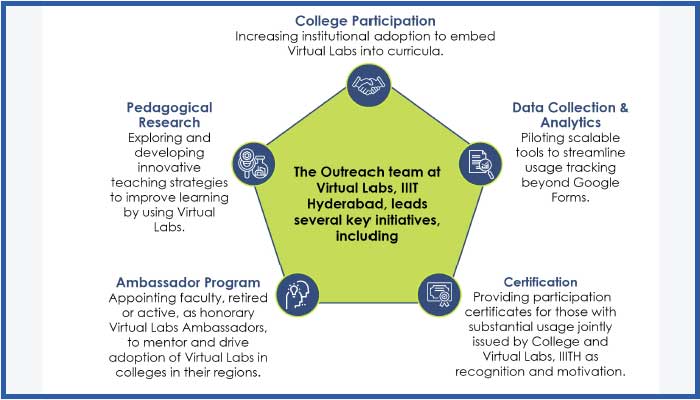
The outreach strategy at IIIT Hyderabad combines a structured push mode with a sustained pull mode of adoption. In the push mode, the team engages institutions through workshops and onboarding—over the past decade, reaching 237 (non-unique) colleges through 255 workshops, resulting in ~9.8 lakh usages from ~90,000 participants. Over time, usage transitions to a pull mode, whether renewing their NC membership or not, where institutions independently integrate Virtual Labs into their academic processes; since January 2023, this has accounted for over 123 lakh cumulative pageviews from 14.23 lakh users. Newer outreach approaches—such as appointing ambassadors from academia and industry, focused-duration usage plans, student participation certification initiatives and periodic surveys on student and faculty perceptions —are strengthening this transition. This clearly indicates that while outreach initiates adoption, sustained impact is achieved when Virtual Labs becomes a self-driven academic resource within institutions.
How to Get Started
Getting started with Virtual Labs is simple. Visit https://vlabs.ac.in to explore and perform experiments across disciplines anytime, anywhere. Faculty and students can directly access the platform, while institutions can enhance adoption through workshops and hands-on training. Colleges are encouraged to register as Nodal Centres to integrate Virtual Labs into academic processes, track usage, and maximise learning outcomes.
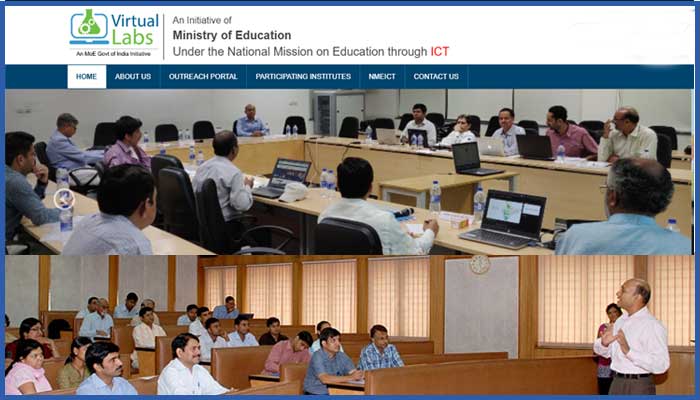 Virtual Labs Portal – https://www.vlab.co.in/
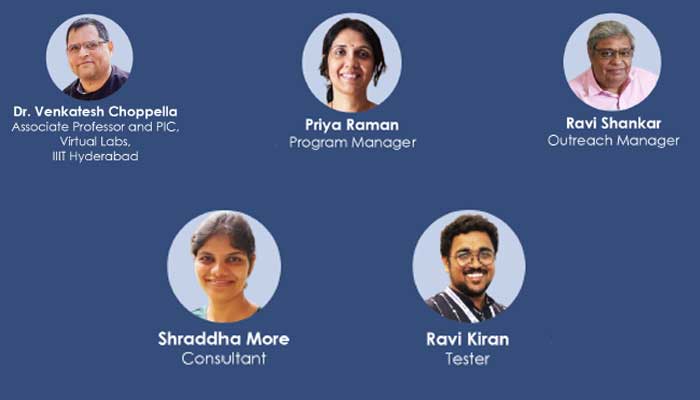
Meet the VLEAD Team
Call to Action
We invite colleges to become part of the Virtual Labs ecosystem and leverage this national resource to enhance teaching and learning. Faculty and students are encouraged to actively explore the platform, integrate experiments into coursework, and experience the benefits of hands-on, flexible learning. By adopting Virtual Labs, institutions can significantly enrich academic delivery and expand access to high-quality experimental education.
Virtual Labs at IIIT Hyderabad exemplifies how engineering, pedagogy, and research can converge to create scalable, impactful learning systems for the future
April 2026