
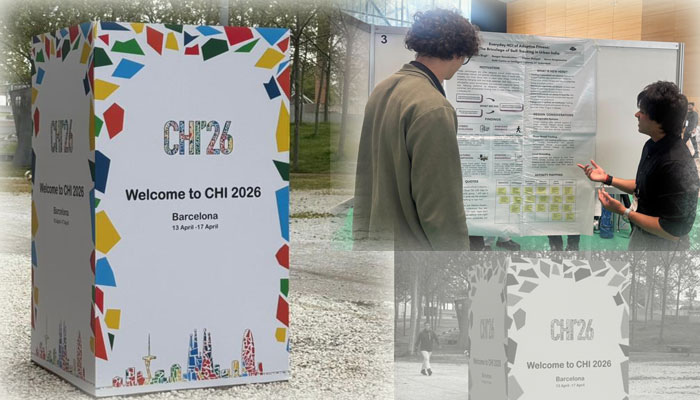
Prof. Nimmi Rangaswamy and her students presented the following two papers at SIGCHI 2026 held at Barcelona from 13 to 17 April. Paper on Everyday HCI of Adaptive Fitness: The Bricolage of Self-Tracking in Urban India was presented in the main conference and the paper on Bridge Over Troubled Waters Aligning Commercial Incentives with Ethical Design Practice to Combat Deceptive Designs in the workshop – Bridge Over Troubled Waters Aligning Commercial Incentives with Ethical Design Practice to Combat Deceptive Designs.
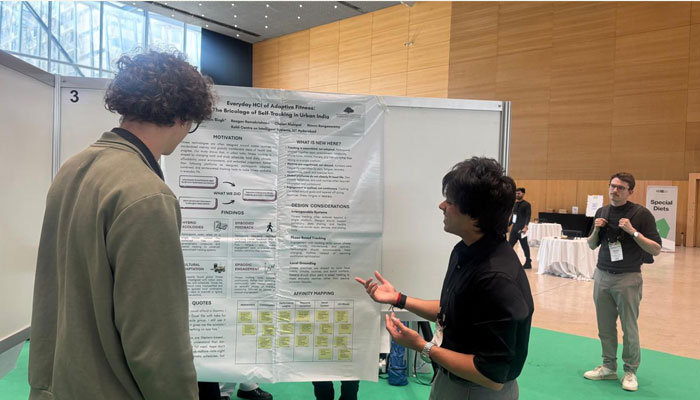
- Everyday HCI of Adaptive Fitness: The Bricolage of Self-Tracking in Urban India – Shivam Singh, (DD student); Raghav Ramakrishnan and Chetan Mahipal, (Honours students) and Prof Nimmi Rangaswamy
Here is the summary of the paper as explained by the authors:
Drawing on prior literature studies and primary qualitative fieldwork, the paper examines how young fitness practitioners adopt and negotiate the use of self-tracking technologies. Using bricolage as an analytical lens, the paper suggests how users creatively repurpose tools, navigating data-driven guidance and embodied intuition. Our findings show three key themes: creation of hybrid self-tracking ecologies, technology domestication via selective appropriation, and adaptation of fitness tracking to local socio-material contexts. Fitness emerges as a situated and relational practice shaped by resource constraints and interpretive self-tracking.
Link to the full paper: https://dl.acm.org/doi/10.1145/3772363.3798708
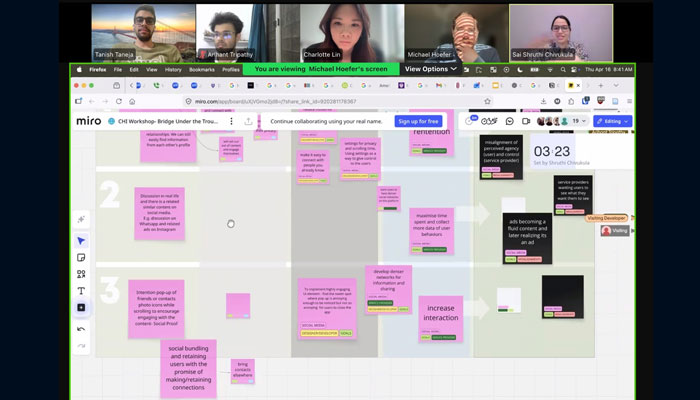
- Dark Pattern in Indian Quick Commerce: A student Perspective – Tanish Taneja and Arihant Tripati, (IS student) and Prof Nimmi Rangaswamy
Here is the summary of the paper as explained by the authors:
The paper explores the ‘awareness-action gap’ among a student community with regard to quick commerce practices where digitally fluent young adults recognize deceptive UI yet participate due to reasons of constraints. The paper argues that normalisation of these practices points to the urgency of developing value sensitive design to prioritise user autonomy over forced convenience.
Link to the full paper: https://arxiv.org/abs/2604.02257
Conference page: https://chi2026.acm.org/
April 2026
Prof. Nimmi Rangaswamy and her students presented the following two papers at SIGCHI 2026 held at Barcelona from 13 to 17 April. Paper on Everyday HCI of Adaptive Fitness: The Bricolage of Self-Tracking in Urban India was presented in the main conference and the paper on Bridge Over Troubled Waters Aligning Commercial Incentives with Ethical Design Practice to Combat Deceptive Designs in the workshop – Bridge Over Troubled Waters Aligning Commercial Incentives with Ethical Design Practice to Combat Deceptive Designs.
- Everyday HCI of Adaptive Fitness: The Bricolage of Self-Tracking in Urban India – Shivam Singh, (DD student); Raghav Ramakrishnan and Chetan Mahipal, (Honours students) and Prof Nimmi Rangaswamy
Here is the summary of the paper as explained by the authors:
Drawing on prior literature studies and primary qualitative fieldwork, the paper examines how young fitness practitioners adopt and negotiate the use of self-tracking technologies. Using bricolage as an analytical lens, the paper suggests how users creatively repurpose tools, navigating data-driven guidance and embodied intuition. Our findings show three key themes: creation of hybrid self-tracking ecologies, technology domestication via selective appropriation, and adaptation of fitness tracking to local socio-material contexts. Fitness emerges as a situated and relational practice shaped by resource constraints and interpretive self-tracking.
Link to the full paper: https://dl.acm.org/doi/10.1145/3772363.3798708
- Dark Pattern in Indian Quick Commerce: A student Perspective – Tanish Taneja and Arihant Tripati, (IS student) and Prof Nimmi Rangaswamy
Here is the summary of the paper as explained by the authors:
The paper explores the ‘awareness-action gap’ among a student community with regard to quick commerce practices where digitally fluent young adults recognize deceptive UI yet participate due to reasons of constraints. The paper argues that normalisation of these practices points to the urgency of developing value sensitive design to prioritise user autonomy over forced convenience.
Link to the full paper: https://arxiv.org/abs/2604.02257
Conference page: https://chi2026.acm.org/
April 2026